
Equipment Loan Interest Rates: What Affects Them and How to Compare Offers

Key takeaways
Equipment loan interest rates reflect how risky the lender judges the deal: your credit, your time in business and cash flow, the equipment itself, the term, and how the contract is built.
- Price follows risk. The borrower, the equipment, the term, and the contract each add to it.
- A used machine gets priced on age, condition, and resale value, not on the word “used.”
- Compare total cost and the end of the term. The payment alone hides both.
- Nobody can quote you a real rate from an article. That includes us.
You ask a lender about equipment loan interest rates, and it asks you about the machine. How old is it? Who’s selling it? How long has the business been open? Feels like stalling. It isn’t. The lender is pricing the deal, and it can’t finish until it knows.
We know. You wanted a number. There isn’t one in this guide, and that’s deliberate: a figure that fits one borrower is wrong for the next, and a rate printed on a web page turns a guess into something that looks like an offer. What you get instead is what moves the number, plus a way to put two offers side by side.
Fair warning: we finance equipment, and that colors how we see things. Paying cash? Already carrying a credit line with a cost you know? Run that number first. If you’re still sorting out how the pieces fit, start with our page on equipment financing, or walk through the steps from quote to last payment.
How Equipment Loan Interest Rates Get Set
An interest rate on an equipment loan is the price of borrowing, shown as a yearly percentage of the amount owed. Lenders set it by pricing risk: the likelier a deal is to go wrong, or the harder the equipment would be to resell, the more the lender adds to its own cost of money.
Start with that cost. The Federal Reserve’s daily H.15 release says prime is one of several base rates banks use to price short-term business loans. Equipment loans run longer than that, so the benchmark isn’t always prime. The shape stays the same, though: a base, then a spread added for risk.
The spread is the part you can move.
Here’s the layer most guides skip. Banks like big, low-risk business, so a lot of equipment lending outside the banks runs on money that started with a bank or another funder. That money tends to get sorted into pools by how much risk each carries. Think of buckets, each with its own price tag.
A strong borrower buying a machine that resells easily goes in one bucket. A younger business with a thin credit file goes in another. That’s why pricing slides along a scale instead of landing on one number, and why two lenders can read the same file and quote it differently.
What the Borrower Brings
Credit first, and for a small company that’s two files. One is the business: payment history, balances, whatever it already owes. The other is the owner, because a small company’s owner often signs a personal guaranty, and that puts the owner’s credit inside the deal.
Time in business is next. A few years of statements give a lender a story. A few months give it a paragraph. Less to read looks like more risk, which is arithmetic, not a verdict on you.
Cash flow is the third piece, usually read off recent bank statements. Does the payment fit inside what already comes in? A landscaping company’s January looks like trouble on paper until somebody mentions that it’s January.
Lenders commonly ask to see:
- Recent business bank statements
- The seller’s quote or invoice for the machine
- A list of what the business owes today, and to whom
- Full financial statements, on larger deals
Every lender keeps its own list. Treat this one as a starting point.
The Equipment Is Part of the Price
The machine is the collateral, so the lender prices what it could recover if the loan went bad. Skid steers, forklifts, and box trucks have plenty of buyers. A custom fabrication line has a few, and they know it. Same loan amount, different risk.
Age and condition outweigh the label. Picture two mini excavators from the same year. One comes with service records and a modest hour meter. The other comes with a weeping hydraulic line and a shrug. The lender sees two different assets.
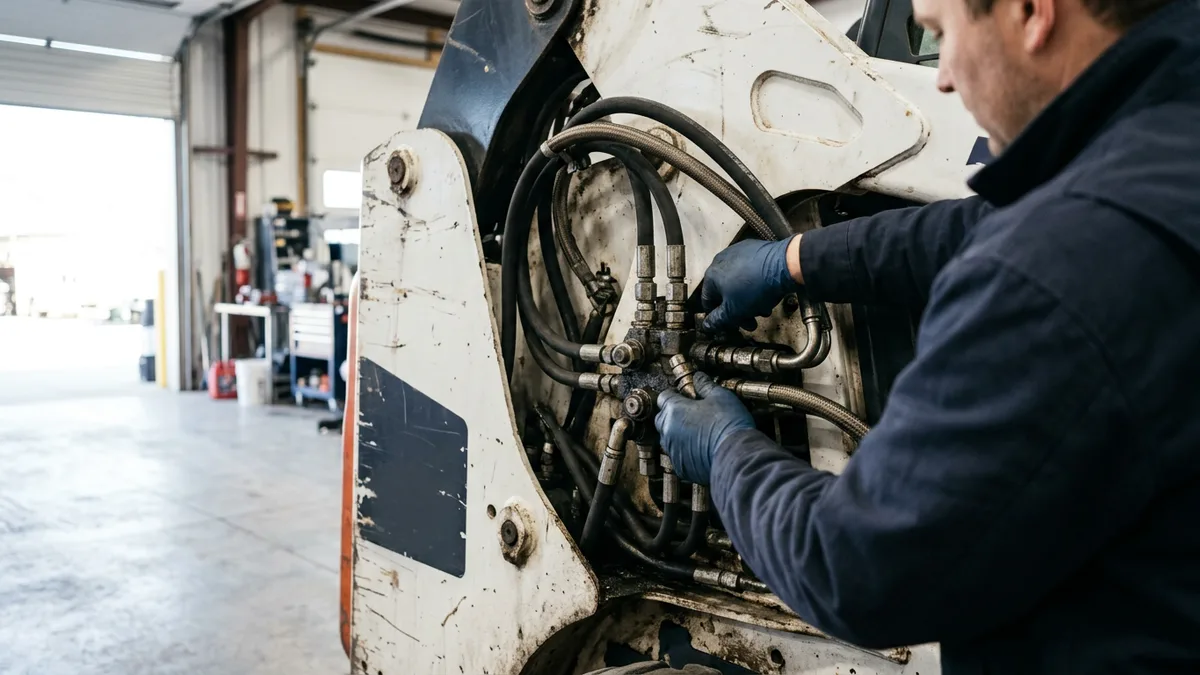
“Used” isn’t a penalty. The machine costs less, so the amount financed is smaller, and plenty of equipment gets financed used. What changes is the picture the lender has to build: an older asset, less life remaining, and a history that only the seller can vouch for. Our page on used equipment financing goes deeper.
Private seller? Expect an extra step. With no dealer behind the sale, the lender wants proof the machine exists, runs, and belongs to the person selling it: the serial number, current photos or an inspection, and a title if the machine has one.
Then the filing. Lenders usually secure a loan with a UCC-1 financing statement filed with the state, and Article 9 of the Uniform Commercial Code lets that filing either describe specific collateral or cover all of a business’s assets. One that names a machine by serial number is narrower than one that sweeps up everything. Ask which you’re getting.
How Term and Structure Change the Math
A longer term shrinks the payment and grows the total, because at the same rate a seven-year loan instead of a five-year one means two more years of interest, and lenders may also price the longer term higher since they carry the risk longer.
Structure is where the rate goes missing. A loan prints a rate. A lease usually prints a payment, with the financing cost folded in, and on a fair market value lease the lessor’s guess at what the machine will be worth at the end is folded in too. No rate on the page isn’t the same as no rate in the deal.
| Fair market value lease | $1 buyout lease | Equipment loan | |
|---|---|---|---|
| What the paper prints | Usually a payment | Usually a payment | A rate and a payment |
| Who owns it at the end | The lessor, unless you buy | You, for a dollar | You |
| Price this first | The buyout | All the payments | Rate, term, and fees |
If you’ll keep the machine past the term, price the buyout before you compare payments. A fair market value lease sets the buyout at what the machine is worth when the term ends. Nobody knows that number on day one. The end-of-term clause lives in the agreement itself, and our page on the equipment lease agreement shows where to find it.
Reading Equipment Loan Offers Before You Sign
Two offers can look alike and cost very different amounts. Fill in the same lines for both:
- Total dollar cost: every payment, every fee, and any buyout, added up.
- The term, and how often you pay.
- Whether you can pay it off early, and whether that costs anything.
- What the quote assumed. A credit score? The machine’s condition? The price on the invoice?
- Fees, by name.
California has already written a checklist. For a covered offer of commercial financing, the provider has to disclose the total funds, the total dollar cost, the term, how often and how much you pay, and the prepayment policy, and the borrower signs those disclosures before the deal is finalized, per the state’s commercial financing disclosures page. Whether your deal is covered is a question for the lender or your attorney. The list is useful regardless.
60%
of small employer firms that borrowed from online lenders said their actual borrowing costs were higher than expected (2025 survey, 6,525 responses)
Source: Federal Reserve Banks, 2026 Report on Employer Firms, March 2026
Online lenders only, and a convenience sample, so don’t stretch it to every borrower. The point survives anyway: expected cost and actual cost can part ways. Ask what the quote assumed. Comparing lenders as well as offers? Our guide on how to compare equipment financing companies covers that side.
When a Higher Rate Still Wins
A higher rate on a shorter term can cost less in total than a lower rate stretched over seven years. A lease with a modest payment and a steep buyout can cost more than a loan with a bigger payment. Do the arithmetic. A spreadsheet will do.
A range that says what it assumes beats one tidy number. A figure that holds only until the lender reads your file isn’t a quote. It’s a hope.
Questions Owners Ask About Equipment Rates
So is a used machine always more expensive to finance?
Not always. Lenders price used equipment on its age, condition, and what it could resell for, so a well-kept machine can be priced very differently from a worn one of the same year. A private-party purchase adds paperwork more than it adds cost: the serial number, photos or an inspection, and a title where the machine has one.
Does a longer term make the deal cheaper, or only the payment smaller?
Smaller payment, usually larger total. Spread the same loan over more months and the lender collects interest for longer, and it may price the extra time higher too. Add up every payment on both terms. Compare the totals.
Is the rate on a lease the same thing as the rate on a loan?
A lease usually prints a payment, not a rate. The financing cost is folded into that payment, along with the lessor’s assumption about what the machine will be worth at the end. So a lease and a loan only compare on total cost. Not on a percentage.
Why is it so hard to get a real rate before the lender looks at the file?
Because the price belongs to the whole deal, not the product. Credit, equipment, term, and structure are all unknown until someone reviews them, so any number given earlier is a guess. A range that says what it assumes beats a single figure. Ask what it assumes before you plan around it.
How do you compare two offers when one has the lower payment?
Start with total dollar cost: every payment, every fee, and any buyout, added up over the whole term. The lower payment often comes with a longer term, and a longer term can cost more in total. Then check how often you pay, whether paying early costs anything, and what each offer assumed.
Does the Federal Reserve changing rates change an equipment quote?
Partly. Banks price business loans off base rates such as prime, and lenders outside the banks borrow in the same market, so a move in benchmarks can show up in what they charge. Your own profile still sets where you land on top of it.
Next Steps
Once you know which levers you can move, the rest is a conversation. See how Paramount Financial finances equipment, or start an application when you’re ready. Bring the machine, the seller’s quote, and a rough idea of the term. That conversation gets short.