
How to Buy a Used Semi Truck From a Dealer or Private Seller: Inspection, Paperwork and Financing

Key takeaways
How to buy a used semi truck comes down to three checks in order: who really owns it, what a mechanic finds under it, and which papers change hands. Do them before money does.
- A Class 8 title may carry no odometer reading at all, because federal disclosure rules skip trucks that heavy.
- No title in the seller’s name, no deal.
- The FTC’s used-car window sticker doesn’t cover tractors, so any warranty has to be in writing.
- Before you fall for a truck, ask your lender whether it finances private-party purchases.
Most advice on how to buy a used semi truck stops at the engine. Fair enough, since engines are the expensive part. But a tractor with a lender’s name still on its title is a bad truck at any mileage, and nothing a mechanic does under the hood will show you that.
So we’ve followed the paperwork as closely as the metal here. Paper is the part you can check before you pay. How the money side works is on our page about semi truck financing.
How to Buy a Used Semi Truck, Step by Step
Buying a used truck means buying three things at once: the tractor, the title that says who owns it, and any lien a lender still has on it. Dealers tend to hand you all three together. A private seller hands you each one separately, and checking is on you.
- Decide how you’ll pay, and ask your lender whether it finances private-party purchases.
- Choose between a dealer, an auction, and a private seller.
- Get the VIN, then run the title and history checks before you drive anywhere.
- Pay an independent shop to inspect the truck and pull its ECM data.
- Settle the paper, meaning the bill of sale, the lien release, and the signed title.
- Insure it, register it, and sort out the heavy-vehicle use tax.
That order is on purpose. An engine that runs beautifully is no help if step five goes wrong.
Dealer, Auction or Private Seller
Each seller pushes a different slice of the risk onto you. Where it lands decides how much of that list is yours to do.
| Dealer | Auction | Private seller | |
|---|---|---|---|
| Who clears the title | Ask what they’ll put in writing | Read the sale terms | You do |
| What it comes with | What the contract says | What the terms say | What the bill of sale says |
| When to inspect | Before you sign | Before you bid, if allowed | Before money moves |
Used tractors are commonly sold as is, and that phrase does real work. Under UCC §2-316, words like “as is” or “with all faults” can exclude every implied warranty, so once you drive off, the repairs are yours. A warranty on the engine, say, needs its dates and coverage written down. Get it on paper.
Dealers add a wrinkle. The FTC’s Buyers Guide rule, the window sticker you’ve seen on a used car, covers vehicles under 8,500 pounds gross vehicle weight rating (16 CFR 455.1). A semi tractor sits far above that. No sticker, then. Ask for the warranty terms, or for the absence of any, in writing.
Private-Seller Paperwork for a Used Semi Truck
Do this before you hand anyone a deposit, or burn a day driving to their yard.
Start with the title. The name on it should be the seller’s, and the VIN should match the one stamped on the truck. Any lienholder should be gone or ready to be released. Name mismatch? Stop. A seller who “lost the title” isn’t a seller yet.
On a titled truck, the lender’s claim is recorded on the certificate of title itself. UCC §9-311 treats compliance with the state’s title statute as equivalent to filing a financing statement, so the first place to look is the title’s lienholder line and your state titling office’s record for that VIN, not the Secretary of State’s UCC index. If a lender is listed, get a written lien release or payoff letter before the title transfers. A UCC search is still a cheap second look, since lenders to the seller’s business sometimes file there too, and our guide to UCC-1 filings explains how it works.
16,000 lb
Gross vehicle weight rating above which federal odometer disclosure rules don’t apply to a vehicle
Source: Legal Information Institute, 49 CFR 580.17, Exemptions, read November 3, 2026
Mileage is the odd one. A Class 8 tractor, the heaviest weight class, is well past that line, so the title may show no odometer figure at all, and the dash reading is just the seller’s word. Compare the miles the ECM has recorded against the service records and the last few annual inspection reports. They disagree? Believe the paper trail.
Write the bill of sale as if a stranger will read it later. Both names and addresses, the VIN, year, make, and model, the odometer reading and where it came from, the price, the date, any lien being paid off, and an “as is” line if that’s the deal. Both sign. Your state’s titling office may want its own form, and its rules win over this list.
Run the VIN through a title history report too. The federal NMVTIS consumer page says reports can show title brands like salvage or junk. It also says federal reporting is required for common automobiles only, and that a search can return a false negative while state reporting is incomplete. Treat it as one input.
One more bill comes later. The IRS’s Form 2290 page says the heavy highway vehicle use tax applies to vehicles with a taxable gross weight of 55,000 pounds or more, and the form also covers a used taxable vehicle you acquire and use during the period. Ask the seller what’s been paid for the current period, read the IRS’s July 2026 instructions, and consult your tax advisor about what applies to your truck.
Inspecting a Used Semi Truck Before You Pay
Hire a heavy-truck shop that doesn’t profit from the sale and works on that engine. A Cummins X15, a Detroit DD15, and a PACCAR MX-13 each come with their own diagnostic software, and a shop without the right one reads less of the ECM.
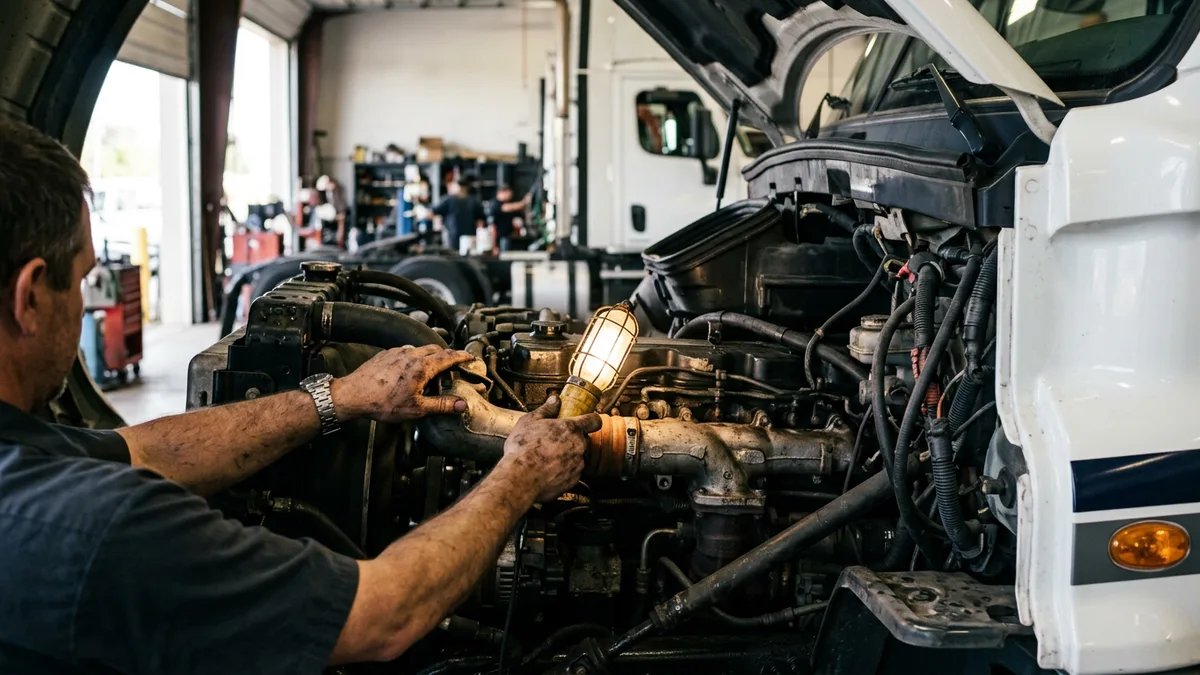
Ask for the ECM’s fault history and idle hours. Then the frame rails and crossmembers, for cracks and old welds. Next come the fifth wheel, the turbo, and the DPF, EGR, and DEF systems. Then drive it.
Ask for the last annual inspection report as well. 49 CFR 396.17 requires a commercial motor vehicle to pass an inspection at least once in the preceding 12 months, and the report or a sticker shows the date, the carrier, and the vehicle. A tractor that ran for a motor carrier should have one on file.
Get the findings in writing. Price them, then negotiate. Can’t price it? Leave. A seller who won’t let a shop near the truck has already answered you.
Paying for a Used Semi Truck
We finance equipment. Weigh this section knowing that. Lenders set their own rules for used tractors, but the questions run close to the same: how old the truck is, how many miles it has, what shape it’s in, and whether the VIN, the title, and the bill of sale agree with one another. A private-party purchase can change the paperwork a lender wants, and some lenders don’t do those at all. Ask before the deposit.
Our page on how a lender reads a used tractor covers the general picture, and used equipment financing does the same for other machines. Not set on owning it? Semi truck leasing works differently.
What Buyers Ask Before They Buy a Used Semi
Dealer or private seller: who carries more of the risk?
With a private seller, more of the checking lands on you: the title, the lien, and whatever the truck comes with after the sale.
A dealer’s contract can cover some of that, but only what it actually says, and an auction’s terms can differ from both. Whichever you pick, the independent inspection stays.
Can a used semi from a private seller be financed at all?
Some lenders do it and some don’t, so ask before you commit to a truck.
A lender that does will usually want the VIN, the title, and a bill of sale or purchase agreement that agree with one another, and it will look at the truck’s age, miles, and condition. The general picture is on our page about how lenders treat used machines.
How do you find out whether a used semi has a lien on it?
Read the lienholder line on the title, then ask your state’s titling office for the record on that VIN.
On a titled truck, the lender’s claim is noted on the title itself under UCC §9-311, and a written release from that lender is what clears it. Get the release before the title moves.
Do used semis come with a warranty?
Often not.
Used tractors are commonly sold as is, and under UCC §2-316 that wording can exclude every implied warranty. If a seller promises coverage on the engine or the transmission, get the dates and what it covers in writing. A spoken promise is hard to hold anyone to.
Is there a mileage where a used tractor stops being worth buying?
Not one number, and on a Class 8 the title may not list one at all.
Federal odometer disclosure skips vehicles that heavy, so lean on the maintenance records, the miles the ECM recorded, and what the shop finds. Two trucks with the same miles can be years apart in condition.
Does a clean history report mean you can skip the inspection?
Not on its own.
A history report covers paper: title brands, reported events, and odometer readings. It can’t tell you what’s wrong with the engine, and the NMVTIS page itself says a search can miss things while state reporting is incomplete.
Next Steps
Still pricing trucks? Our used semi truck asking prices, from dated listings, are on the cost page. Starting from zero? What starting a trucking company takes comes before the truck does. When the truck, the seller, and the paper line up, see how semi truck financing works or start an application.