
How Much Does a Semi Truck Cost? New vs Used Prices for Owner-Operators

Key takeaways
How much does a semi truck cost? On listings we read November 2, 2026, new Class 8 tractors’ model medians ran $160,949 to $248,885, and used sleeper tractors asked a median of $67,950.
- A new Kenworth T680 sleeper and one with about 375,000 miles sat $117,138 apart at the median.
- Two 2022 sleepers, 1,120 miles apart. $40,200 apart in price.
- On a new truck, ask whether the 12% federal excise tax is in the number.
- Buying from a private seller? Get the title, a lien search, and the seller’s Schedule 1 before money moves.
- More than half of the new tractors we found showed no price at all.
Ask how much does a semi truck cost and you can get a $7,500 answer or a $276,676 answer. Both were for sale on the same website on the morning of November 2, 2026. Neither one tells you much.
So we pulled every listing Soarr’s public semi truck pages would show us and threw out what isn’t a road tractor: the pickups, the box trucks, the yard spotters. That left 580 new tractors and 1,276 used ones, which we sorted by model, cab, and miles. Dealers and fleets wrote those prices. They’re asks.
Paying for the truck is a separate job, covered on our page about semi truck financing. We’re in the business of financing equipment, so discount our opinions on buying accordingly.
What a New Semi Truck Costs
A semi truck, or tractor, is the power unit that pulls a separate trailer. Owner-operators mostly buy Class 8 tractors, the heaviest federal weight class, in one of two forms: a sleeper cab with a bunk for nights on the road, or a day cab for drivers who get home each evening.
Here’s the new side, model years 2025 to 2027, from Soarr’s new semi truck listings. Cabs are mixed in these rows because too many listings don’t say which they are.
| New tractor | Priced listings | Asking range | Median |
|---|---|---|---|
| Mack Anthem | 27 | $129,000 to $178,999 | $160,949 |
| Freightliner Cascadia | 3 | $158,000 to $173,900 | $164,000 |
| International LT | 13 | $159,900 to $189,900 | $179,900 |
| Volvo VNL | 65 | $126,000 to $206,750 | $182,224 |
| Peterbilt 579 | 24 | $164,999 to $200,495 | $182,600 |
| Kenworth T680 | 25 | $172,665 to $218,362 | $195,040 |
| Western Star 49X | 11 | $187,000 to $215,000 | $203,400 |
| Peterbilt 589 | 19 | $205,999 to $238,700 | $230,999 |
| Kenworth W900 | 77 | $209,900 to $276,676 | $248,885 |
Read the counts before the dollars. Three Cascadias isn’t a market, even though the Cascadia is the most common tractor on the used side by a wide margin. And we left one truck out of the 579 row, a 2025 at $329,998 in Ohio, because its spec sheet lists the fuel type as electric. Different purchase.
The bigger surprise is what’s missing. Of the 580 new tractors, 302 showed no price. Dealers want the phone call.
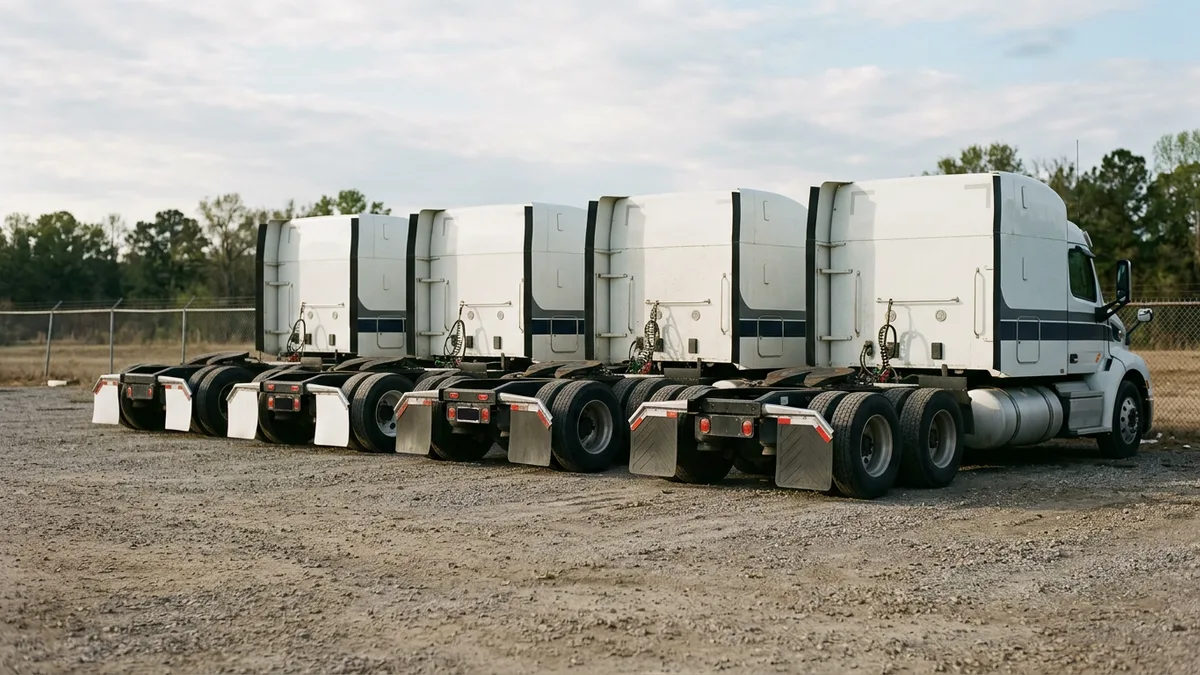
Model year matters right now, too. Of the 278 priced trucks, 174 were 2027s, and Heavy Duty Trucking reported on July 10, 2026, that the EPA’s changes to its 2027 NOx rule were still only a proposal, with 2027 trucks still expected to cost more than current models. A leftover 2025 can be the better number. Ask which one you’re being quoted.
What a Used Semi Truck Costs
$67,950
median asking price across 721 priced used sleeper tractors with odometer readings, read November 2, 2026
Miles sort this market well. Not perfectly.
| Sleeper tractor miles | Priced listings | Asking range | Median |
|---|---|---|---|
| Under 250,000 | 14 | $79,810 to $205,950 | $159,475 |
| 250,001 to 400,000 | 154 | $48,700 to $185,000 | $82,475 |
| 400,001 to 550,000 | 340 | $39,900 to $154,950 | $69,862 |
| 550,001 to 750,000 | 160 | $26,900 to $114,900 | $52,950 |
| Over 750,000 | 53 | $7,500 to $85,000 | $46,495 |
Look at how few trucks sit under 250,000 miles. Fourteen.
Most of this inventory looks like it came off fleets, with one rental and leasing company’s sales arm alone holding 354 of the 1,188 priced tractors we counted, and fleets tend to run a truck hard before they let it go. Several 2025 Cascadias here already show more than 500,000 miles. Think about that. A recent model year doesn’t mean a young truck.
Same odometer, different money. A 2022 International LT sleeper at 465,682 miles asked $44,700 in West Memphis, Arkansas, while a 2022 Volvo VNL 760 sleeper at 466,802 miles asked $84,900 in Austin, Texas, and nothing on the odometer explains a gap that size. Model does a lot of that work. Here’s the median sleeper ask for the models with enough listings:
- Kenworth W900: $125,000, on 13 trucks. Long-nose trucks ask more.
- Peterbilt 389, $100,950.
- Volvo VNL at $88,400 on 38 trucks, then Kenworth T680 at $75,950 on 222.
- Peterbilt 579 and Freightliner Cascadia, nearly tied: $61,425 and $61,268.
- International LT at $49,999, on 131 trucks, the cheapest way into a late-model bunk on this list.
Day cabs? Harder to pin down. Only 40 priced listings labeled themselves day cabs, with a median of $47,975, while 427 gave no cab label at all, with a median of $38,500, so any tidy day cab number you see elsewhere deserves a second look. One late-model example: a 2021 International RH613 at 214,635 miles, asking $26,500 in Santa Fe Springs, California.
Then there’s the bottom. $7,500 buys a 2006 Volvo VNL with 1.2 million miles in Minnesota. Good luck. Only 13 priced sleepers on the site were older than 2018, so this end is thin, and a price like that deserves a mechanic before it deserves a deposit.
New or Used: Price the Miles
Here’s the rule we’d use. Stop comparing sticker prices, and work out how much asking value disappears per mile at each stage of a truck’s life. One model. One morning.
| Kenworth T680 sleeper | Median miles | Median ask | Value lost per mile |
|---|---|---|---|
| New (19 listings) | 0 | $197,138 | Not applicable |
| Used (97) | 375,772 | $80,000 | 31 cents |
| Used (98) | 455,200 | $69,950 | 13 cents |
| Used (22) | 631,664 | $50,950 | 11 cents |
We’re simplifying. These are different trucks on one day, not a single truck tracked for years, and a new T680 today may well cost more than those used ones did when they were new, which would pad that first row. Asks aren’t sales either. Still, the shape held across the mainstream sleepers we checked. The steep part comes early.
For scale, ATRI’s 2025 operating cost survey, in FleetOwner’s report, put repair and maintenance at $0.22 per mile on average. Take the T680 gap between new and 455,200 miles, $127,188. At 100,000 miles a year, a round number for the math, that gap covers more than five years of average repair spending.
Don’t lean on that too hard. A 455,000-mile truck won’t necessarily cost you the average, because ATRI’s figure comes from carriers running trucks of every age on every kind of freight, and nobody’s averaging your particular turbo.
So, the decision. Will you keep the truck a long time and run it past 400,000 miles yourself? New can make sense, since you’re the one who gets the warranty and the known history.
Planning to sell in a few years? You’d be paying for the steepest part of the curve. Bad trade.
Buying at 400,000 miles or more skips that part and hands you the repair risk instead, so hold back real money for it, compare whatever warranty is left in writing, and ask the seller whether that warranty actually transfers to you. Easy step to skip.
What the Asking Price of a Semi Truck Leaves Out
Fuel first, because it’s the one that can sink you.
$6.352
U.S. on-highway diesel price per gallon, week of October 26, 2026
Source: U.S. Energy Information Administration, Gasoline and Diesel Fuel Update, 2026
At that price, 100,000 miles at 6.5 miles per gallon burns about $97,723 in diesel. At 7 miles per gallon it’s about $90,743. That’s half a mile per gallon, worth roughly $6,980 a year. Those miles-per-gallon figures are our assumptions for the arithmetic, so swap in your own, but the point survives any set of numbers you pick: the engine spec and axle ratio on two similar listings aren’t small print.

The federal excise tax is next. IRS Publication 510, in its December 2025 revision, sets a 12% tax on the first retail sale of heavy truck chassis and tractors above its weight limits, and Soarr’s listings don’t say whether it’s in the price. If it isn’t and the whole figure is taxable, that’s about $23,657 on the $197,138 median T680. Get it in writing.
Used trucks are usually past it, though the same publication brings it back when repairs and modifications cost more than 75% of a comparable new truck’s retail price. This is general information for 2026, not tax advice. Consult your tax advisor about your own purchase.
The rest stacks up quietly:
- A trailer. None of the prices above include one, and you may not need one if you’re leased on to a carrier that supplies it.
- Form 2290 highway use tax. The IRS instructions for Form 2290 use $550 as the full-period tax in their example of an 80,000-pound truck, for July 1, 2026, to June 30, 2027.
- Insurance, at $0.11 per mile on ATRI’s average. Under your own authority, 49 CFR 387.9 sets a $750,000 minimum for for-hire interstate hauling of nonhazardous freight. That’s the regulation’s minimum. Shippers and brokers can ask for more.
- California, if you’ll run there. CARB’s Truck and Bus Regulation calls for 2010 or newer engines with some exceptions, and it’s enforced through DMV registration. A cheap older tractor can be a problem in one state and fine in another.
Buying a Used Tractor From a Private Seller
We looked for private-party prices we could verify. We didn’t find any. Soarr’s sellers are dealers and fleets, and we found nobody publishing what one owner-operator paid another, so we won’t make up a discount.
The bands above give you a reference point instead. If a private seller’s ask sits above the median for that mileage, make them explain why.
Any savings get paid for in paperwork and risk. There’s no dealer to go back to. Before any deposit:
- The title should be in the seller’s name, and its VIN should match the truck.
- Run a lien search. On a titled truck, a lien usually shows on the title, and a UCC-1 can sit on file as well. Our guide to UCC-1 filings explains how the search works.
- Ask for the stamped Schedule 1. The IRS says to confirm the seller paid the current period’s tax, and the Schedule 1 can prove it.
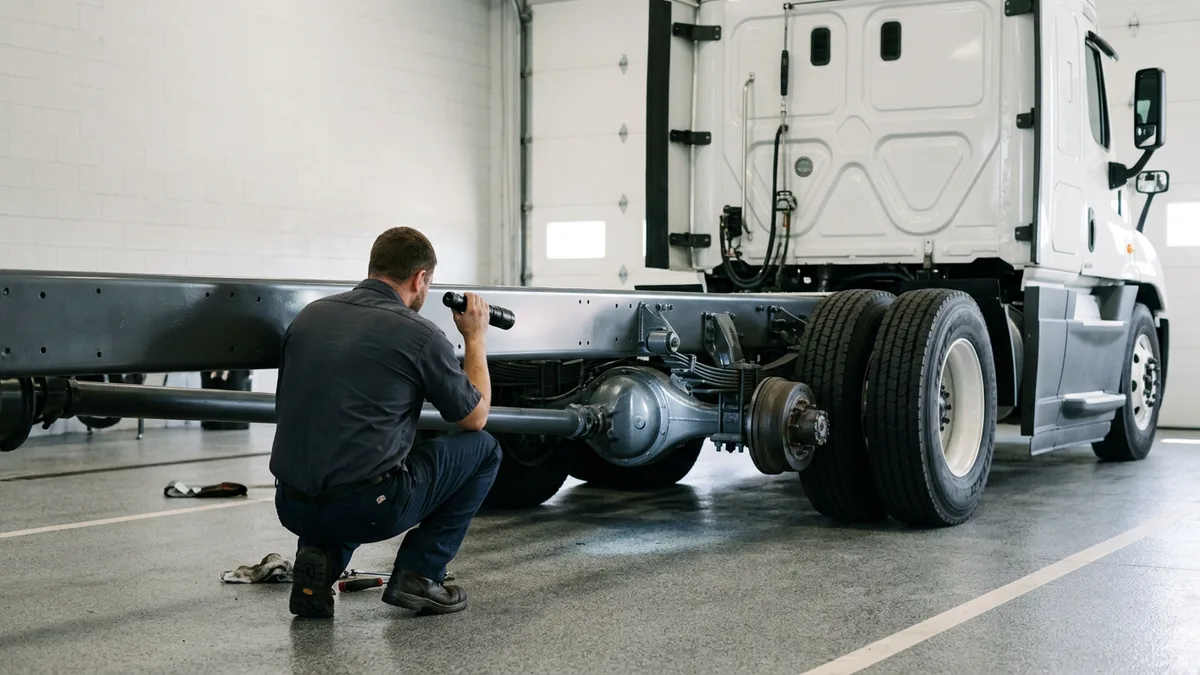
- Hire a mechanic who works on that engine. Pull the ECM report and compare its miles with the odometer, then read the fault codes, the DPF and EGR service history, and the frame rails for cracks and welds.
- Get the last annual inspection report, the one 49 CFR 396.17 requires.
Won’t let your mechanic near it? Walk.
What Owner-Operators Ask Before Buying a Truck
Is $50,000 enough for a used semi?
A $50,000 budget lands around the 550,001 to 750,000-mile band for sleeper tractors, where the median ask was $52,950 on our November 2, 2026 read. That can buy a 2022 International LT with far fewer miles, too. Whether it’s a good truck is your mechanic’s call, not ours.
At what mileage does a used tractor stop being a bargain?
Wrong number to fix on, mostly. Maintenance history and engine condition tell you more than any odometer, and the sleeper listings past 750,000 miles still asked a median of $46,495, which is not far under what a truck with about 175,000 fewer miles asks. Do that subtraction first.
Day cab or sleeper: how much does the cab change the price?
$47,975 against $67,950 were the used medians on our read, but only 40 priced listings called themselves day cabs. Thin sample. Compare the same model at similar miles before you read much into that gap.
Does anybody owe the excise tax on a used tractor?
Usually not, because the 12% tax in IRS Publication 510 falls on the first retail sale. The exception is a truck whose repairs and modifications cost more than 75% of a comparable new one’s retail price. Planning a rebuild? Consult your tax advisor first.
What does it cost to keep a semi on the road for a year?
ATRI’s average for 2025 was $2.336 per mile, or $233,600 over 100,000 miles, and that’s a carrier average that includes driver pay. An owner-operator’s own numbers will differ. Fuel, repairs, and insurance are the lines to build first, then the truck itself, which ATRI put at $0.28 per mile.
Do you need a CDL just to buy one?
Short answer: not to buy it, only to drive it. Under 49 CFR 383.91, a combination with a gross combination weight rating of 26,001 pounds or more, towing over 10,000 pounds, is a Group A vehicle, so a tractor pulling a loaded semitrailer calls for that license.
Will a lender look at a truck from a private seller?
Some will and some won’t, so ask before a deposit changes hands. Lenders generally want clean title, a clear lien search, and a truck whose age and miles fit their guidelines. For the general picture, see how lenders look at used equipment.
Next Steps
Once you’ve got a model, a mileage band, and a price you can defend, the money question is what’s left. Start with how semi truck financing works, then read about semi truck leasing if you’d rather not own it, or commercial truck financing for the wider picture. Buying your first one? Read what starting a trucking company takes before you sign.
Pricing something for a job site as well? We’ve got dump truck prices too. Feeding a crowd from a truck instead? Here’s how much does a food truck cost. Picked your truck? You can start an application.