
Last updated: November 5, 2026
Screen Printing Equipment Financing for Apparel Decorators
See how lenders read a press, a dryer and a DTF line, new or used, before you apply.
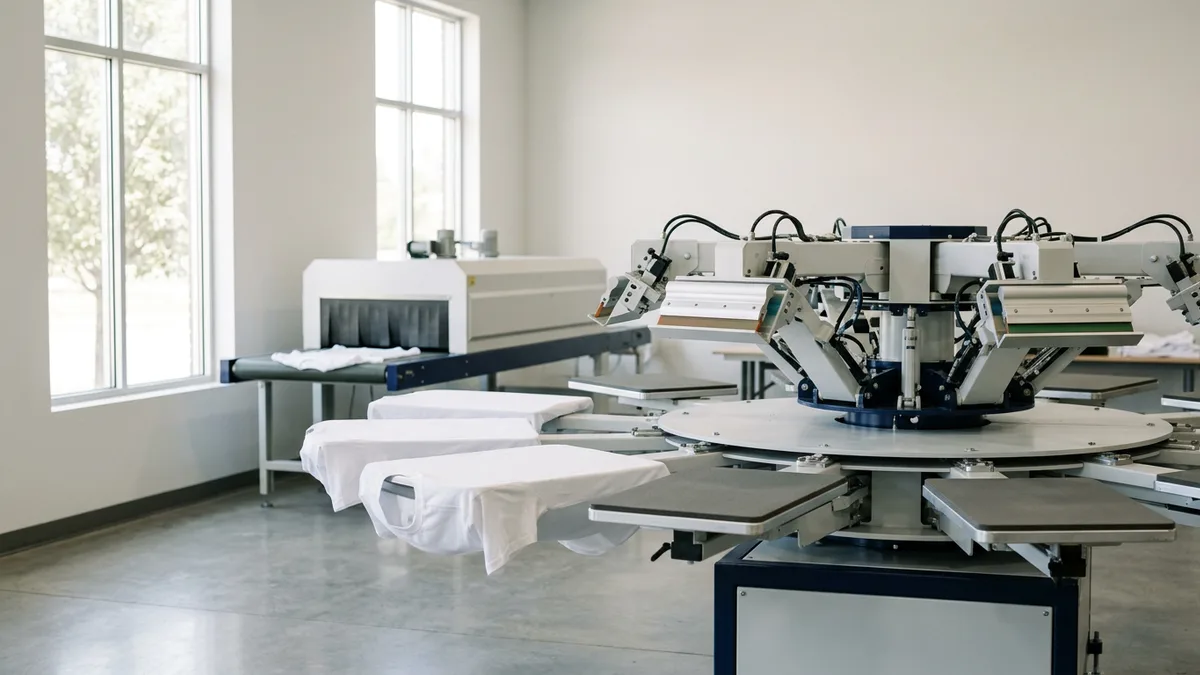
Screen printing equipment financing is a loan, equipment finance agreement or lease that pays for presses, dryers and prepress gear, and the lender reads the press, its serial number and the seller’s file together.
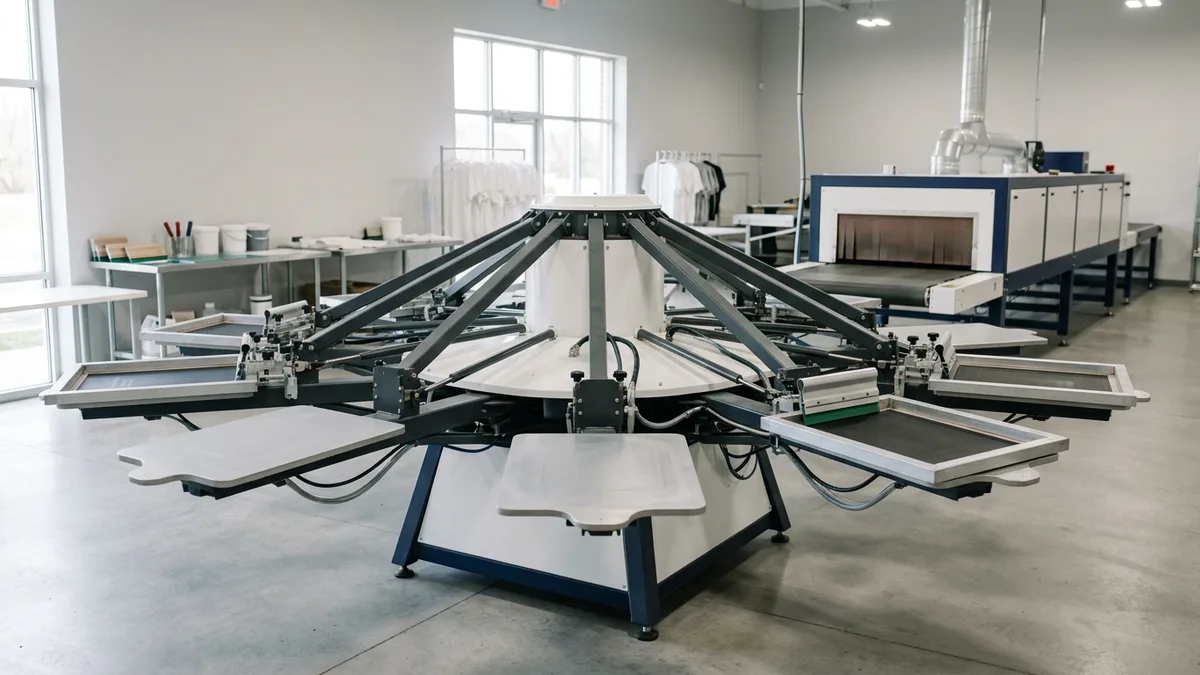
An eight-color press is only the middle of a decoration line. Screens come off an exposure unit and a washout booth ahead of it, a conveyor dryer cures the ink behind it, and a DTF printer or an embroidery machine may sit along the back wall. Lenders read the whole line. Not just the press.
This page is part of our commercial equipment financing guide and follows one decoration shop from the first quote to the first run of shirts. The general mechanics of loans and leases live on how equipment financing works.
What screen printing equipment financing covers
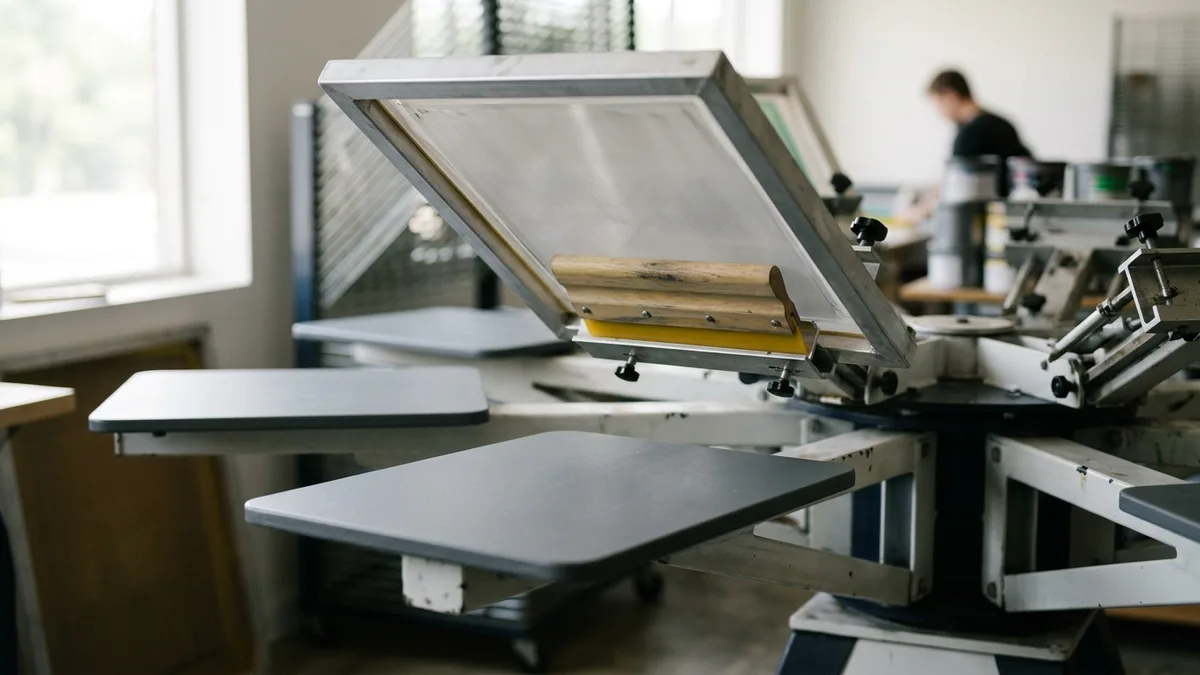
In practice, screen printing equipment financing covers every machine on the shop floor, not only the press: the dryers, the screen-prep gear and the printers beside them. With a loan or an equipment finance agreement, the shop owns the equipment and the lender holds a lien. In a lease, the lessor owns it until the term ends.
A press with a dealer network behind it is easier to place. Parts matter. If a lender ever had to sell it, a buyer would want parts, a technician and a manual, and a rare brand with no service nearby is harder to move.
What to know before used screen printing equipment financing starts
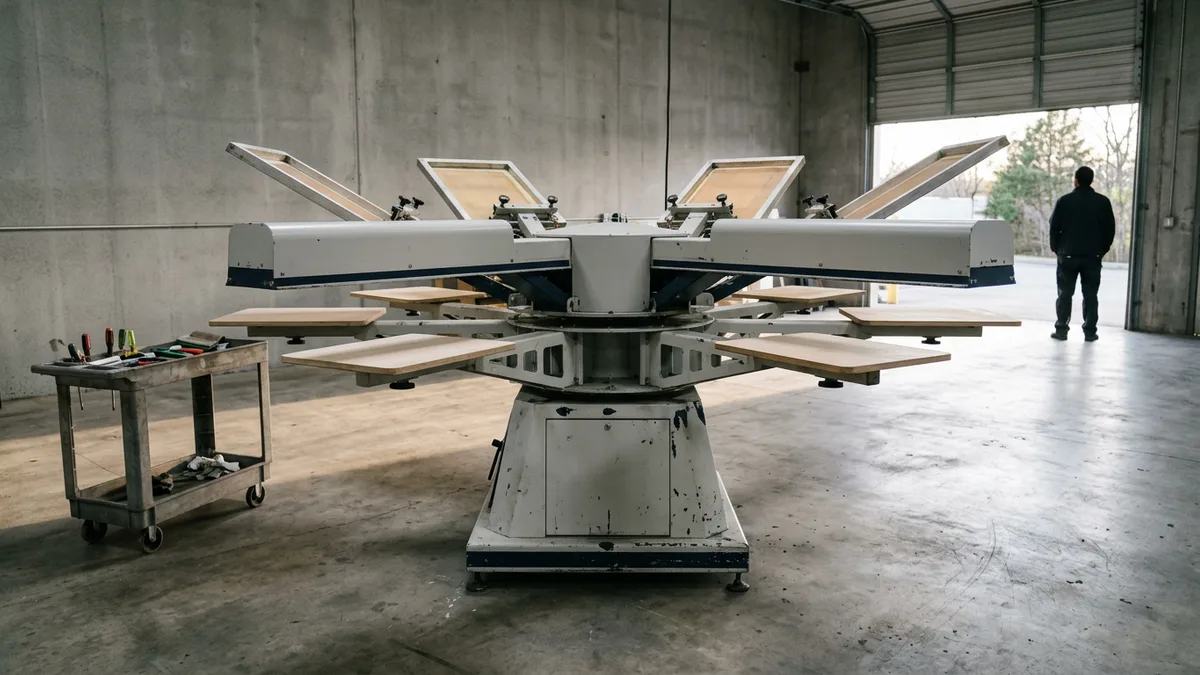
Used presses come from dealers, shops that are closing or upgrading, auctions and classified listings, and each seller hands over a different file. A dealer may have serviced the press and run it under power, while a private seller may not have touched it in a year. Photos aren’t proof. A lender checks five things.
Check the plate first. A press that sat in a damp garage makes a different file than one a dealer ran last month, and our page on used equipment financing shows how dealers and private sellers compare.
Follow a garment through the shop
A decoration shop is a line, and a lender reads it in the order a shirt moves through it. Here’s what usually sits at each stage, and what a lender may ask to see. Stage by stage.
| Stage | Machines | What a lender may ask to see |
|---|---|---|
| Prepress | Exposure unit, washout booth, screen racks, and the design software and RIP behind a DTF line | A seller’s quote that lists each machine, with serial numbers where there are any |
| Printing | Automatic press, direct-to-garment printer, DTF printer | A quote or invoice naming the model, the color and station count, and the serial number |
| Curing | Flash dryer, conveyor dryer, heat press, curing oven | The dryer’s size and power draw, with the installer’s quote for the electrical work |
| Embroidery and engraving | Multi-head embroidery machine, laser engraver | A quote naming the head count or the laser’s power rating, with serial numbers |
| Setup | Freight and rigging, electrical, compressed air, ventilation | Quotes from the carrier, the electrician and the installer |
Before you sign a press quote, ask the lender which of those lines it will include in the financed amount. Freight, electrical work and compressed air can add up fast, and anything the lender leaves out comes from the shop’s cash. Ask in writing. Our guide to equipment lease agreements and our page on the top 5 mistakes companies make when buying equipment cover the terms and traps worth reading first.
Owning or leasing equipment that ages at different speeds
A fair market value lease sets the buyout at what the equipment is worth at that point, and a $1 buyout lease is structured so the shop ends up keeping it. Which structure fits depends on how long the shop plans to run the machine.
Start with the calendar. A press that will run for ten years in one shop points toward owning, through a loan or a $1 buyout lease. A DTF printer is another story: its print heads wear and its software moves on, so a shop planning to swap it in four years can lean toward a fair market value lease. For a loan, the lender records a UCC-1 financing statement describing the equipment, as UCC section 9-310 sets out, and our page on UCC filings explains it.
Three government figures to check before you sign for a press
These figures come from IRS Publication 946 for tax years beginning in 2026 and from the SBA’s microloan page. A business elects Section 179 on Form 4562, the equipment has to be placed in service in the tax year, and you should consult your tax advisor about what applies to you. The numbers move every year.
$2,560,000
Maximum Section 179 deduction for tax years beginning in 2026
Source: IRS Publication 946, What’s New for 2026 (checked November 2026)
100%
Special depreciation allowance for qualified property, new or certain used
$50,000
Largest SBA microloan, made through SBA funding intermediaries
Three kinds of decoration equipment, and how each is specified
Related equipment financing pages
Screen printing equipment questions decorators ask first
So how does screen printing equipment financing actually work?
A lender pays the seller for the equipment, and the shop repays the lender over a set term. On a loan or equipment finance agreement, the shop owns the equipment and the lender files a UCC-1 financing statement, a public record at the state filing office, that describes it by make, model and serial number. On a lease, the lessor owns the equipment during the term. Compare the total over the whole term, not only the monthly payment.
Can you finance a used screen printing press?
Lenders review used presses, and a press is described by its year, its colors and stations, and its serial number. A dealer’s service record shows what was replaced and when, an auction lot usually has none, and the nameplate has to match the bill of sale. Each press stands alone.
What does a lender ask for on a press purchase?
A press purchase file usually holds the seller’s quote or invoice, basic information about the business and details on the owner. Some lenders add bank statements, and the list changes with the lender and the size of the file. Paperwork varies. Ask which documents a lender needs before you apply.
Is it better to lease a DTF printer or finance it?
A DTF printer can suit a lease, because its print heads wear out and its RIP software keeps changing, while a press that runs for years on new platens and parts can suit ownership. UCC section 1-203 treats a lease as a financing when the lessee can’t end it and will own the goods for nominal extra money, which is why a $1 buyout lease behaves like a loan. A fair market value lease leaves ownership with the lessor. Consult your tax advisor, because tax treatment depends on the lease terms, and see our leasing vs buying equipment page for how to decide.
Can a dryer, screens and installation be financed with the press?
Some lenders include the dryer and the installation in the financed amount and some leave them out, because a quote lists the press, the dryer and the installation as separate lines. Freight, an electrical circuit sized for the dryer and compressed air are the usual extras, and each should be priced in writing before you sign. Inks, emulsion and blank garments are a working-capital cost, and our working capital page is the place to start. Don’t assume.
Does a screen printing press qualify for Section 179?
Section 179 lets a business elect to deduct the cost of qualifying equipment in the year it is placed in service, and for tax years beginning in 2026 the limit is $2,560,000 under IRS Publication 946. Tangible business property such as a press, a dryer or a DTF printer is the kind of equipment the election covers, but ownership for tax purposes, which a lease can change, decides who can claim it. IRS Publication 946 has the rules, and our Section 179 deduction page walks through the year-end steps. Consult your tax advisor.
What if the shop is new and the press is the business?
A lender reviewing a new decoration shop has no payment history to read, so it weighs the equipment itself, the work already booked and the owner’s years in the trade. Booked work helps. So does a clear plan for the press’s first months. Our startup equipment financing page covers that review in more depth.
Ready to talk through your next press or printer?
Leave your name and contact details, and a Paramount Financial specialist will reach out about the equipment you have in mind. Or start the credit application.