
Last updated: November 5, 2026
Office Equipment Leasing for Copiers, Furniture and Workstations
How copier, furniture and workstation leases differ, and which structure fits each kind of office equipment.
Office equipment leasing lets a business use copiers, furniture and workstations for a fixed term while a lessor owns them. The lease type you pick decides who owns them when the term ends.
Office equipment falls into three groups. Machines such as copiers and multifunction printers need toner, parts and a technician. Furniture such as desks, filing cabinets and task chairs needs almost nothing. Phones and displays sit between.
Our commercial equipment financing overview covers the wider field, and our IT equipment financing page covers servers, network gear and computers. This page covers the office: which lease type each group tends to get, which clauses cause the trouble, and the four ways a lease can end when the term runs out.
How office equipment leasing works
An office equipment lease is a contract in which a lessor buys equipment a business has picked and rents it to that business for an agreed term of months or years. The lessor keeps title. The business insures the equipment, uses it and, when the term ends, returns it, renews or buys it on the terms the lease sets.
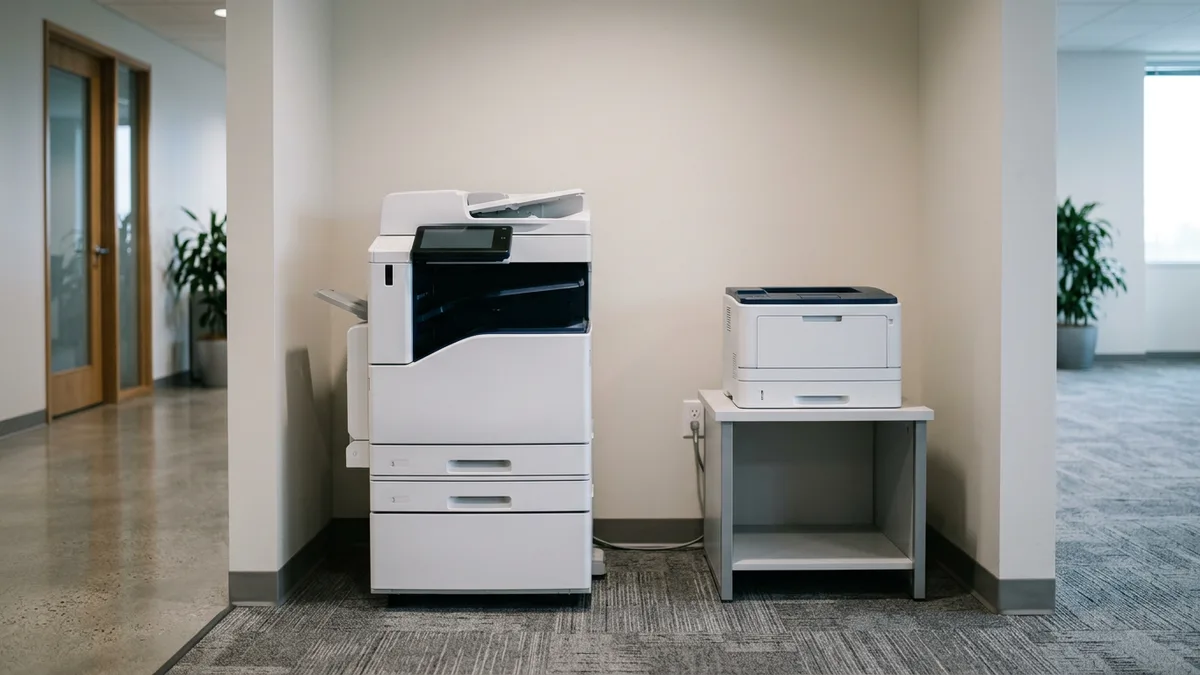
A copier lease usually has three parties: the dealer that sells and services the machine, the finance company that buys it, and the business that signs the lease and makes the payments. The lease is with the finance company. Repairs are the dealer’s job. Payments go to the lessor.
Leasing and lending aren’t the same deal
A loan or an equipment finance agreement makes the business the owner from day one, and the lender records a security interest, often as a UCC-1 financing statement at the state filing office. A lease doesn’t. Servers and network gear are a separate category.
Four office items, four different leases
Read across. The faster an item ages, the shorter the commitment you want.
| Office item | How fast it ages | Lease that tends to fit | Read this first |
|---|---|---|---|
| Copiers and multifunction printers | Fast. Models turn over, and service matters as much as the machine. | A fair market value lease, with service in its own agreement. | The last day to give notice that you’re ending or renewing. |
| Workstations and desks | Slowly. Commercial desks, files and chairs stay in use for years. | A $1 buyout lease or a loan, when you’ll keep them. | Who owns them when you move offices. |
| Phones and conference room displays | In between. The hardware lasts, but software and standards change under it. | A fair market value lease with an upgrade option. | Whether an upgrade restarts the term. |
| A trial space or a short project | It doesn’t. The need ends first. | A short rental instead of a lease. | The minimum rental period. |
Furniture and workstations: lease, or own at the end?
IRS Publication 946, the edition for 2025 returns, lists desks, files and safes as 7-year property and copiers as 5-year property. Those are the periods over which a business that buys an item recovers its cost. Different clocks.
A fair market value lease on a desk ends with a return or a buyout at what the desk is worth that day. A $1 buyout lease ends with the business owning the desk for a dollar. Pick by the next move. Will the desk still be in use after it?
If you’d rather buy, Section 179 applies to property you buy and put in service, with a 2026 limit of $2,560,000 that starts to phase out above $4,090,000 of equipment (IRS Revenue Procedure 2025-32). Leased property is different. Publication 946 says a lessee generally can’t depreciate what it leases, because it doesn’t keep the incidents of ownership. Figures change every year, so check irs.gov for the current one and consult your tax advisor before you choose.
Contracts for office equipment leasing: what to read first
UCC 2A-103 defines a finance lease as one where the lessor doesn’t select, make or supply the goods and acquires them in connection with the lease, which is what separates it from a plain rental. UCC 2A-407 then says that, in a finance lease that isn’t a consumer lease, the lessee’s promises become irrevocable and independent once the lessee accepts the goods. So a copier that jams for a week doesn’t, by itself, stop the payments.
Our equipment lease agreement checklist covers the other clauses, and operating versus finance leases explains how the two get booked.
Office equipment leasing in three numbers
26%
Share of 2023 equipment and software acquisitions made through leasing, the most used method
Source: Equipment Leasing & Finance Foundation, Horizon Report 2024
55%
End users who named protection from equipment obsolescence as a reason to finance
Source: Equipment Leasing & Finance Foundation, Horizon Report 2024
5 and 7
Years in the IRS recovery class for a copier and for office furniture, if bought
Four ways an office lease can end
The equipment lease agreement guide shows where each of the four sits in the contract.
Weighing a different route?
Office equipment leasing questions before you sign
So how does office equipment leasing actually work?
Short answer: a lessor buys the equipment and a business pays to use it for a fixed term. Article 2A of the Uniform Commercial Code governs leases of goods in the states that adopted it. Service, insurance, return and buyout terms come from the lease contract, so read it first.
Should I lease or buy office furniture?
Lease the furniture you expect to move or replace, and buy it or use a $1 buyout lease for furniture you’ll keep. The IRS gives office furniture a 7-year recovery period and copiers 5 years (Publication 946, 2025 returns), a rough guide to how long each stays in service. Your tax advisor can say how a lease or a purchase is treated.
What does a copier lease cover, and what does it leave out?
Two documents usually come with a copier: the finance company’s lease for the machine and the dealer’s service agreement for toner, parts and labor. The per-page rate sits in the second. Check both end dates. Read both before signing either.
Can I end an office equipment lease early?
Under UCC 2A-407, a finance lessee’s promises become irrevocable and independent once the equipment is accepted, so an early exit generally needs the lessor’s written agreement to a payoff. Get it in writing. A lawyer reading the early termination clause answers it better than any article.
What happens at the end of a copier lease?
Return, renew, swap or buy: the contract names which of the four you get. Notice deadlines and evergreen renewal clauses sit in the end-of-term section, so read that section the day you sign. Calendar the date.
Can I lease used or refurbished office equipment?
Lessors treat used and refurbished office equipment case by case. Age, condition and resale value drive the answer, so a request that lists the model, the serial number and a written condition report gets a clearer reply than one that doesn’t. Ask early.
Fitting out an office or replacing a copier?
Tell us what you’re equipping, how long you expect to keep it and what you want at the end of the term, or start an equipment application if you already know. Questions first? Talk to a Paramount Financial specialist.