
How to Start a Laundromat: Location, Machines and Startup Costs

Key takeaways
The first decision in how to start a laundromat is the building, not the machines: buy a working store or build one, confirm the water, sewer, gas, and power can carry the washers and dryers, then price equipment.
- Buying a store prices its cash flow. Building one prices construction and machines.
- Some state plumbing codes require a lint interceptor in a laundry’s drain.
- Top-load washers wear out years sooner than front-loaders, on the industry’s own schedule.
- Listed prices ran from $1,119 for a small gas dryer to $14,399 for a stacked pair, on one dealer’s site in November 2026.
- Used washers and dryers are financed regularly. Their age and condition weigh heavily.
Ten steps. A cost range. A software pitch. That’s the usual guide on how to start a laundromat, and of the five we read on November 8, 2026, one mentioned the sewer.
Just one. Every washer in the store empties into the same drain line, and the pipes, the gas meter, and the electrical panel decide which machines you can bolt to the floor. So the store comes first here, then the building, then the machines, with laundromat equipment financing near the end.
Buy a Laundromat or Build One
Buying an existing laundromat means paying for a business with customers, machines, a lease, and a record of revenue. Building one means paying for an empty space, its plumbing, gas, venting, and electrical work, and a full set of new equipment, with no sales history behind any of it.
The two are priced on different bases. In its industry overview, the Coin Laundry Association says existing stores “normally sell for a multiple of their net earnings,” usually three to five times net cash flow, and that new stores are valued on actual construction and equipment costs. Income versus parts.
29,500
U.S. coin laundries counted by the Coin Laundry Association, which puts their combined gross revenue at nearly $5 billion a year (industry overview read November 8, 2026).
The association’s ranges are wide: market values from $50,000 to more than $1 million, and annual cash flow from $15,000 to $300,000. They describe the industry. Not your store.
The same overview shows why machine age matters in a purchase. It lists a useful life of 5 to 8 years for top-load washers and 10 to 15 years for front-load washers, so two stores with the same cash flow and the same multiple can carry very different replacement bills over the next five years. Ask the seller for the purchase date and serial number of every washer and dryer. In writing.
A new store has no sales record. None. Its turns per day stay a guess until the doors open, so the location has to carry the weight.
Where a Laundromat Works
Renters. That’s the short answer the association gives: stores “perform exceptionally well in predominately renter-occupied, densely populated areas,” because people without a washer at home are the ones who come in.
The association puts most stores at 1,000 to 5,000 square feet of retail space, with a 2014 average of 2,170, on long-term leases of 10 to 25 years, open roughly 6 a.m. to 10 p.m.
Ten years is a long time to be wrong about a corner. Walk it at night. Walk it on a weekend morning too.
Zoning comes before the lease, too. The SBA’s licensing guide notes that zoning is usually controlled at the local level and points owners to the city planning department, and a laundromat will also need whatever business license your city issues plus permits for the plumbing, gas, and electrical work. Ask the planning office whether a laundromat is allowed at that address. Before the deposit.
Before you sign anything, get answers to these:
- How many apartment units sit within walking distance, and how many of them have in-unit laundry?
- Where’s the nearest competing store, and how old are its machines?
- Parking. Can someone carry three baskets from a car to the door without crossing a lot?
- Will the landlord sign a lease long enough to outlast the equipment, with renewal options?
- Does the lease let you cut into the floor for drain lines and the roof for dryer vents?
That last question is the one that ends deals, and it leads straight into the building.
What the Building Has to Carry
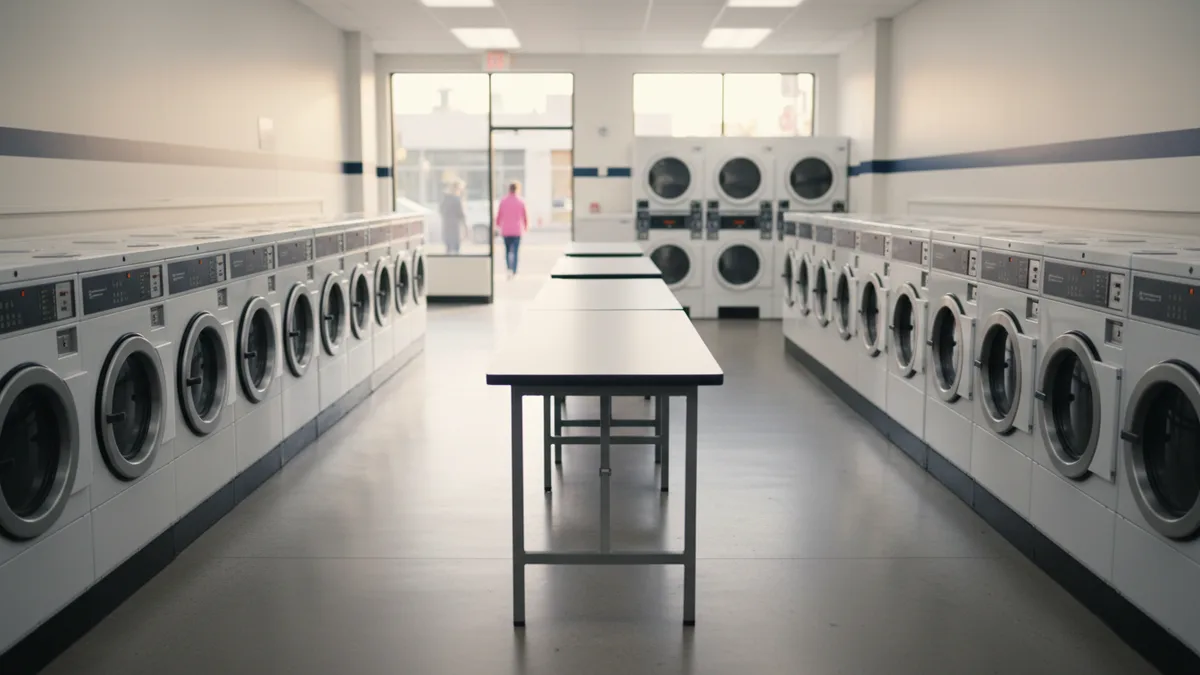
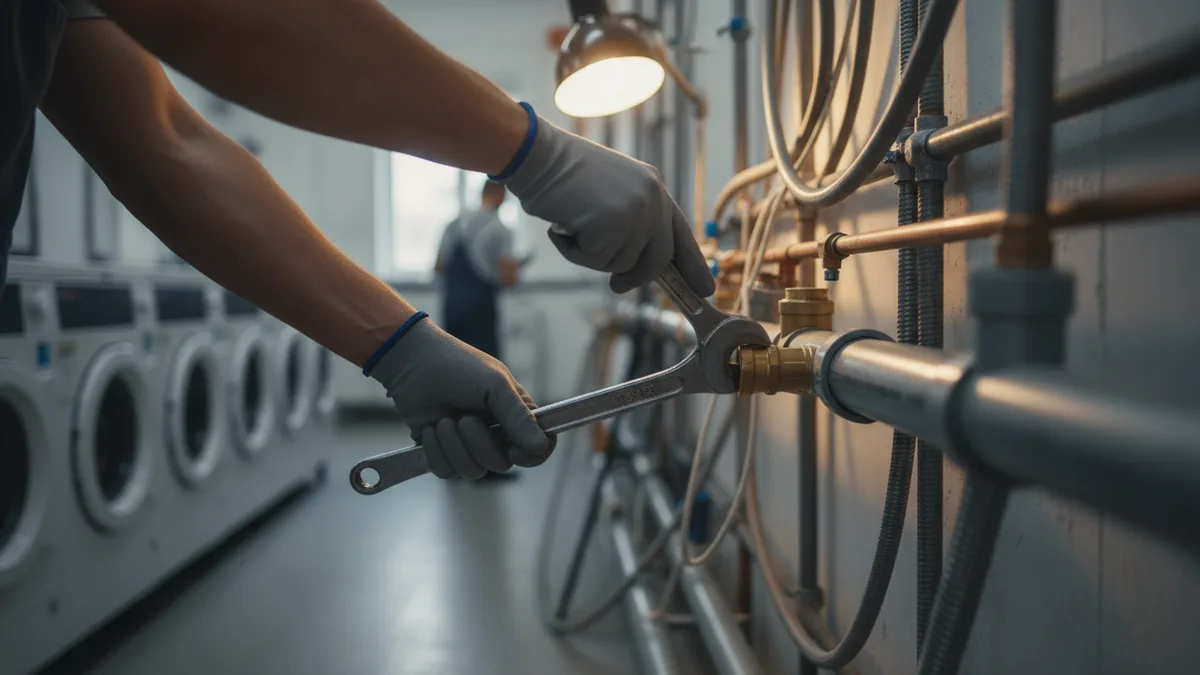
Every washer you install sends water into a drain. Twenty of them, cycling all day, send a lot of it at once, and the line, the sewer connection, and the water heater all have to keep up. A retail unit built for a phone store may not. Upgrading it can cost more than the first row of machines.
Then there’s lint. Commercial laundries have to catch it before it reaches the sewer in states that have adopted that part of the plumbing code.
Michigan’s plumbing rule, for example, says commercial laundries “shall be equipped with an interceptor with a wire basket or similar device, removable for cleaning,” that stops solids 0.5 inch or larger, string, rags, and buttons. Your state’s version may read differently. Your plumber will know.
Dryers need gas and air. Every large dryer in the dealer table below burns natural gas, and each one needs its exhaust run outside, which means a path through the wall or the roof and a gas line sized for the whole bank.
Electrical is the third line item: the larger washer-extractors run on 208/240-volt service, while many small 27-inch machines plug into 120 volts. Check the listing for every model on your list. Then show it to an electrician.
Water use is the cost you’ll feel every month. ENERGY STAR says certified commercial washers are on average 9% more efficient and use about 45% less water than standard models, and that some front-loaders wash over 20 pounds at once against 10 to 15 for a standard top-loader. That matters on a water bill. It matters more on an undersized drain.
Our rule, plainly put: no lease and no purchase agreement until a plumber, the local sewer utility, and an electrician have looked at the actual machine list and answered in writing. Get the gas utility too. Weighing a car wash instead? Its sewer conditions can shape the equipment list, covered in our car wash startup guide.
Laundromat Startup Costs
Published totals are guesses, and most of them don’t cite anything. Take Homebase, a scheduling and payroll software company. Its June 2026 guide lists the ranges below and gives no source for any of them. One company’s estimate.
| Line item | Homebase estimate |
|---|---|
| Buying an existing store | $200,000 to $1,000,000 |
| Build-out of a new store | $50,000 to $200,000 |
| Plumbing, electrical, and HVAC | $45,000 to $150,000 |
| New washers and dryers | $1,000 to $6,000 per unit |
| Permits, licenses, and insurance | $3,000 to $11,000 |
| Working capital | $40,000 to $150,000 |
Look at the second and third rows together. The building work alone can rival a small store’s price. It’s also the line that moves most from one address to the next, which is why a contractor’s walk-through beats any published range.
Split your own budget in two:
- One time: machines, the build-out, plumbing and venting, the lint interceptor, payment systems, permits, deposits.
- Every month, for as long as you’re open: rent, water and sewer, gas, electricity, repairs, insurance, and whoever cleans the floors and empties the lint screens.
What Washers and Dryers Cost
These are listed prices, read on November 8, 2026, from WebstaurantStore’s coin washer listings and its gas dryer listings. One dealer, one day. A snapshot.
| Machine | Listed price | Notes |
|---|---|---|
| Top-load washer, GE VTW565ASVWB, 3.8 cu ft | $1,399.00 | Coin compatible |
| Top-load washer, Speed Queen TV4000WN, 3.19 cu ft | $1,699.00 | Coin operated |
| Front-load washer, Speed Queen FV6010WN, 3.42 cu ft | $2,499.00 | Coin operated |
| Front-load washer, Wascomat WQD745, 6.4 cu ft | $11,999.00 | Coin operated, 208/240 V |
| Gas dryer, GE GTX52GASPWB, 6.2 cu ft | $1,119.00 | Free use |
| Gas dryer, Speed Queen DV4000WG, 7 cu ft | $1,699.00 | Coin operated |
| Gas dryer, Wascomat D767, 19.4 cu ft | $8,099.00 | Coin operated |
| Stacked gas dryers, Wascomat D750S, 15 cu ft | $14,399.00 | Free use |
Set that against Homebase’s $1,000 to $6,000 per unit. The small 27-inch machines fit inside it. The big Wascomat washer-extractors and the stacked dryer pair don’t come close, and a store built around large-capacity front-loaders will spend well past that range per machine.
Delivery, installation, and the coin or card system usually aren’t in a listed price, either. A single coin drop for one GE model lists at $127.99. Multiply.
Useful life changes the comparison more than the sticker. The association’s schedule, which it says varies with usage, sales volume, and maintenance, gives these spans:
- Top-load washers, 12 to 14 pounds: 5 to 8 years.
- Front-load washers, 18 to 50 pounds: 10 to 15 years.
- Dryers, 30 to 60 pounds: 10 to 15 years. Heating systems and coin changers, the same.
Do the arithmetic. On that schedule, a store may buy a top-loader twice in the life of one front-loader.
Front-loaders also take the bigger loads, and ENERGY STAR notes some wash over 20 pounds at once. Comforters. Work clothes. Sleeping bags.
The association measures use in turns per day: washers generally run three to as high as eight or more, and dryer income is usually 40% to 60% of washer income. Those two ratios set the dryer count. Count a busy store’s machines on a Saturday.
Buying Used Washers and Dryers
- Get the purchase date and serial number of every machine, and a bill of sale that lists them.
- Front-loaders with half their 10 to 15 years left are a different buy from top-loaders near year eight.
- Who services this brand within an hour of the store? Call them first.
- Ask whether the coin or card system moves with the machines or stays with the seller.
- Removal, rigging, and reconnection: whose bill is it?
Paying for Laundromat Equipment: Cash, Loan, or Lease
We finance equipment. Keep that in mind here.
Plenty on this list doesn’t need a loan at all: a coin drop listed at $127.99, a folding table, one replacement dryer. Cash. Or the credit line you already have.
| Pay cash | Equipment loan | Equipment lease | |
|---|---|---|---|
| Who owns it during the term | You | You, with a lien on it | The lessor |
| At the end | Nothing to settle | Paid off, lien released | Return, renew, or buy |
| Read closely | What’s left for repairs | The total cost, not the payment | How the buyout is priced |
Let machine life pick the structure. Front-loaders, at 10 to 15 years on the CLA’s schedule, are machines you’ll likely keep past a typical term. Own those. Top-loaders, at 5 to 8, may suit a fair market value lease, which lets the business return, renew, or buy the machines at their value when the term ends.
Used commercial washers and dryers get financed all the time. Lenders commonly review the age and condition of the machines, the seller (a dealer, a private party, or the store being bought), and the business applying, and each lender weighs those factors differently. Our used equipment financing page describes how a secondhand purchase usually works.
For a first store with no sales history, the startup equipment financing page describes what lenders typically review, and the guide to what an application review covers lists common documents. Before signing any agreement, check whether the UCC-1 filing describes only the machines or all of the business’s assets. Different filings. Read it.
Questions People Ask Before Opening a Laundromat
How much does it actually cost to open a laundromat?
Homebase’s June 2026 guide puts the purchase of an existing store at $200,000 to $1,000,000 and lists no source. Build costs vary most with the plumbing, gas, and electrical work a space needs, which a contractor’s site visit prices more accurately than any published range.
Is buying an existing laundromat smarter than building one?
Different risks. The Coin Laundry Association says existing stores usually sell for three to five times net cash flow, while new stores are valued on construction and equipment costs. A purchase comes with a sales history; a new build comes with new machines.
How many washers and dryers does a new store need?
Washers generally run three to eight or more turns a day, the Coin Laundry Association reports, and dryer income is usually 40% to 60% of washer income. A Saturday count at a nearby busy store is a useful check on both numbers.
Realistically, how long do commercial washers last?
Five to eight years for a top-loader and 10 to 15 for a front-loader, according to the Coin Laundry Association’s useful-life schedule, which notes that usage, sales volume, and maintenance change both.
Does a laundromat need special plumbing?
Usually a larger drain and a lint interceptor. Michigan’s administrative code, rule 408.30731, requires commercial laundries to have an interceptor with a removable wire basket that stops solids 0.5 inch or larger. Local inspectors enforce their own adopted version.
Can used commercial washers and dryers be financed?
They are, regularly. Lenders commonly review the machines’ age and condition, the seller, and the applying business, and weigh each factor differently. Serial numbers and purchase dates for every machine are worth having ready.
Before You Sign the Lease
Three calls come first. The local sewer utility, about drain capacity and interceptor rules. A licensed plumber and an electrician, with the machine list. Then a dealer, for a quote that includes delivery, installation, and the payment system.
After that, see how laundromat financing works at Paramount Financial, or start an application for a review. Other startup guides on this site cover how to start a restaurant, how to open a coffee shop, and how to start a landscaping business.