

Leasing vs Buying Fleet Vehicles: How Businesses Weigh Cost, Control and Turnover

Key takeaways
The lease vs buy fleet vehicles decision turns on three things: how many miles each truck runs, how long you’d keep it, and who should hold the title and the resale risk when the term ends.
- Judge each truck on its own history, not the fleet’s average.
- A closed-end lease hands the end-of-term value gap to the lessor. A TRAC lease hands it to you.
- Tax treatment follows who owns the truck, so bring your tax advisor in before you sign.
- Cash, or a credit line you already hold, can beat both.
A contractor with six pickups and two cargo vans has two replacements coming due and three ways to pay: buy, lease, or a mix. The right answer differs by truck, so this look at lease vs buy fleet vehicles starts with the trucks and leaves the contracts for later. It pairs with our Section 179 deduction guide for the tax side.
Disclosure first. Paramount Financial finances equipment, so a decision to finance helps us. Cash, or a credit line you already hold, can be the right answer, and we’ll say when.
Lease vs Buy for Fleet Vehicles, Defined
Leasing a fleet vehicle means paying a lessor, the company that owns it, to use a truck or van for a set term, then returning it, renewing, or buying it as the lease provides. Buying means the business owns the vehicle, usually with a lender’s lien on the title until the loan is paid. A fleet can use both.
A fleet meets three kinds of paper. A financed purchase. A closed-end lease, where the lessor sets the end value and keeps the resale risk. And an open-end lease, usually written as a TRAC lease (terminal rental adjustment clause), where the business keeps that risk.
Each puts its cost in a different place.
Miles, Upfit, and Replacement Cycles
Start with the odometer. Pull each truck’s last full year of readings before anyone quotes a payment. Miles drive almost everything after them.
A closed-end lease sets a mileage allowance and charges for the miles past it. An owned truck has no allowance, but every mile comes off its resale value.
A truck that runs the same routes all year can be fitted to an allowance. One that idles through a slow winter and works nonstop in summer can’t, because a flat allowance averages the two seasons.
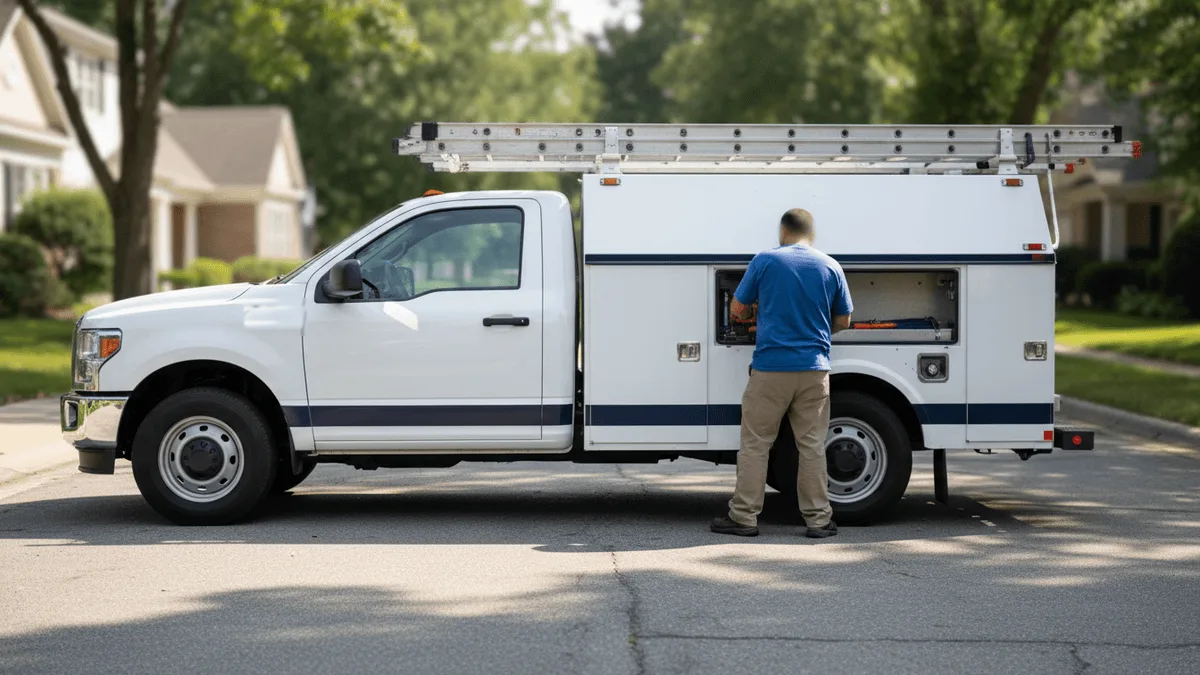
Then look at the body. Shelving, a ladder rack, a liftgate, a utility body: an upfit is built for one trade, not for the next owner. A van fitted for an electrician’s stock can be worth less to a stranger than the same van empty, so read the lease’s clause on alterations before ordering a single bolt.

Last, write down the age or mileage at which you really replace trucks. The honest number.
S&P Global Mobility put the average light truck on U.S. roads at 11.9 years old in 2025, across every kind of owner. A business that turns work trucks well before that is living on the young end of the range.
11.9 years
The average age of light trucks in operation in the United States in 2025, across all owners and not only fleets.
Source: S&P Global Mobility, Average age of vehicles in the US rises to 12.8 years in 2025, May 27th, 2025
Now compare your own. A lease term shorter than your habit turns over trucks you’d have kept. A loan that outlasts your habit leaves you paying on a truck that has already gone. Match the term to how long a truck really stays on your jobs.
Three Structures, Side by Side
Here’s how the three compare.
| Financed purchase | Closed-end lease | Open-end (TRAC) lease | |
|---|---|---|---|
| Title during the term | The business, with a lien | The lessor | The lessor |
| End-of-term value gap | The business | The lessor | The business, up or down |
| Miles and wear | Show in resale value | Allowance, then charges | Show in the sale price |
| Section 179 election | Generally available | Generally not | Generally not |
Read the second row twice. Owners get surprised there.
On a closed-end lease the lessor fixes the end value at signing and carries the risk that the truck sells for less. You return the keys. Past the allowance, you pay for the miles or wear. An open-end lease flips that: under 26 U.S.C. §7701(h), a terminal rental adjustment clause lets the rent be adjusted “upward or downward” by what the lessor realizes when it sells the vehicle, so the business carries the gap both ways.
For how fair market value and $1 buyout leases fit in, our guide to operating lease vs finance lease covers the tests an accountant applies. The table’s last row is general and for tax year 2026 only. Consult your tax advisor about your own paper.
Who Holds the Title and the Risk
Spreadsheets miss control. On a financed purchase, the title is in the business’s name with the lender’s lien noted on it until the loan is paid. In a certificate-of-title state, UCC §9-311 says that notation, not a UCC-1 filing (the usual public notice of a lender’s claim on equipment), is how the claim is made official.
A lease reads differently. The lessor’s name is usually on the title, so changes you’d make freely to your own truck, like selling it mid-term, swapping the body, or moving it to another company you own, may need the lessor’s consent. Ending a closed-end lease early can carry a charge written into the contract, so ask for the early-termination formula in writing. Ask early.
Then ask who does what. Maintenance, insurance, registration, and the return paperwork can sit with the lessor or with you, depending on the lease.
Fleet Vehicle Tax Treatment for 2026
Everything here is educational, for tax year 2026, and your tax advisor has the last word. Under IRS Publication 946, property has to be acquired by purchase to qualify for the Section 179 election (expensing it in the first year), and a lessee can depreciate leased property only when it keeps the incidents of ownership, such as legal title and the risk of loss.
A financed purchase generally qualifies. A true lease generally doesn’t. A $1 buyout lease turns on what its contract actually says, so show your tax advisor the clause, not the sales sheet.
$32,000
The most the cost of a heavy SUV can count toward the Section 179 deduction, for vehicles placed in service in tax years beginning in 2026. Some work trucks and vans fall outside the cap.
Source: IRS, Publication 946 (2025 edition), What’s New for 2026
Leasing has its own wrinkle. In the “Leasing a Car” section of Publication 463, a business may deduct the part of each lease payment that’s for business use, and for a lease of 30 days or more it may have to reduce that deduction by an inclusion amount when the vehicle’s value on day one passes an IRS threshold. The page speaks of a “car, truck, or van”, so ask your advisor whether it reaches yours.
Weight rating, bed length, and the business-use log sit in our guide to Section 179 for vehicles. Bonus depreciation does too. Pick the structure for the truck first and the tax treatment second, then consult your tax advisor before you sign.
A Lease vs Buy Test for Your Trucks
Run this for each truck, not for the fleet. Six checks.
- Pull a full year of odometer readings. A truck whose miles swing from month to month won’t sit comfortably inside a flat allowance.
- Write down the age or mileage at which you really replace trucks.
- What would the upfit be worth to a stranger? If the answer is “little,” weigh carrying that risk yourself.
- Read the end-of-term clause first. Who holds the value gap?
- Total each option over the same period: every payment, the buyout or return charges, insurance, and service.
- Could cash, or a credit line you already hold, cover the truck and still leave room for payroll and fuel?

A fleet can mix them. A van on fixed routes may suit a closed-end lease. A service truck with a custom body and uneven miles may suit ownership.
For the machine side of the same choice, see leasing vs buying equipment.
What Fleet Owners Ask Before Signing
Who eats the loss if a leased truck sells for less than expected?
The lease type decides it. On a closed-end lease the lessor set the end value and carries the shortfall. On an open-end lease with a terminal rental adjustment clause, the rent adjusts to the sale price, so the lessee absorbs the shortfall and takes the credit if the truck sells for more. Read which one you signed before the truck is due back.
What happens when a leased van goes over its mileage allowance?
Every mile past the allowance carries a per-mile charge set in the lease, so that charge, not the monthly payment, is the number to find. Multiply it by a heavy year’s miles.
Can a leased work truck carry shelving, racks, and company graphics?
Read the alterations clause first. Some leases allow bolt-in shelving, racks, and a painted company name, while others want the body returned as it came, so the answer sits in your contract and not in a dealer’s promise. Get in writing what happens to a ladder rack or a liftgate at return.
Does the IRS treat a leased truck differently from one you finance?
Form 4562, Part I, is where the Section 179 election goes. It follows ownership: for tax year 2026, a business that bought the truck, even with a loan, can generally make the election, and the lessee of a true lease generally can’t. The contract’s wording counts for more than its label, so consult your tax advisor before you sign.
Is it ever smarter to pay cash for a work truck?
Cash is a fair answer when it would otherwise sit idle and paying doesn’t leave payroll and fuel short before the next invoice clears. Financing keeps cash on hand, and paying cash avoids a finance charge. Which matters more depends on your cash cycle, and your accountant knows it better than we do.
Should every truck in a mixed fleet use the same structure?
Not necessarily. A van on fixed routes and a service truck with a custom body and uneven miles are different problems, and a fleet can hold a financed purchase, a closed-end lease, and a TRAC lease at the same time. The cost is bookkeeping, since each structure brings its own end-of-term date.
Next Steps
Pricing the next truck? Talk with us about commercial equipment financing, or read about commercial vehicle financing for work trucks and vans first. When you’re ready, start an application.
Planning around tax year 2026? Our Section 179 deduction for equipment guide is the place to begin, and your tax advisor should be in the room before you sign.