

Last updated: November 11, 2026
Warehouse Equipment Financing for Racking, Conveyors and Dock Systems
Pay for racking, conveyors, dock equipment and chargers as one project, with the paperwork lenders ask for.

Warehouse equipment financing pays for racking, conveyors and dock equipment over a set term, and the equipment usually secures the deal, so a business can fit out a building without paying for it all up front.
This page is for the people fitting out a distribution center, a 3PL building, a plant’s storage bay or a retail stockroom. Rarely one purchase. Trucks, racks, belts and docks arrive from different vendors on different dates. Different invoices too.
The wider picture is in Paramount Financial’s commercial equipment financing overview, and trucks have their own page on forklift financing, as do packaging lines.

What warehouse equipment financing covers
Warehouse equipment financing is an arrangement where a lender pays the seller for racking, conveyors, dock equipment, chargers and similar systems, and the business repays over a set term with the equipment as collateral. A lease works differently: the lessor owns the equipment during the term, and the business pays to use it. Own or rent.
Most projects mix the groups. Take a 3PL adding a second shift: a conveyor line, a few dozen racking bays and a charging bay, ordered in one quarter from three vendors. Three vendors, three invoices.
How warehouse equipment attaches to the building
The useful question isn’t what an item costs. Attachment matters. Loose equipment gets judged like a truck, bolted equipment like a fixture, built-in equipment like a construction job.
| Group | Examples | What a lender looks at |
|---|---|---|
| Loose | Reach trucks, order pickers, pallet jacks | Make, model, serial number and hour meter, one unit at a time |
| Bolted down | Pallet racking, shelving, conveyors, sortation lines | A line-item quote, who owns the building and whether a fixture filing is needed |
| Built in | Mezzanines, dock levelers, new sprinkler or lighting runs | The permit, the drawings and, in a leased building, the landlord’s consent |
| Powered | Battery chargers, battery racks, lithium-ion packs | The trucks they serve, the battery’s age and where charging happens |
| Soft costs | Installation, freight, engineering, permits | Whether the invoice splits hardware from labor |
Racking and conveyors: the fixture question
Anchor a rack to the slab and it starts to look like part of the building. UCC Section 9-102 defines fixtures as goods that have become so related to particular real property that an interest in them arises under real property law, and Section 9-334 says a security interest can still exist in goods that are fixtures. So a lender can hold bolted-down equipment as collateral. It may record a fixture filing beside the usual UCC-1 filing.
Who owns the building matters too. Racking in a leased building sits on someone else’s property. Read the lease, and expect the landlord’s consent to come up.
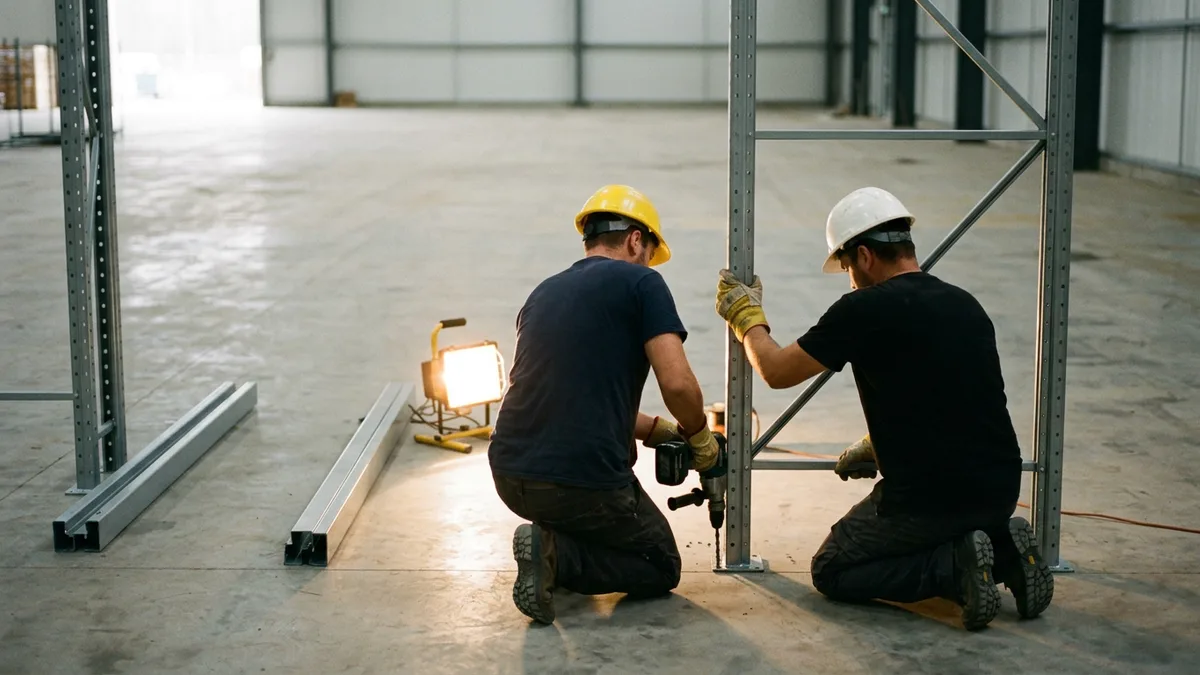
That’s what J.J. Keller’s 2023 summary says the rack standard, ANSI/MH 16.1, addresses, and OSHA references it during inspections. Used racking should arrive with its load data.

Docks, mezzanines and chargers: plan the paperwork
A dock leveler isn’t just steel. OSHA’s dockboard rule, 29 CFR 1910.26, says dockboards must carry the maximum intended load, and those put into service on or after January 17, 2017 must be built to keep transfer vehicles from running off the edge unless the employer shows there’s no such hazard. Check the date.
A mezzanine is a structure, so expect a permit. Under the International Building Code’s general rule, Section 505.2.1, the combined mezzanine area in a room can’t exceed one-third of that room’s floor area, as the City of Houston’s 2023 technical memo restates, though some construction and sprinkler setups allow more. The local building department decides which applies. Ask early.
Charging areas
Chargers have a rule of their own. OSHA’s 29 CFR 1910.178(g) puts battery charging in designated areas, with ventilation for gassing batteries, fire protection and a way to neutralize spilled electrolyte. Budget the space and the power before the chargers arrive. Not an afterthought.
Fitting out a new building: the order things arrive
Order matters. Floors get sealed, racking goes up, conveyors follow, and chargers and docks tie into power, while each vendor invoices on its own date, so one project can leave a stack of documents behind.
A building purchase can come with an SBA 504 loan. SBA describes 504 as long-term, fixed-rate financing for major fixed assets, made through a Certified Development Company (CDC) and a senior lender, so ask the CDC which items sit inside the project budget, because anything outside it needs its own plan. Then line up the rest before orders go out:
Two guides cover what to have ready: equipment financing documents and equipment financing requirements. Pricing the trucks that go with it? See how much a forklift costs.
Three numbers behind a warehouse fit-out
17.1%
Share of US retail sales made online in the second quarter of 2026, seasonally adjusted
Source: U.S. Census Bureau, Q2 2026
18
Inches of clearance OSHA requires between sprinklers and the material below them
Source: OSHA, 29 CFR 1910.159
$2,560,000
Maximum Section 179 deduction for tax years beginning in 2026
Source: IRS, Publication 946
Ways to pay for a warehouse fit-out
Before you finance a warehouse build-out
Can used racking, conveyors or dock equipment be financed?
Short answer: used equipment can be financed, and lenders ask more questions as it gets older. Age, condition and records come first, so ask the seller for serial numbers, the rack’s load data and any service history. Our used equipment financing guide shows how lenders weigh age across other machines.
Does financing a conveyor include installation?
That depends on the lender and on how the invoice reads. Separate lines for hardware, freight and installation let a lender weigh each one. A lump sum gives it less to go on. Ask early, before ordering.
Should I lease or finance racking and material handling equipment?
The better question is who should own it when the term ends. With a loan or an equipment finance agreement, the business owns the equipment from day one and the lender holds a security interest. With an equipment lease, the lessor owns it during the term, and a fair market value lease usually ends with a choice to return, renew or buy. Racking you expect to keep for the life of the building and a battery fleet you expect to swap don’t need the same structure.
Can pallet racking be part of an SBA loan?
Sometimes, and the lender and the CDC decide, not the equipment vendor. SBA says 504 loans fund major fixed assets, so a racking purchase tied to a building project may be worth raising with a CDC early. Whether it fits depends on the project and the program rules, and our SBA loan for equipment guide walks through the options. SBA’s 504 loan page has the program basics.
Do I need a down payment for warehouse equipment financing?
Three things shape it: the lender, the structure and the business behind the request. No one answer. Compare quotes by what’s due at signing as well as the monthly figure, and get the terms in writing.
Does Section 179 apply to racking and conveyors?
It can for qualifying equipment placed in service during the 2026 tax year, though whether racking, a conveyor or a mezzanine counts as equipment or as part of the building is a question for a tax advisor. IRS Publication 946 explains the property rules, the Form 4562 instructions cover claiming the election, and Paramount Financial’s Section 179 deduction guide has the current-year figures. Consult your tax advisor.
Ready to finance your warehouse equipment?
Tell us what’s going in, new or used, and who’s supplying it, and a member of our team will follow up.