
How to Start a Junk Removal Business: Trucks, Trailers and Startup Costs

Key takeaways
How to start a junk removal business, in order: pick the first rig against the federal CDL weight lines, line up a transfer station and a scrap yard, register and insure, then price each load by volume and weight.
- A heavy pickup towing a 14,000-lb dump trailer can cross the federal CDL line. A box truck rated 26,000 lb or less, towing nothing heavy, stays under it.
- Used Isuzu NPR box trucks asked $8,900 to $61,155 on one national listing feed we read on November 14, 2026.
- Old refrigerators and window AC units carry an EPA refrigerant rule.
- Price the share of the truck a load fills, then check it against what that load costs at the scale.
- A used trailer behind a pickup you already own can be a cash purchase.
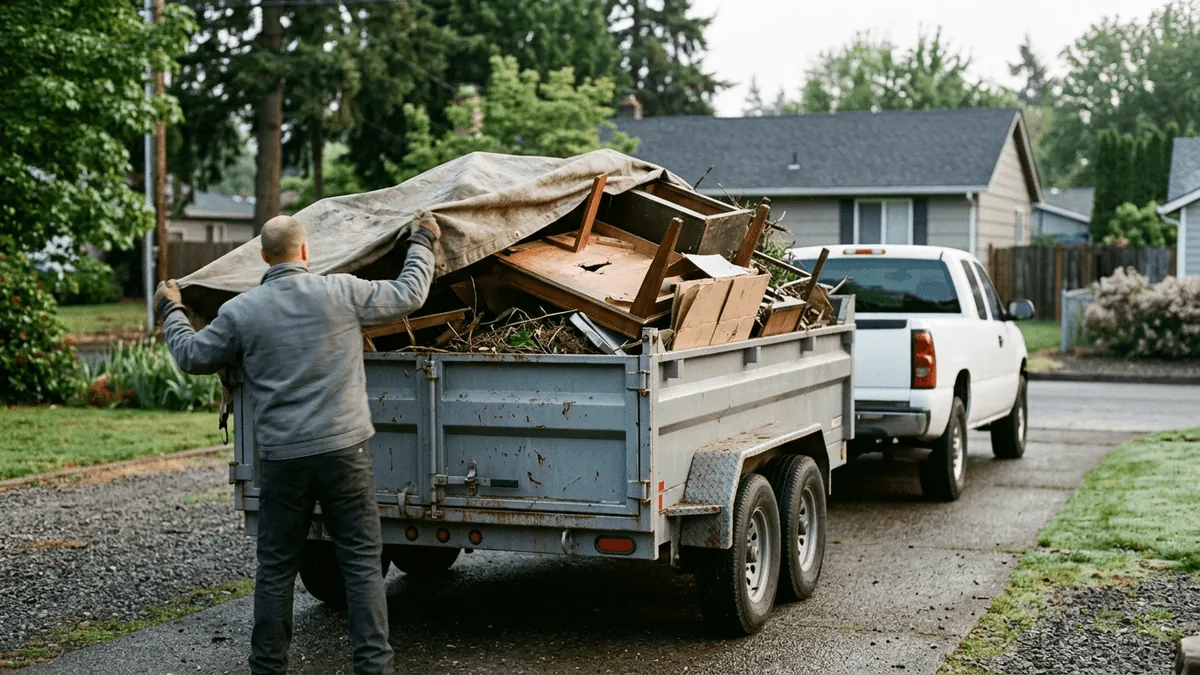
Most of how to start a junk removal business gets settled by the first purchase. A box truck on an Isuzu NPR chassis and a 7×14 dump trailer behind a heavy pickup differ on three things: the license rules in 49 CFR 383.91, how each one unloads, and what each one cost in the listings we read in November 2026.
Rig first. Our page on dump trailer financing covers hoist types, titles, and the four weight lines a trailer meets.
How a Junk Removal Business Earns Its Money
A junk removal business hauls unwanted items (furniture, appliances, yard waste, and renovation debris) out of homes and businesses, then pays a transfer station or landfill to take whatever a scrap yard or charity won’t. It bills the customer by volume, usually in fractions of a truckload. The scale bills it by weight.
Typical jobs:
- garage, basement, and estate cleanouts for homeowners
- renovation and demolition debris for remodelers who’d rather not haul it
- unit turnovers for property managers, and old desks from offices that are moving
Volume in. Weight out. A steel bed frame sells by the pound at a scrap yard, and a sound dresser can go to a charity pickup, so neither one adds to the scale ticket.
Sorting takes labor. Some loads repay it. Some don’t.
Box Truck or Dump Trailer First
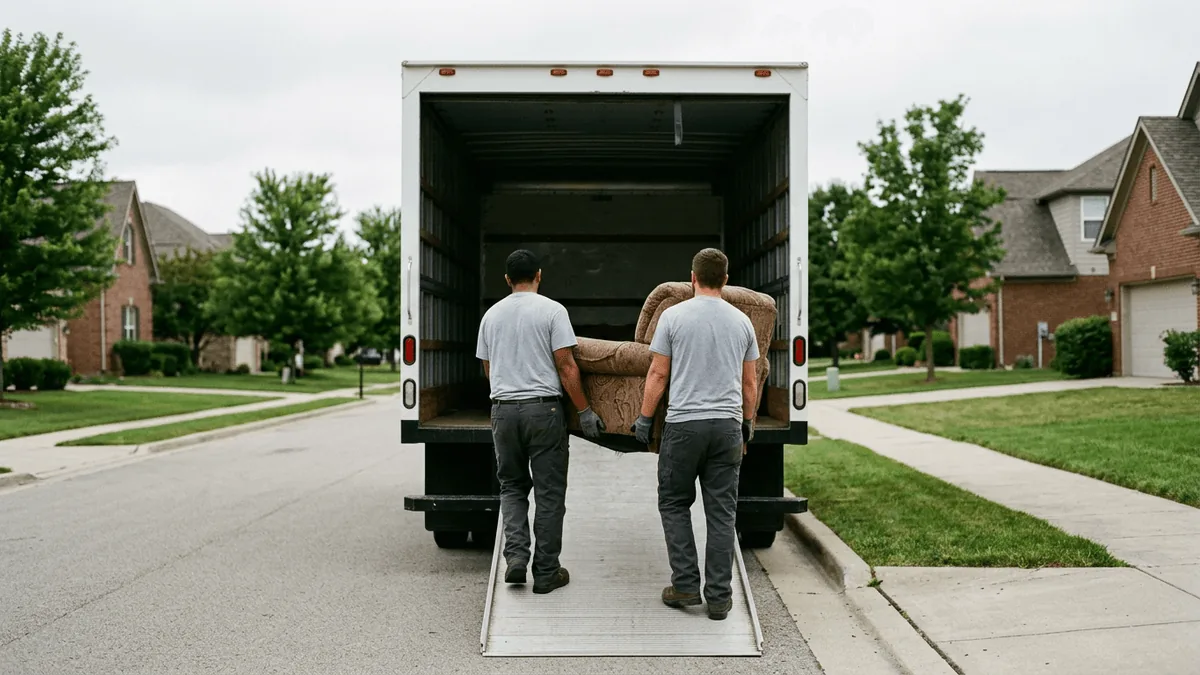
Two rigs cover most starts: a box truck, often a cabover like the Isuzu NPR with a 14- to 16-foot body, or a heavy pickup towing a dump trailer. Both load from the back. They unload very differently.
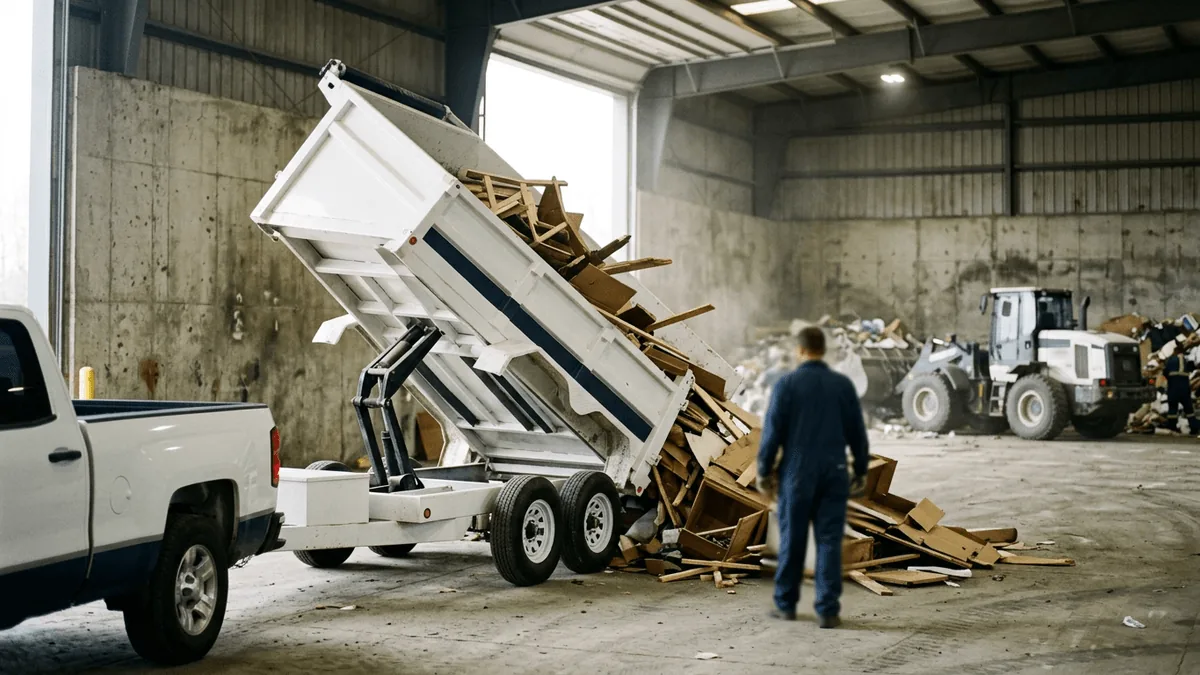
A dump trailer tips its load with a hydraulic hoist, so the crew spends little time on the tipping floor. No shoveling. A box truck gets emptied by hand unless it has a dump body, but it keeps a mattress dry in the rain and hides the load from the street. Trailer volume is simple arithmetic: 7 feet wide by 14 feet long with 4-foot sides is 392 cubic feet, about 14.5 cubic yards level full, and 2-foot sides hold half that.
Then there’s the license. Under 49 CFR 383.91, a single vehicle rated 26,001 pounds or more is a Group B commercial vehicle, and a combination rated 26,001 pounds or more is Group A whenever the towed unit is rated over 10,000 pounds. A 7×14 dump trailer on two 7,000-lb axles is typically rated 14,000 pounds. That’s over the line.
The combination’s rating, per the definitions in 49 CFR 383.5, is the greater of the number on the pickup’s certification label and the two vehicles’ GVWRs added together. A pickup rated 12,001 pounds or more, towing a 14,000-lb trailer, reaches 26,001. Group A. A 6×12 trailer rated 10,000 pounds or less never trips the trailer half of that rule.
Our rule of thumb: read both door stickers before you buy either vehicle. Add them up. If the total reaches 26,001 and the trailer is rated over 10,000, whoever drives it needs a Group A CDL, because a junk hauler’s rig is used in commerce.
| Box truck | Pickup + 6×12 trailer | Pickup + 7×14 trailer | |
|---|---|---|---|
| Unloads | By hand, unless it has a dump body | Hydraulic hoist | Hydraulic hoist |
| Towed rating | Nothing towed | 10,000 lb or less | Usually 14,000 lb |
| Group A CDL | No, at 26,000 lb or less | Not by the trailer rule | Yes, if the pair rates 26,001 lb or more |
| Weather | Enclosed | Open, tarped | Open, tarped |
| Good for | Furniture and cleanouts | Light loads, solo starts | Heavy debris, yard waste |
What the First Rig Costs in 2026
The guides ranking for this search quote junk removal startup costs as round ranges with nothing behind them. We read listings instead, on November 14, 2026. Asking prices, not sales. They move weekly.
On one national truck-listing feed, 91 used Isuzu NPR and NPR-HD box trucks carried a price, running from $8,900 to $61,155 with a median of $31,495. The median odometer read about 163,000 miles, on model years from 2009 to 2024.
Big spread. Miles and age explain most of it. Read the maintenance records before the price. For new box trucks, our box truck cost guide collects dealer figures.
Trailers are tighter. A South Carolina trailer dealer’s inventory page listed new 7×14 dump trailers rated 14,000 pounds at $9,280 to $11,580, depending on side height and hoist type, and its 6×12 units rated 9,950 to 10,000 pounds at $7,480 to $7,880. Two other dealers’ 7×14 listings we read on November 14 landed close to that band.
| Cost line | What moves it | What we found |
|---|---|---|
| Used box truck (Isuzu NPR, NPR-HD) | Miles, age, body, and liftgate | $8,900 to $61,155 asking; median $31,495 |
| New 7×14 dump trailer, 14,000 lb | Side height, hoist | $9,280 to $11,580 asking |
| New 6×12 dump trailer, 10,000 lb or less | Deckover or low profile | $7,480 to $7,880 asking |
| Pickup to tow it | GVWR, tow rating | Yours, or a separate buy |
| Insurance | Vehicle, crew, and state | An agent’s quote |
| Licenses | State, county, and city | Your state and city sites |
The tools are small next to the rig, and easy to forget:
- two furniture dollies and an appliance hand truck with straps
- moving blankets, so a dresser leaves the house without gouging a doorframe
- ratchet straps and a heavy tarp for the drive
- a reciprocating saw for the hot tub nobody can lift whole
- contractor bags, a flat shovel, and a push broom
- gloves, eye protection, and steel-toe boots for everyone on the crew
Where the Loads Go
Transfer stations and landfills weigh a loaded vehicle in and the empty vehicle out, then bill the difference against a posted price per ton. Prices differ by county. Before the first quote, call the nearest two or three and ask:
- what it refuses outright
- what it charges extra for, asked by name: tires, mattresses, electronics, and paint
- whether a new hauler needs an account or can pay at the scale house
Some loads skip the scale. Scrap steel sells by weight, charities schedule furniture pickups, and a working washer can sell on a local listing.
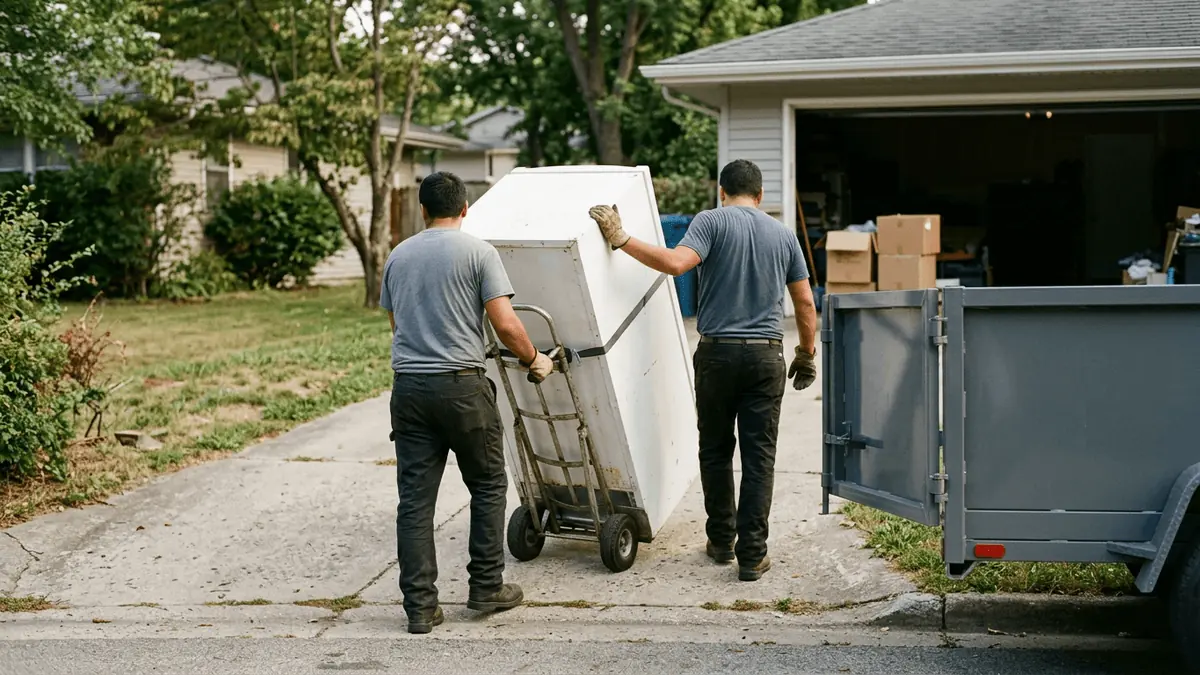
Appliances with refrigerant are federal territory. EPA’s appliance disposal page, last updated July 8, 2026, lists refrigerators, freezers, window air-conditioning units, and dehumidifiers as household appliances that historically held CFC and HCFC refrigerants. It assigns recovery of that refrigerant to the final disposer. When another party recovers it first, EPA requires a signed statement giving that party’s name and address and the recovery date.
The rule behind it is 40 CFR 82.155, which also has the final processor keep those statements on file. So the scrap yard asks the hauler. Decide early whether a certified technician recovers the refrigerant before the drop or the yard does it on site.
Paperwork Before the First Haul
The SBA’s launch checklist, updated August 28, 2026, puts the steps in this order:
- pick a business location (for a hauler, where the truck and trailer park overnight, which local zoning ordinances can limit)
- choose a business structure
- choose a name
- register the business
- get federal and state tax ID numbers
- apply for licenses and permits
- open a business bank account
- get business insurance
Two structures come up first for a one-truck hauler. In the SBA’s description, you’re a sole proprietorship by default once you do business without registering as anything else, while an LLC can “protect you from personal liability in most instances.” Ask an accountant which fits.
Licensing is local and layered:
- a state business registration
- a county or city business license
- in some cities, a separate permit to haul waste (the city clerk will know)
Insurance follows the rig. A titled truck needs a commercial auto policy with the trailer listed on it. General liability covers property damage at a customer’s home, and once you hire, your state’s workers’ compensation law applies.
Crew and Pricing for a Junk Removal Business
Most jobs need two people. A sleeper sofa doesn’t go down a staircase with one.
$18.38
Median hourly pay in 2025 for hand laborers and material movers, the federal job group that includes refuse and recyclable material collectors
Source: U.S. Bureau of Labor Statistics, Occupational Outlook Handbook, 2025
The Bureau of Labor Statistics counted 6,917,800 jobs for hand laborers and material movers in 2025 and put the group’s median pay at $38,220 a year. Your local wage, payroll taxes, and workers’ compensation premium sit on top of whatever figure applies where you hire.
Price sheets in this trade usually run in fractions of a truckload: an eighth, a quarter, a half, or a full load. Weight breaks that symmetry. A quarter load of asphalt shingles and a quarter load of patio chairs take the same space and get very different scale tickets. Run each fraction through four numbers before it goes on the website:
- the dump fee for what that fraction weighs, with heavy debris priced on its own line
- crew time, door to door
- fuel to the scale and back
- the rig’s monthly cost, spread over the loads you expect to haul in a month
Quoting and the first calls:
- quotes happen on site or from photos; photos save a drive and miss the piano behind the door
- real estate agents staging listings, property managers turning units, and remodelers between phases handle junk every week
- a truck that arrives when it said it would is its own advertising
Paying for the Truck or Trailer
We finance equipment. Weigh this accordingly. Simplest first:
- cash, for a low-end trailer behind a pickup you already own, which leaves no payment to cover while bookings build
- an equipment loan, which makes the business the owner from the start while it repays the lender
- a lease, which lets the business use the truck or trailer for a set term, then return it, renew, or buy it under the lease’s purchase option
- on a loan, the lender’s lien on a box truck or a titled dump trailer goes on the certificate of title under UCC 9-311, not into a UCC-1 filing, and on a true lease the title stays in the lessor’s name
No track record? Lenders commonly weigh:
- the owner’s personal credit history
- related experience in moving, driving, or demolition cleanup
- the truck or trailer as collateral
- a plan for the first jobs
Read next:
- how lenders review a new business, factor by factor
- box truck financing, for the enclosed rig
- starting a dump truck business, if hauling gravel for contractors appeals more than cleanouts
- dumpster financing, for adding roll-off containers once the trailer runs full
Questions Junk Haulers Ask Before Launch
Is there one license for hauling junk?
Usually three layers apply: a state business registration, a county or city business license, and in some cities a separate permit to haul waste.
- The driver also needs a CDL if the rig crosses the weight lines in 49 CFR 383.91.
- The city clerk can say whether haulers need their own permit.
Can a junk removal business start with no money at all?
No, because three bills come first: commercial auto insurance, a business registration, and dump fees at the scale.
- That holds even with a borrowed pickup and a rented trailer.
- Some owners start on weekends with what they already have and buy a rig once bookings are steady.
How long before the first paid haul?
As long as three offices take: the state’s business registry, the city or county licensing desk, and the insurer quoting the specific truck or trailer.
- Get insurance quotes on the exact vehicle before you buy it, since the vehicle changes the premium.
- Have a mechanic inspect a used truck before you count on it.
Does a junk removal franchise cost less to start?
Item 7 of a franchisor’s Franchise Disclosure Document answers that for any one brand, because 16 CFR 436.5 requires a table titled “Your Estimated Initial Investment.”
- Under 16 CFR 436.2, the franchisor has to hand you that document before you sign or pay.
- Put its Item 7 next to your own independent estimate, line by line, and see what the brand and the system cost on top of the same truck.
What happens to a refrigerator after you haul it away?
Its refrigerant has to be recovered before it’s scrapped or landfilled, and EPA puts that duty on the final disposer.
- When someone else recovered it, the yard can ask for a signed statement with that person’s name, address, and the recovery date.
- Call the yard before you load one.
What do lenders look at when the hauling business is brand new?
Lenders commonly review four things on a new business: the owner’s personal credit history, related work experience, the truck or trailer as collateral, and the plan for the first jobs.
- Each lender weighs those differently.
- None of them settles the answer on its own.
Before You Buy the First Rig
Settle the order before the purchase: the rig and its weight ratings, the transfer station and the scrap yard, the paperwork, and the price sheet. Then buy. When a dump trailer is the pick, talk to us about a dump trailer, or go back to the box truck page above if an enclosed body suits your loads better.