
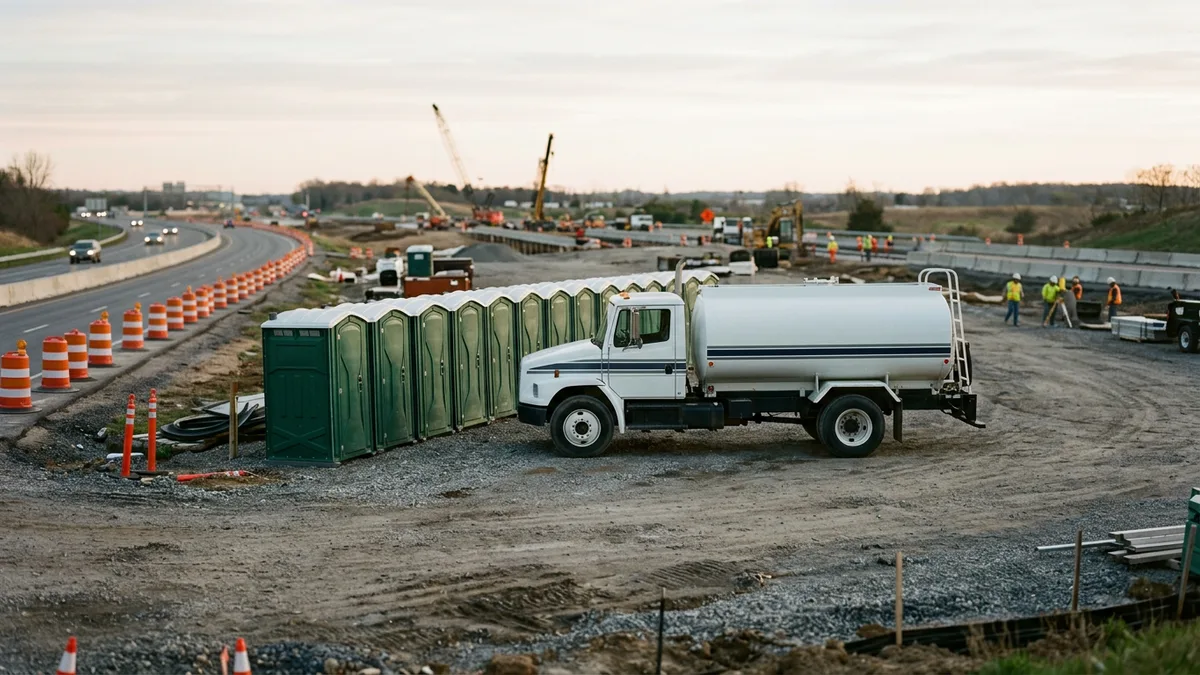
How to Start a Portable Toilet Business: Planning Units, Service Trucks and Trailers

Key takeaways
How to start a portable toilet business, in order: line up a place to dump the waste, buy the service truck, size the units from a contract’s headcount, and add restroom trailers last.
- OSHA’s Table D-1 turns a contract’s headcount into a unit count: one toilet for 20 workers or fewer, then one seat and one urinal per 40.
- Tanks totaling 1,000 gallons or more make a truck a “tank vehicle” in the federal rules. A 300-gallon slide-in never gets there.
- Portable toilet waste counts as domestic septage under 40 CFR 503.9, so the dump site comes before the truck.
- A PolyJohn PJN3 with a urinal was listed at $1,560.79 at one retailer on November 17, 2026.
- Trailers come last: the lowest price on one dealer’s 1-2 station page equals about 21 of those units.
On November 17, 2026, one retailer listed a PolyJohn PJN3 portable toilet with urinal at $1,560.79. The toilet’s the cheap part. The truck that empties it, the dump site that takes the waste, and the contract that sets the count are the business.
Our page on equipment financing by industry shows where this trade sits beside the others a new company might enter. The order below follows the work: dump site, truck, units, then trailers.
What a Portable Sanitation Company Does
A portable sanitation company rents self-contained toilets, handwash stations, and restroom trailers to job sites and events, then services them on a schedule. Each service visit has the same parts, and each customer type sets a different count.
A service visit:
- pump the waste out of the holding tank
- refill the fresh water and the chemicals
- restock paper and supplies
Customers:
- a road-construction contractor with a crew on one stretch of highway for a season
- a festival, a fair, or a race weekend, where a crowd shares the units for a day or two
- a city or county parks department with units placed for the whole season
The contractor is the one who can hand you a headcount and a schedule. That sizes the first order.
Standard Units, ADA Units and Restroom Trailers
A standard unit is the plastic box people mean by “porta potty.” PolyJohn’s PJN3 page lists a 60-gallon holding tank, a 91-inch exterior height, and a 165-pound plastic skid base.
The ADA version on PolyJohn’s line is the We’ll Care III. The 2010 ADA Standards handle clusters of single-user portable units in section 213.2, exception 3, and each unit built to section 603 carries the International Symbol of Accessibility.
Trailers are another machine. PolyJohn’s 2-Stall Trailer is 7.5 by 12 feet with a 100-gallon fresh-water tank and a 300-gallon wastewater tank, which is five PJN3 holding tanks of waste in one body.
| Standard unit | Restroom trailer | |
|---|---|---|
| Example | PolyJohn PJN3 | PolyJohn 2-Stall Trailer |
| Waste tank | 60 gal | 300 gal |
| Size | 91 in tall, 47 in long | 7.5 by 12 ft |
| Getting it there | Loaded on a truck or trailer | Towed |
| Price listed | $1,560.79 at one retailer | $32,880 to $83,370 on one dealer’s page |
Both prices were read on November 17, 2026. The industrial supplier GoVets listed the PJN3-1008 with urinal at a $1,560.79 special price against a $2,185.11 regular price. PolyJohn’s own product pages carry quote buttons instead of prices.
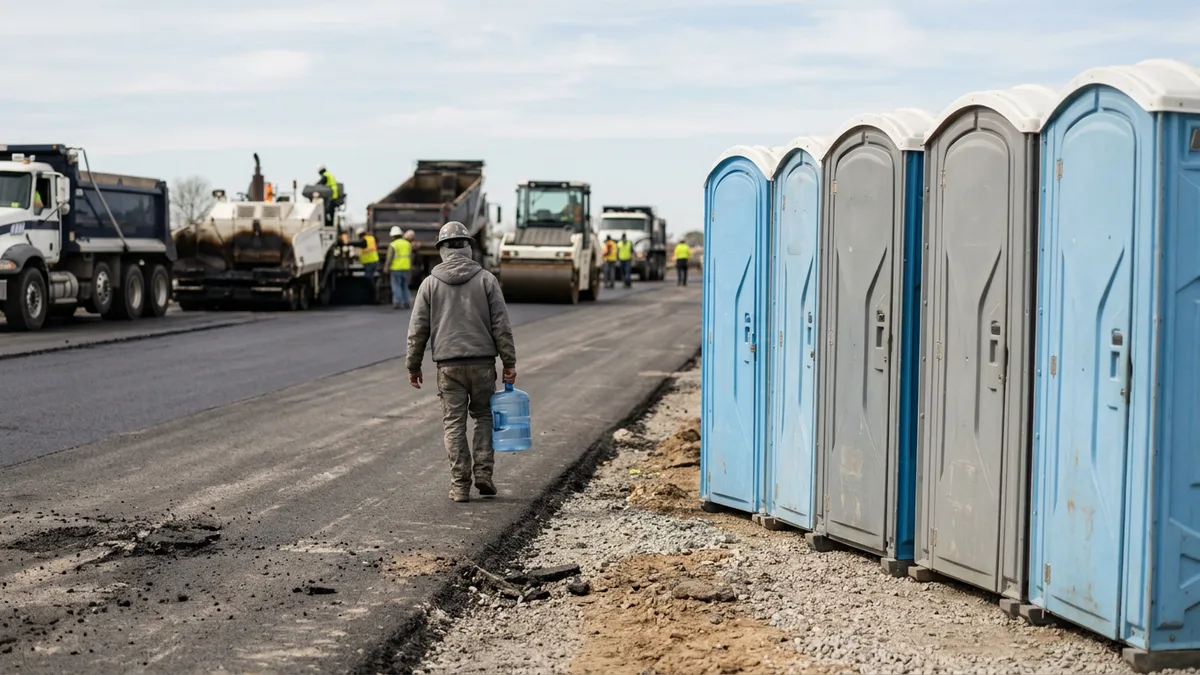
Size a Portable Toilet Business From One Contract
Table D-1 in 29 CFR 1926.51(c), the Occupational Safety and Health Administration’s rule on toilets at construction jobsites, reads:
- 20 employees or fewer: 1 facility
- 20 or more: 1 toilet seat and 1 urinal per 40 workers
- 200 or more: 1 toilet seat and 1 urinal per 50 workers
| Workers on site | Table D-1 line | Straight division |
|---|---|---|
| 15 | One facility | 1 |
| 85 | Per 40 workers | Just over 2 |
| 240 | Per 50 workers | Just under 5 |
A straight division leaves a remainder, and a remainder is a worker without a toilet. Plan the next whole unit. That’s 1 for the 15-person crew, 3 for the 85, and 5 for the 240.
Three limits:
- The table is a floor for the employer, not an order size, and a contract’s bid documents can ask for more.
- Under (c)(3), a site with no sanitary sewer may use chemical toilets unless local codes prohibit them.
- Under (c)(4), mobile crews with transportation to nearby toilets are exempt.
Ask the contractor:
- the peak headcount, which sets the units
- the months on site, which set how many service visits the truck makes
Read next:
- starting an equipment rental business, for the same per-unit math on rented machines
The Service Truck and the Weight Lines
A slide-in vacuum tank rides in the bed of a heavy pickup. A truck-mounted tank is built onto the chassis. The slide-in costs far less and holds far less. Tank size is the trade.
Federal rules draw two lines through that choice. Under 49 CFR 383.5, a tank vehicle has tanks with an individual rated capacity above 119 gallons and an aggregate rated capacity of 1,000 gallons or more, and 49 CFR 383.93 puts the tank endorsement on the commercial driver’s license (CDL) of anyone who drives one. A 300-gallon slide-in stays under that aggregate line. Weight is the other line: a single vehicle rated 26,001 pounds or more is Group B under 49 CFR 383.91, the same threshold we walk through on our page about starting a junk removal business.
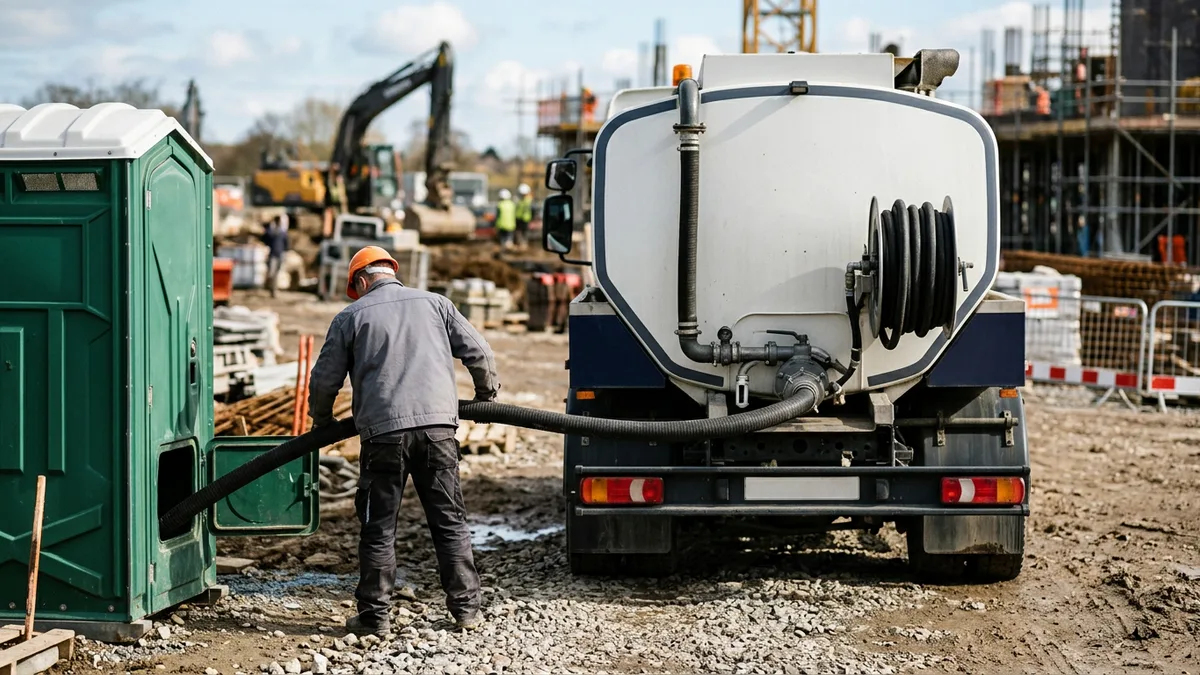
Ask the dealer:
- the waste and fresh-water tank sizes, listed separately
- pump hours, and the service records behind them
- the chassis rating on the door label, added to anything it tows
- whether the tank has had weld repairs, and who did them
Prices swing with the chassis, the tank, and the pump, so each quote should arrive as a written spec.
Where the Waste Goes
Federal rules have a name for it. Under 40 CFR 503.9, domestic septage is material removed from a septic tank, cesspool, portable toilet, or similar works that receive only domestic sewage, and the same section counts domestic septage as sewage sludge. EPA’s page on sewage sludge laws and regulations calls Part 503 self-implementing, so its standards apply whether or not a permit exists.
In practice, nothing gets pumped until someone has agreed to take what comes out of the tank, so the first call goes to the nearest wastewater utility or receiving station, before any truck is bought.
Ask the utility:
- whether it takes portable toilet waste at all, or only septic tank loads
- its receiving hours, and whether a driver needs an account or a permit to unload
- what paperwork rides with each load
- how far it sits from your first work zone, since every route ends there
PSAI, the Portable Sanitation Association International, offers a free whitepaper on septage disposal challenges on its home page, produced with the National Septage Disposal Crisis Alliance Task Force.
Why Trailers Come Last
A restroom trailer serves a different kind of booking, such as an event or a job site that asks for one by name.
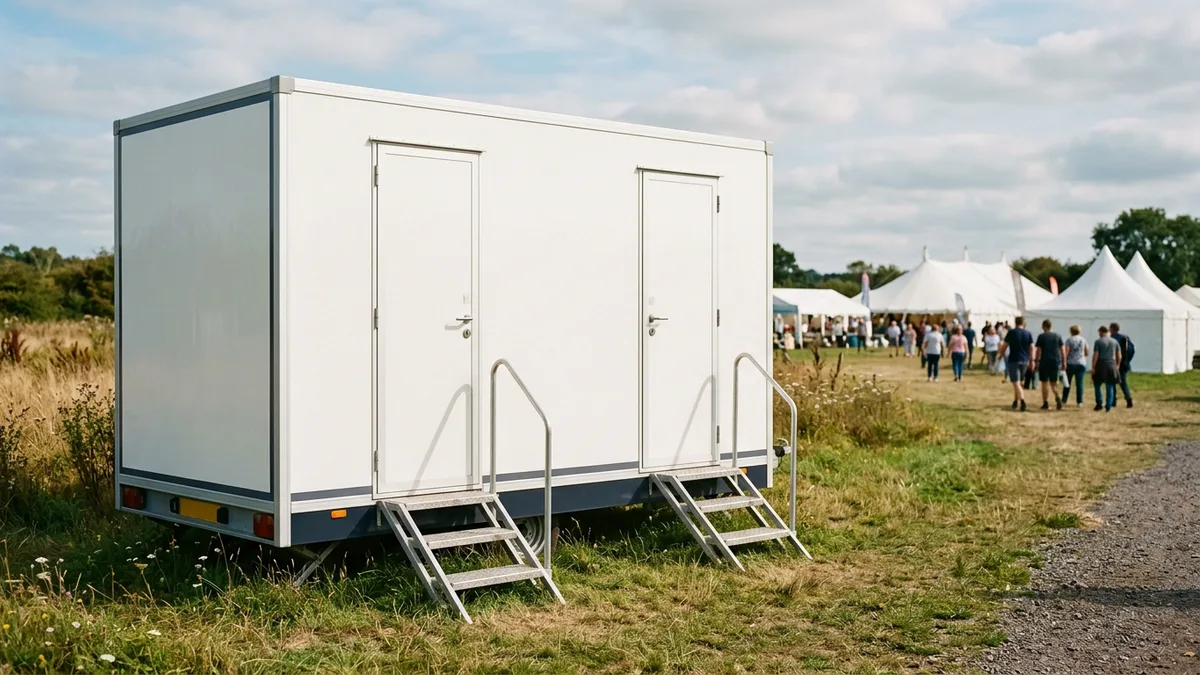
$32,880
The lowest trailer price on one dealer’s 1-2 station page, read November 17, 2026. The highest listing was $83,370.
Set that beside the retailer’s PJN3 and the arithmetic is blunt. The lowest trailer on that page costs about what 21 units do at the $1,560.79 special price, or about 15 at the $2,185.11 regular price.
So buy the first trailer against a named booking, with dates, not against a hunch. An idle unit is a small problem. An idle trailer isn’t.
Read the trailer’s weight rating against the tow vehicle’s before you buy either, using the same federal lines as above. Our page on trailer financing goes through titles, leases, and the weight labels on trailers a business tows.
Training, Permits and Insurance
PSAI’s certification program, as its page reads on November 17, 2026:
- Certified Portable Sanitation Professional: 2,000 or more hours of front-line experience
- Certified Portable Sanitation Apprentice: fewer hours than that
- valid for three years before renewal
- training is optional unless a state or county requires it, and the page names Illinois and Georgia as examples
- regulators are linked for fourteen states
The SBA’s launch checklist sets this order:
- location, which for a hauler means where the truck and units park between jobs
- structure
- name
- registration
- tax IDs
- licenses and permits
- a bank account
- insurance
Insurance follows the work:
- a commercial auto policy for the truck
- general liability for units sitting on a customer’s property
- whatever the dump site requires from a hauler
Paying for the First Truck and Units
We finance equipment, so weigh this section with that in mind.
- cash buys a slide-in with no payment to cover while bookings build
- an equipment loan makes the business the owner while it repays the lender
- a lease lets the business use the equipment for a set term, then return it, renew, or buy it under the lease’s purchase option
- a lien on a titled truck or trailer goes on the certificate of title under UCC 9-311, while untitled units take a UCC-1 filing, because UCC 9-310 requires one to perfect most security interests
Ask any lender:
- whether an agreement can be paid off early, and how the payoff is figured
- whether the truck and the units sit on one agreement or several
Common Questions Before the First Order
How many units does a new company actually need?
OSHA’s Table D-1 sets one toilet for a crew of 20 workers or fewer.
- Above that, it adds one seat and one urinal per 40 workers.
- At 200 workers or more, the table moves to one per 50.
- A contract can ask for more than the table does.
- Events and parks aren’t construction jobsites, so Table D-1 doesn’t set their count.
Does driving the service truck take a CDL?
Sometimes. The weight rating decides first, then the tank size.
- A single vehicle rated 26,001 pounds or more is Group B under 49 CFR 383.91.
- Tanks totaling 1,000 gallons or more make it a tank vehicle, which brings the tank endorsement on a CDL.
- A pickup with a 300-gallon slide-in sits under the tank line, and its weight rating still has to be read.
Where does the waste go after a unit is pumped?
40 CFR 503.9 counts portable toilet waste as domestic septage.
- The same section counts domestic septage as sewage sludge.
- The nearest wastewater utility or receiving station can say what it accepts.
- Ask before you buy the truck, not after.
Is a restroom trailer a different business from standard units?
Close cousins, with different budgets.
- PolyJohn’s 2-Stall Trailer carries a 300-gallon wastewater tank, against 60 gallons in a PJN3.
- One dealer’s trailer listings run $32,880 to $83,370, against $1,560.79 for one retailer’s PJN3.
- Trailers are towed, so the weight lines apply to the tow vehicle too.
Do states license portable sanitation haulers and technicians?
PSAI’s certification page links regulators in fourteen states.
- It names Illinois and Georgia as states where training can be required.
- A county or city can add its own permit for hauling waste.
- Check the state before the county.
What do lenders look at when a sanitation company is brand new?
Lenders commonly review four things on a company with no history.
- The owner’s personal credit history.
- Related work experience, in sanitation, hauling, or construction.
- The truck and units as collateral.
- Paperwork on the work lined up, such as a contract or an event booking.
Next Steps
Buy in order. Dump site, truck, units sized from a contract, and a trailer only against a named booking. When the truck or the first batch of units is next, our page on how lenders review a new business lists what to line up, or you can start an application.