
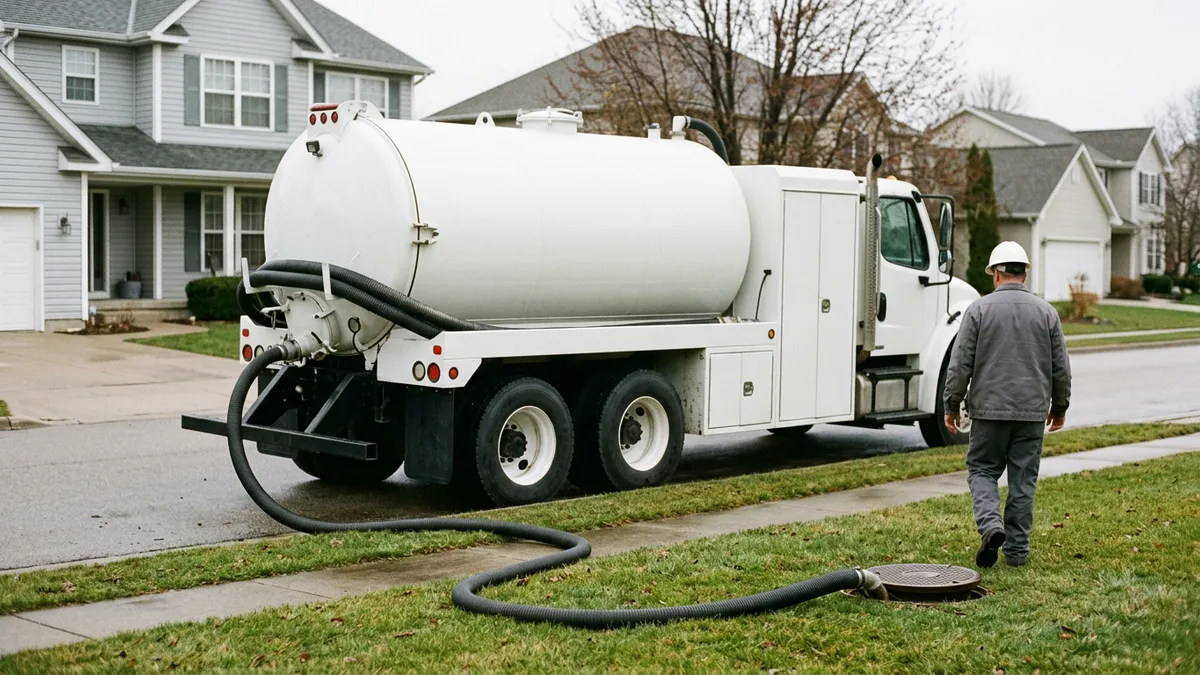
How Much Does a Septic Truck Cost? Budgeting for a Vacuum Truck by Tank Size

Key takeaways
How much does a septic truck cost? On November 19, 2026, one Miami dealer asked $145,000 to $175,000 for new 2,500-gallon trucks and $78,000 to $96,000 for used ones.
- Tank size sets the steps: new 2,000-gallon trucks asked $132,000 to $157,000, new 5,000-gallon trucks $236,000 to $281,500.
- Per gallon, the big tank costs less. A used 2,500-gallon truck ran about $33 a gallon at the median, a used 4,000-gallon truck about $31.
- Steel or aluminum? $12,000 to $20,000 apart in four matched pairs.
- A slide-in unit with no truck under it asked $16,000 to $26,500.
- Tax, delivery, and registration sit outside the asking price.
So how much does a septic truck cost? Say a pumping company is pricing a second truck, and the first number a dealer quotes is for a 2,000-gallon tank, while the 5,000-gallon truck sits more than $100,000 above it. We read three dealers’ inventory pages in one day and tied every figure to its seller. For axles and paperwork, our septic truck financing page picks up where this one stops.
We finance equipment, which colors how we read a price list, and none of this is a quote.
What a Septic Truck Price Covers
A septic truck price covers three parts a dealer prints as one number: a cab and chassis, a tank bolted behind the cab and sized in gallons, and a vacuum pump that pulls septage into it, measured in cubic feet per minute.
- The chassis moves the number by maker and year.
- The tank moves it by size and metal.
- The pump moves it by make.
New Septic Truck Cost by Tank Size
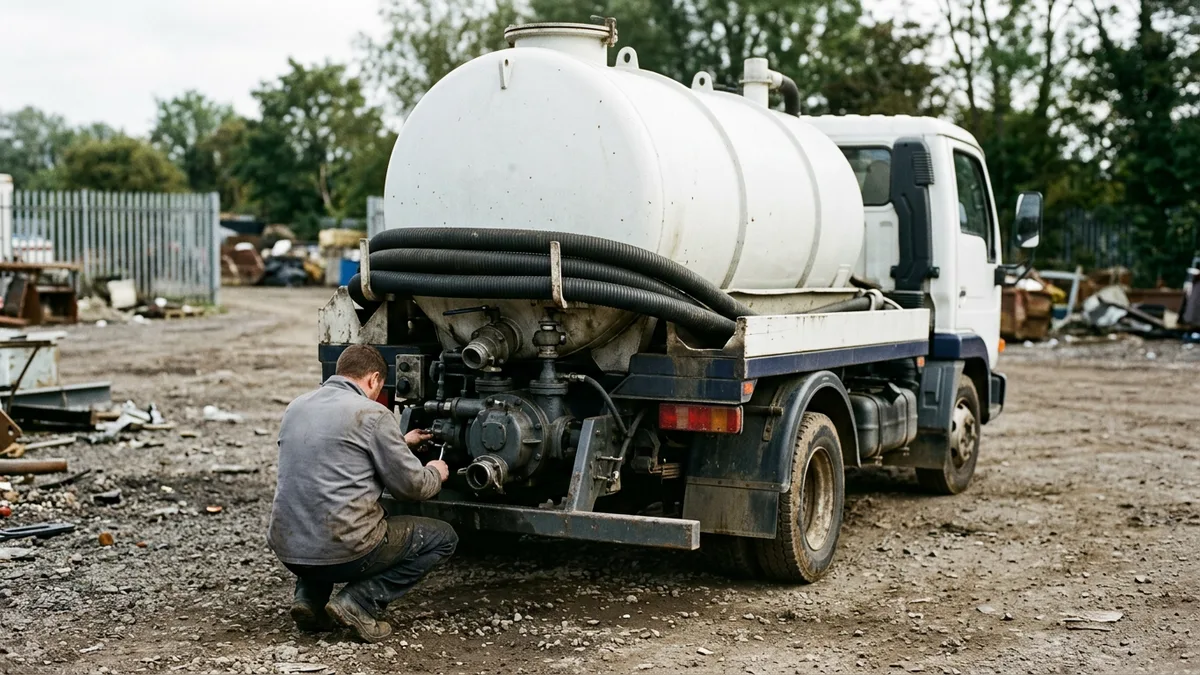
National Truck Center, a dealer in Miami, Florida, lists its whole vacuum truck inventory on one page, and on November 19, 2026 that page held 77 trucks. Forty-four were new, model years 2026 to 2028, with 12 to 21 miles each.
| Tank size | Asking prices (listings) | Median |
|---|---|---|
| 1,200 gallons | $132,000 to $135,000 (3) | $132,000 |
| 2,000 gallons | $132,000 to $157,000 (9) | $145,000 |
| 2,500 gallons | $145,000 to $175,000 (15) | $160,000 |
| 4,000 gallons | $200,000 to $239,600 (4) | $221,500 |
| 4,200 gallons | $219,000 to $262,000 (4) | $244,000 |
| 5,000 gallons | $236,000 to $281,500 (9) | $258,000 |
Look at the 2,500-gallon row. Fifteen trucks and $30,000 between the lowest ask and the highest. The $145,000 truck is a 2027 Mack MD7 with a steel tank and a Masport Titan pump, and the $175,000 truck is a 2027 Mack MD7 with an aluminum tank and an NVE B500 blower.
SepticTrucks.com, the Iron-Vac truck sales site, tells the same story. Its 2026 Freightliner M2 with a 2,100-gallon aluminum tank asks $159,931. Its 2025 Peterbilt 548 with a 4,200-gallon steel tank asks $228,995, and its 2027 Peterbilt 548 with 4,200 gallons of aluminum asks $246,470.
Dealer three undercut the first. Rody Truck Center, also in Miami, asked $125,000 for a 2027 Freightliner M2 with a new 2,000-gallon tank, a new pump, and 4,000 miles on the chassis, which sits $7,000 under National Truck Center’s $132,000 floor for new 2,000-gallon trucks. Get two quotes.
Used Septic Truck Cost and Mileage
The used trucks on that same page are all 2019 and 2020 chassis. We counted 33. Miles ran 114,151 to 247,845.
| Tank size | Asking prices (listings) | Median |
|---|---|---|
| 2,000 gallons | $75,000 to $94,000 (7) | $80,000 |
| 2,500 gallons | $78,000 to $96,000 (8) | $82,000 |
| 3,600 gallons | $100,000 to $114,000 (8) | $110,000 |
| 4,000 gallons | $112,000 to $126,000 (7) | $124,000 |
| 4,200 gallons | $134,000 (1) | $134,000 |
| 5,000 gallons | $130,000 to $152,000 (2) | $141,000 |
Miles don’t set the price. Two 2020 Freightliner M2 trucks carry 2,500-gallon steel tanks and the same Masport Titan pump, and the one with 114,151 miles asked $89,000 while the one with 197,941 miles asked $82,000. That’s $7,000 for 83,790 miles.
Older and bigger can cost less still. Rody Truck Center asked $58,000 for a 2009 International 7400 with a 4,100-gallon tank, a dump system, and 330,000 miles. SepticTrucks.com asked $94,892 for a 2016 Freightliner M2 with a 2,100-gallon steel tank and 95,000 miles, which is more than seven of the eight used 2,500-gallon trucks National Truck Center listed that day. The chassis ages by miles, while the tank and the pump keep their own calendars, and our septic truck financing page explains how to check them apart.
Price per Gallon of Tank
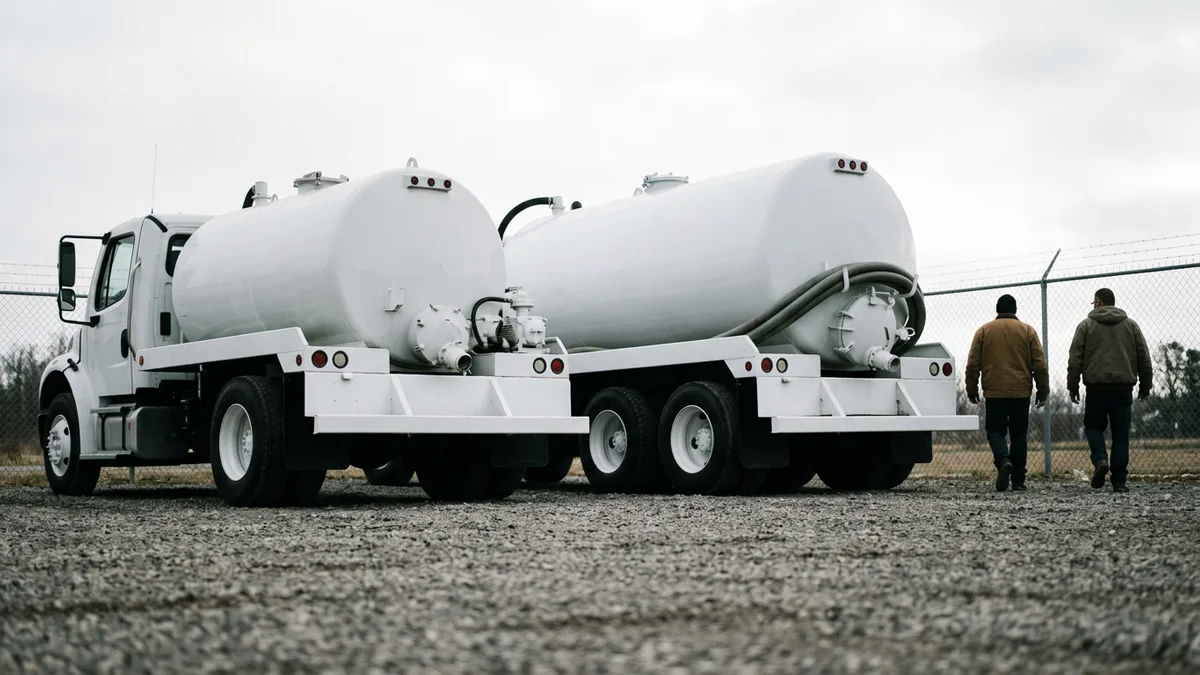
Divide a truck’s asking price by its tank and a pattern shows. These are the medians from the two tables above.
| Tank size | New, per gallon | Used, per gallon |
|---|---|---|
| 2,000 gallons | $73 | $40 |
| 2,500 gallons | $64 | $33 |
| 4,000 gallons | $55 | $31 |
| 5,000 gallons | $52 | $28 |
The big tank costs less per gallon. The cab, the engine, and the pump get bought once whatever the tank holds, though a bigger tank usually wants a bigger chassis, and that’s where the axle limits on our septic truck financing page come in.
The dealer shows it directly. One 2020 Freightliner M2 with 171,564 miles is listed twice, at $114,000 with a 3,600-gallon tank and at $126,000 with a 4,000-gallon tank. Four hundred gallons for $12,000. Thirty dollars a gallon.
The rule is to price the tank you need, not the truck you can find. Extra gallons cost less than the first ones, but they only pay when the route fills them, so count the stops on your own route before you count the gallons.
Steel, Aluminum, and the Pump
Metal is a second step. In each pair below the chassis, tank size, and pump match, and only the tank’s material changes.
| Truck and tank | Steel | Aluminum |
|---|---|---|
| 2020 International MV, 2,000 gallons | $80,000 | $94,000 |
| 2020 International MV, 2,500 gallons | $80,000 | $96,000 |
| 2027 Mack MD7, 2,000 gallons | $145,000 | $157,000 |
| 2026 Mack Granite, 5,000 gallons | $244,000 | $264,000 |
Aluminum adds $12,000 to $20,000 in these four pairs, and the biggest tank carries the biggest gap.
Pumps move it less. They’re steady, though.
$3,000
What National Truck Center asked on November 19, 2026 for an NVE B500 blower in place of a Masport Titan pump, in all four matched pairs of new Mack MD6 and MD7 trucks
Slide-Ins and Trailers
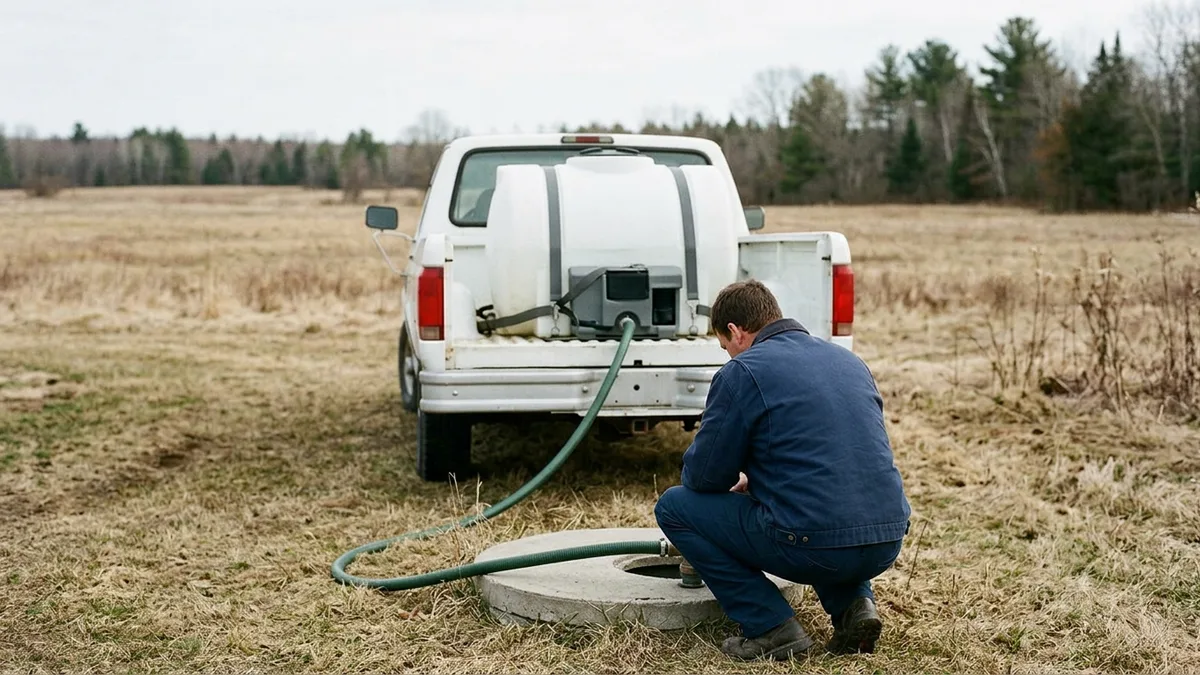
Some jobs need no truck. The same dealer also lists slide-in vacuum units, the kind that sit in a truck bed, and it showed ten of them on November 19. Sizes ran from 300 to 1,200 gallons, and asking prices ran $16,000 to $26,500. A 1,000-gallon slide-in at $21,500 works out near $22 a gallon.
Three 1,000-gallon trailer units asked $32,000 each. A new Ford F-550 carrying 1,200 gallons asked $132,000 to $135,000, which is the small end of the truck table above. The 26,001-pound CDL line and the axle limits behind it are covered on our page about how tank size follows the axles.
What the Asking Price Leaves Off
- The federal excise tax. Internal Revenue Code section 4051, as read in November 2026, puts 12 percent of the sale price on the first retail sale of a truck chassis and body, except one suited to a gross vehicle weight of 33,000 pounds or less. Ask the dealer whether the truck crosses that line. Consult your tax advisor on how it applies to your purchase.
- Delivery, quoted as its own figure.
- Registration. Your state decides what the truck, and in some states the tank’s capacity, needs on file.
- The pump’s service records and the tank’s inspection history. They cost nothing and tell you the most.
- Chassis, tank, and pump on three separate lines of the quote, so each price can be checked on its own. Our used equipment financing page covers how a lender weighs a machine with a past owner.
Budgeting the Truck Against the Route
Start with the route. Say one tank clears two stops before the drive to the disposal site, and a bigger tank clears three. Those are different trucks at different prices, and the per-gallon table says which extra gallons cost the least.
Used is the other lever. In the same inventory, used 2,500-gallon trucks asked about half what new ones did, $82,000 at the median against $160,000. Half the price buys a chassis with 114,151 to 197,941 miles and a tank and pump of unknown age. Ask for both service histories.
One more disclosure. We finance equipment, so read this section with that in mind, and no payment, rate, or term appears anywhere on this page. The ways to pay:
- Cash keeps the title clean and drains the account.
- A loan or equipment finance agreement makes the truck yours from delivery, with the lender’s lien on the title until payoff.
- A fair market value lease ends with a choice: return it, renew it, or buy it at what it’s worth then.
- A $1 buyout lease is built so the truck stays with the business for a nominal amount.
For another truck priced the same way, read our dump truck price guide. If the truck is for a portable toilet route, starting a portable toilet business covers the units and the service truck.
Questions Buyers Ask Before Pricing a Vacuum Truck
So does a bigger tank cost more per gallon or less?
Less, in these listings. Used 2,500-gallon trucks asked about $33 a gallon at the median on November 19, 2026, and used 4,000-gallon trucks about $31.
Is a steel tank or an aluminum one the better buy?
Aluminum asked $12,000 more on a 2027 Mack MD7 with 2,000 gallons and $20,000 more on a 2026 Mack Granite with 5,000.
- The pairs share a chassis, a tank size, and a pump.
- Only the tank’s metal changes.
- How each metal wears is a question for your dealer.
What does the dealer’s asking price leave out?
Twelve percent, possibly. Internal Revenue Code section 4051 puts that share of the sale price on the first retail sale of a truck chassis and body suited to a gross vehicle weight over 33,000 pounds, so ask the dealer, and consult your tax advisor.
- Delivery, quoted as its own figure.
- Whatever your state requires to register the truck.
Can a slide-in tank do a truck’s job?
Sometimes.
- The ten slide-ins we saw held 300 to 1,200 gallons and asked $16,000 to $26,500.
- A new Ford F-550 carrying 1,200 gallons asked $132,000 to $135,000.
What should be on the quote before you compare two septic trucks?
Three prices, one for each part: the chassis, the tank, and the pump.
- The tank’s maker and serial number.
- The pump model.
- The chassis VIN.
- Delivery, as its own figure.
Should a pumping company pay cash or finance a septic truck?
Each one trades something: cash empties the account, and financing spreads the cost across an agreement.
- A lender sets its own terms, and nothing here is a quote.
- We finance equipment, so weigh that.
- See how a lender reads a vacuum truck before you decide.
Next Steps
- Read how commercial vehicle financing covers the rest of a vocational fleet.
- Gather the paperwork early with what to prepare before you apply.
When you’re ready, start an application.