
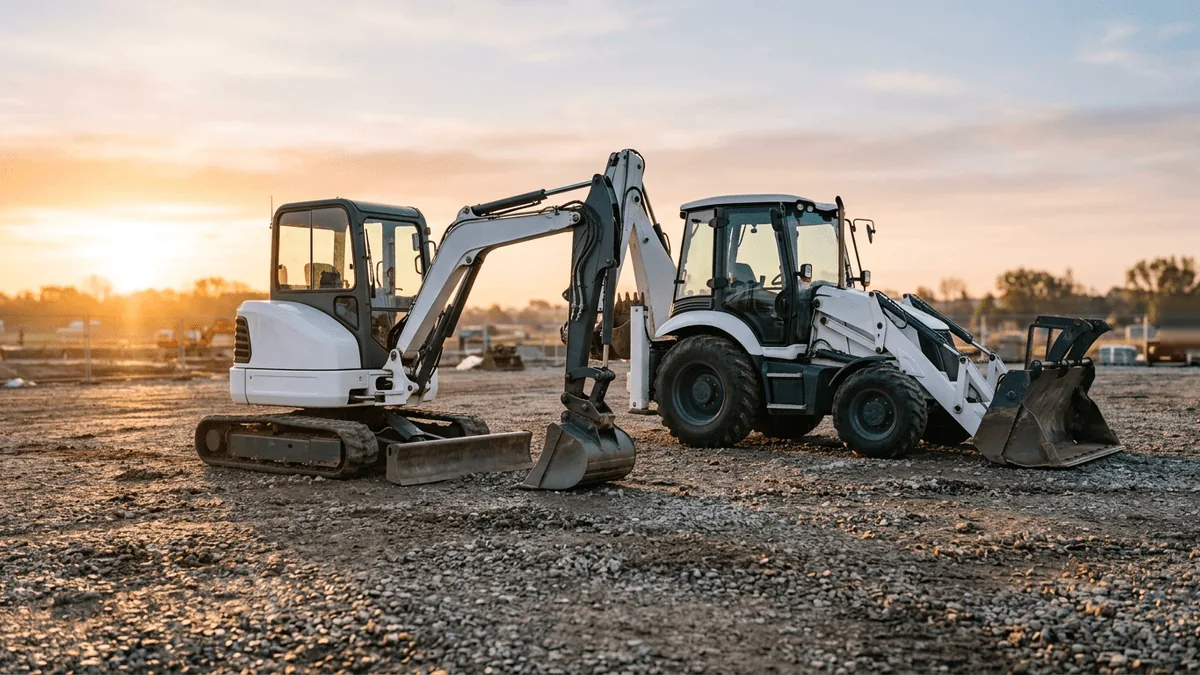
Mini Excavator vs Backhoe: Choosing for Small Crews and Tight Sites

Key takeaways
The mini excavator vs backhoe choice comes down to where the machine works: a mini excavator digs in tight spots, while a backhoe digs, loads, and drives itself between sites.
- Start with the gate. One backhoe sheet prints 11 ft 7 in of width with the stabilizers set.
- Road speed is the backhoe’s edge, and a compact excavator rides a trailer to the next job.
- A backhoe digs and loads, never at the same moment, from a 180-degree arc.
- Count the crew’s day by place, not by task, then buy for the biggest block.
Eleven feet, seven inches. That’s the overall width one published backhoe loader sheet prints once its stabilizers are set, against 69.7 inches for the whole body of a compact excavator. Both machines dig a hole. They don’t ask the same thing of the lot.
This post reads the printed sheets for two backhoe loaders and one compact excavator. It builds a rule from the numbers, for crews buying in heavy and construction equipment. We finance equipment, so weigh the paying section with that in mind. The rest holds for a cash buyer too.
Mini Excavator vs Backhoe: What Each Machine Is
A mini excavator is a compact, usually tracked digging machine whose cab, boom, and bucket rotate on top of the undercarriage, so the tracks stay put while the bucket works. A backhoe loader is a wheeled tractor with a loader bucket in front and a digging arm on the back, so one operator digs, loads, and drives it between sites.
Vendor pages call it specialist versus all-rounder. The sheets are blunter. One machine is a digging arm on a rotating cab. The other shares a single frame between a loader and a digging arm, and that frame sets the width, the swing, the road speed, and the way it gets to the next job.
Mini Excavator vs Backhoe on a Tight Site
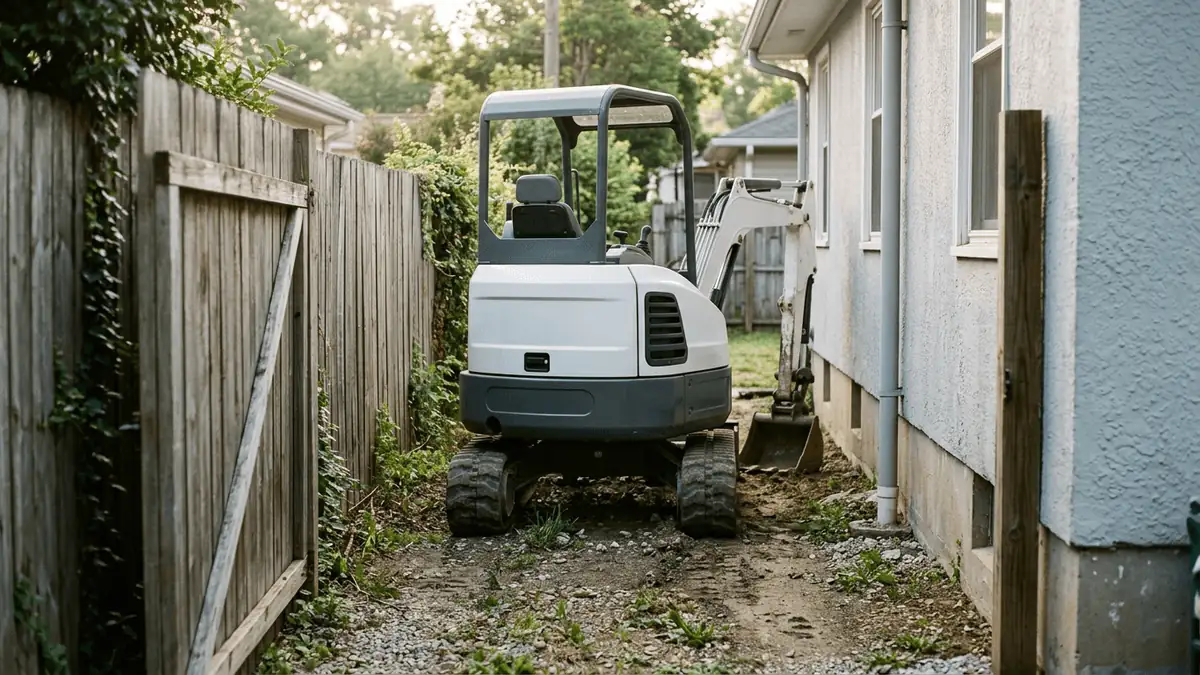
Start with the gate. The 2023 backhoe loader sheet prints 7 ft 3 in (2.20 m) over the tires, and a second sheet, dated March 2026, prints 7 ft 5 in overall. The compact excavator’s page prints 69.7 inches, about 5 ft 10 in, with a tail overhang of 0 inches. That’s about a foot and a half of difference. Then the stabilizers go down.
11 ft 7 in
overall operating width of a backhoe loader with its stabilizers set, on a sheet that lists 7 ft 3 in over the tires, 2023
Source: A maker’s published specifications for a backhoe loader, 2023
The backhoe grows. The same sheet lists a 10 ft 2 in operating spread and an 11 ft 7 in overall operating width, nearly twice the compact excavator’s 69.7 inches. Then comes the swing. The backhoe sheet prints a swing arc of 180 degrees, half a circle behind the machine. The compact excavator’s page describes unrestricted rotation, so the cab turns all the way around while the tracks stay planted.
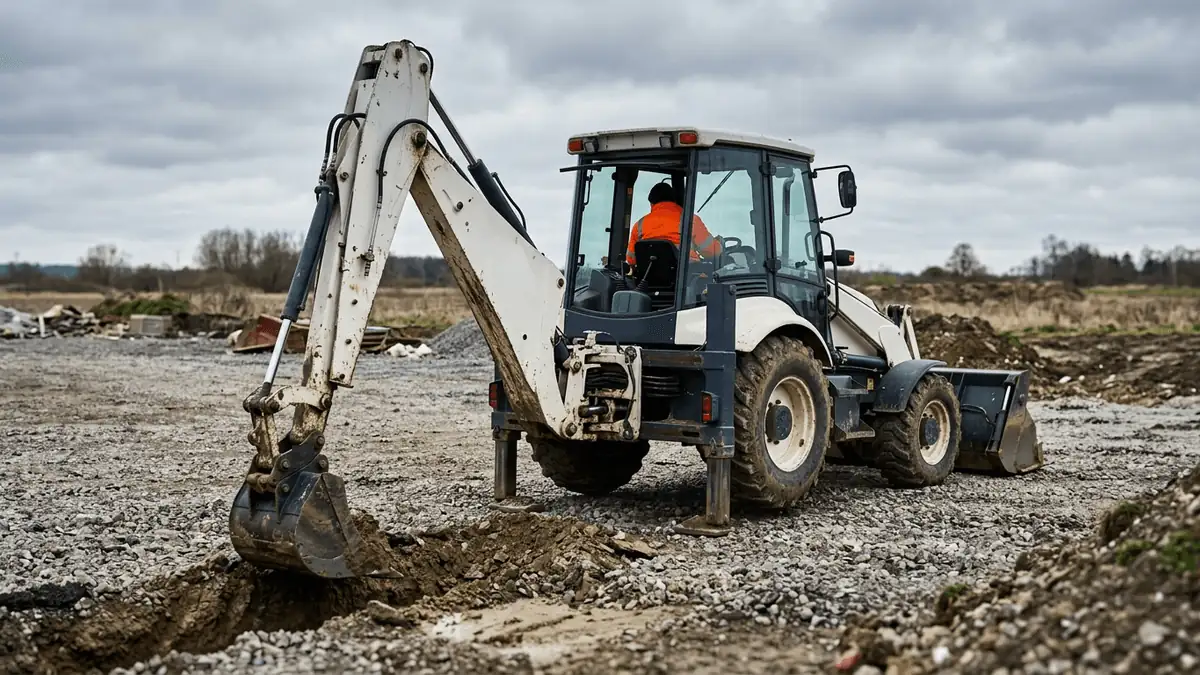
On paper, that’s the tight-site answer. It’s incomplete. Space has a second cost. Under 29 CFR 1926.651(j)(2), excavated material and equipment that could fall or roll into an excavation stay at least 2 feet from its edge, or behind retaining devices. Spoil and a parked machine compete for that strip, so a narrow lot has less working room than its width suggests.
Depth, and the Rules Both Machines Share
The backhoe digs deeper. The two sheets print SAE maximum dig depths of 14 ft 1 in and 14 ft 0 in for their base configurations, and 17 ft 10 in and 17 ft 7 in with an extendable stick. The compact excavator’s page prints 121.2 inches, a little over 10 feet. That’s about 4 feet. It’s also one size class, and a larger compact excavator digs deeper, so read the sheet for the size you would actually buy.
Past 5 feet, both machines are cutting a hole someone may have to work in. 29 CFR 1926.652(a)(1) calls for a protective system unless the excavation is cut entirely in stable rock, or is under 5 feet deep and a competent person’s examination shows no sign of a cave-in. The machine doesn’t change that.
Neither does it change the first step, and that one comes before either engine starts. Section 1926.651(b)(1) says the estimated location of utilities has to be determined before the excavation opens. Call 811, the free national number, and wait for the utilities to mark their lines.
Road Travel and the Trailer
Here the backhoe pulls ahead. The sheets put numbers on it.
- Backhoe loader, fourth gear: 36.6 km/h, or 22.7 mph, on the 2023 sheet.
- Compact excavator, maximum travel: 2.9 mph on its page.
- The backhoe in transport is 23 ft 9 in long and 11 ft 1 in high, per that 2023 sheet.
- Operating weight: an estimated 16,532 lb for the backhoe on the March 2026 sheet, 7,659 lb for the compact excavator.
That’s nearly eight to one. A backhoe can finish one job and drive to the next while the compact excavator waits for a trailer. Road rules for a machine on its own wheels vary by state, so check yours before you plan a route.
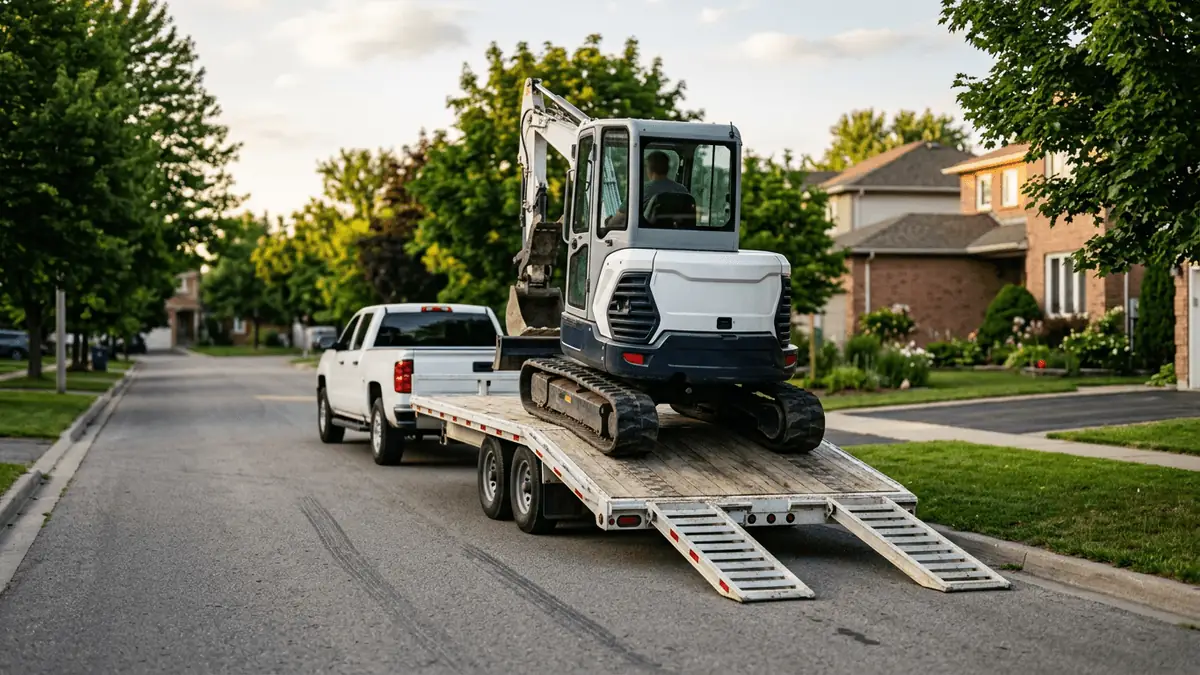
Match the trailer’s plate and the truck’s tow rating to the machine, its bucket, and its attachments, because a compact excavator that fits the gate but not the truck solves nothing.
Loading, Attachments and Who Runs It
On the backhoe, the front end is a loader. The March 2026 sheet lists a 1.25-cubic-yard general-purpose bucket on its base machine.
- The front bucket fills a truck, backfills the trench, and pushes the spoil aside.
- The arm on the back digs the trench itself.
- One seat, one operator, so the two ends never work at the same moment.
The compact excavator only digs. Loading and hauling go to a second person or a second machine, often a skid steer, and our comparison of mini excavator vs skid steer works through that pairing. One operator suits a crew of one or two moving between small jobs, while a crew of three or four with a second machine already on site may find the extra seat worth more than the loader.
Mini Excavator vs Backhoe, Side by Side
| Mini excavator | Backhoe loader | |
|---|---|---|
| Transport width | 69.7 in | 87 to 89 in |
| Width at work | 69.7 in | 139 in, stabilizers set |
| Swing | Full rotation | 180 degrees |
| Dig depth | About 10 ft | About 14 ft |
| Top road speed | 2.9 mph | 22.7 mph |
| Between sites | On a trailer | On its own wheels |
| Loads a truck | With help | Front bucket |
A Rule for Counting the Crew’s Day
Put the week’s jobs on one sheet. Mark each by place first.
- Behind a gate, in a side yard, or between two walls. These belong to the mini excavator, and the gate’s width is the only figure that matters.
- In the open, needing a hole and then a loaded truck. That’s one backhoe at work instead of two machines.
- Three addresses before Friday? Count the trailer loads. Every one is time the bucket isn’t in the ground.
- Rent for the odd job that fits neither.
The biggest block names the machine. When two blocks run close, a rented day of each settles it before anything is bought.
Paying for One or Both
- Cash, a rental, or a credit line you already have may cover a machine that works a few weeks a year.
- A used backhoe has two ends to inspect, the loader arms and the hoe.
- A used compact excavator brings tracks, rollers, and pins onto the list.
- Hours and service records come before any price.
Our pages on mini excavator financing and backhoe financing cover the paperwork side for each, and the cost guides, what a backhoe costs and what an excavator costs, carry dated prices.
What Crews Ask Before Choosing
So can one mini excavator stand in for a backhoe loader?
Short answer: for digging, usually, and for loading, no.
- A compact excavator has no front bucket, so a truck gets loaded by hand or by a second machine.
- A larger compact excavator digs deeper than the one on the sheet above, so read the sheet for the size you would actually buy.
Which one is easier to move between job sites?
The backhoe is easier if the next job is across town.
- One sheet prints a fourth-gear top speed of 22.7 mph, and the compact excavator’s page prints 2.9 mph.
- A compact excavator rides a trailer, which adds the trailer’s length and weight to the haul.
- Road rules for a machine on its own wheels vary by state.
Can a backhoe dig as well as a mini excavator?
A backhoe digs deeper on the sheets above, about 14 feet against about 10, but it needs more room to do it.
- Its stabilizers take a strip 11 ft 7 in wide on one sheet.
- Its arm covers a 180-degree arc instead of a full circle.
Does a septic line or a water service trench change the choice?
29 CFR 1926.651(b)(1) applies to both machines alike: the estimated location of utilities has to be determined before the excavation opens.
- Call 811 first and wait for the utilities to mark their lines.
- Past 5 feet, 29 CFR 1926.652(a)(1) asks for a protective system unless the ground is stable rock.
- After that, pick on access and on where the spoil pile goes.
What should you check on a used mini excavator or backhoe?
Check the hours against the service file before anything else.
- Backhoe: both ends, so the loader arms, the hoe’s pins, and the stabilizer cylinders.
- Mini excavator: tracks, rollers, and play in the pins and bushings.
- Either one: hydraulic leaks around the cylinders and hoses.
Would a mini excavator and a skid steer beat one backhoe?
Sometimes it does, when two people are working and one needs a loader while the other digs.
- One backhoe has one seat, so it digs or it loads, never both at the same moment.
- Two machines mean two operators, two sets of service, and a bigger haul.
- Our skid steer pairing guide works through the pair.
Next Steps
A machine in mind and a quote in hand? The paperwork starts there. Read how financing a compact excavator works, compare financing a backhoe loader, or start an application.