
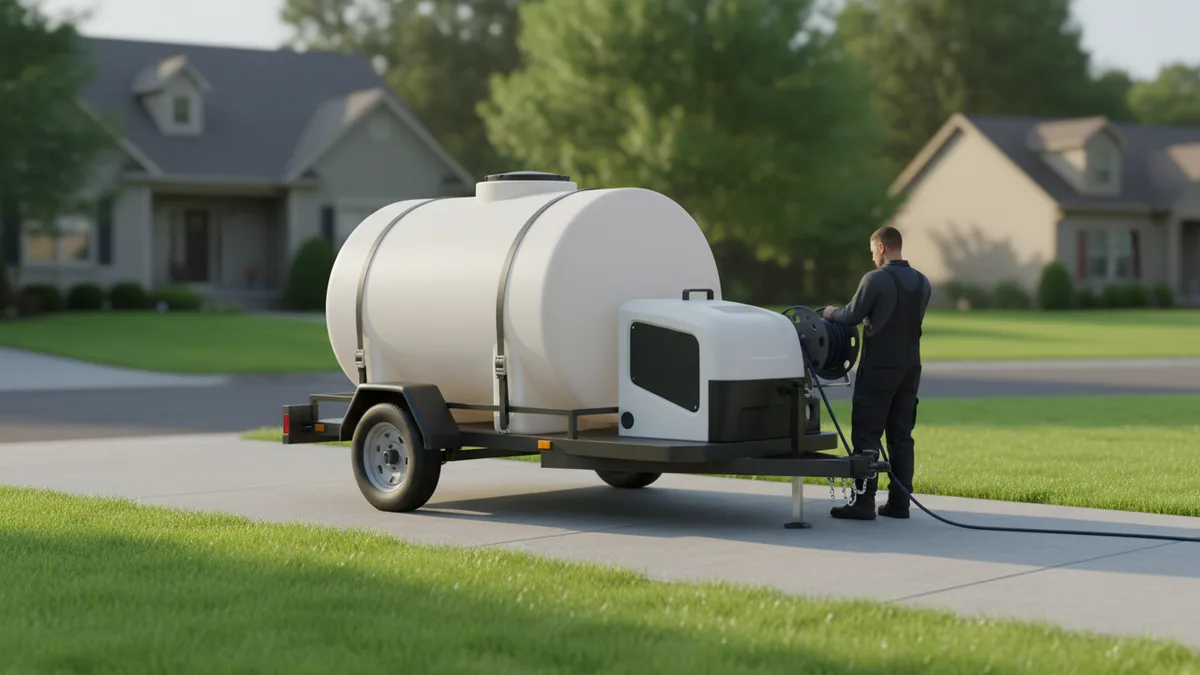
How to Start a Pressure Washing Business: Rig, Trailer and Startup Costs

Key takeaways
How to start a pressure washing business comes down to your first customer: house and driveway work usually needs a cold-water washer and a surface cleaner, while grease and fleet work usually calls for hot water and a trailer rig.
- Pick the customer. Then the rig.
- Dealer prices read on November 21, 2026 ran from $5,174.52 for a cold-water washer to $43,964.00 for a loaded enclosed trailer.
- A full 200-gallon tank holds roughly 1,670 pounds of water, which is nearly half of a 3,500-pound trailer rating.
- Wash water that reaches a storm drain can break a city’s rules, so call the city before you buy gear.
- Cash, a credit line you already have, and equipment financing are all worth pricing for the same rig.
Most guides on how to start a pressure washing business hand you a list: register, insure, buy a washer, find customers. The list isn’t wrong. It just skips the one choice that sets the price of everything else. The rig.
A rig is more than a washer. It’s the water, the hose, the surface cleaner, and whatever carries them to the job. Get it wrong and you own a hot-water trailer for a business that washes driveways, or a cold-water cart for a customer whose back door is coated in grease. Expensive mistakes, both.
We finance equipment, which makes us poor judges of whether you should borrow at all, so this post sticks to the equipment. It uses prices that dealers printed on November 21, 2026, a few rules from government pages, and a buying order you can adjust. The money side has its own page: commercial cleaning equipment financing covers pressure-washing rigs and vans alongside scrubbers and extractors.
Pick the Customer Before the Rig
Three jobs. Three first purchases.
| Work | Water | The rig has to |
|---|---|---|
| House and driveway | Cold | Run a surface cleaner and a soft-wash line |
| Storefront and flatwork | Cold, usually | Catch the wash water |
| Fleet, restaurant, grease | Hot | Carry a burner, fuel, and more water |
The usual advice is cold water for dirt, mildew, and algae, and hot water for grease and oil. Not a rule. A dealer who sells both can tell you which one your first ten jobs need.
A house comes down to one question: how fast can you cover the concrete? A restaurant’s back lot asks two more. Can you get the grease off, and where does the water go?
A Pressure Washing Rig, Piece by Piece
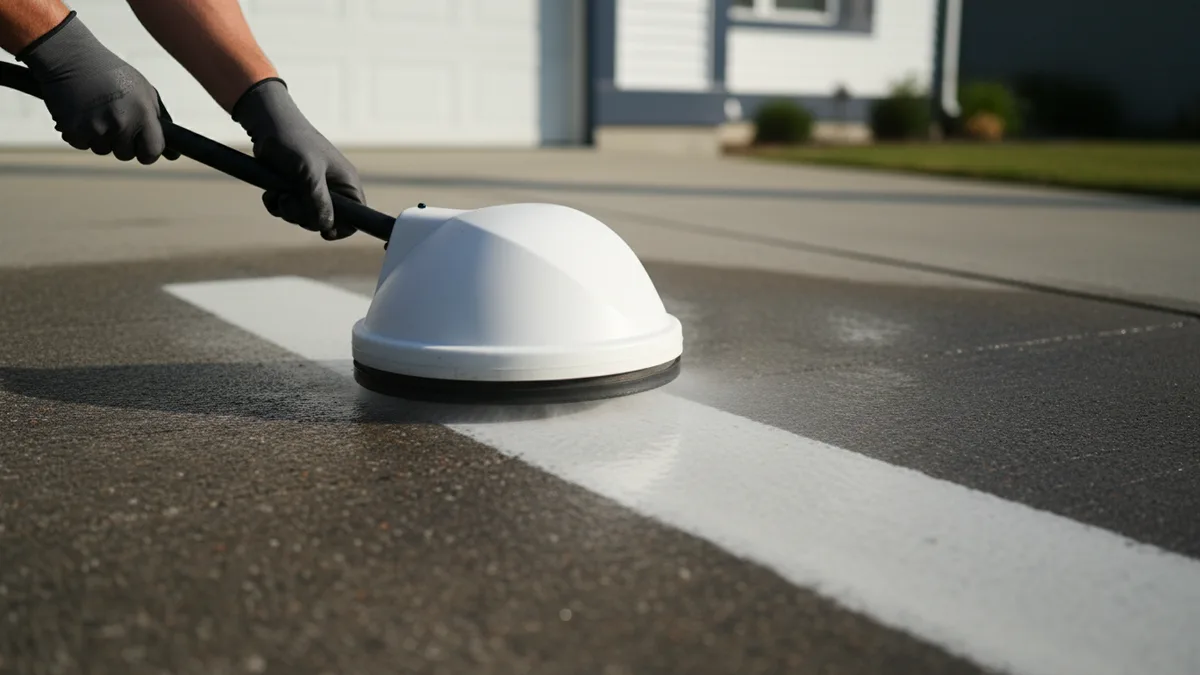
A pressure washing rig is the working package a crew drives to the job: a pressure washer, cold-water or hot-water, a water source such as an on-board tank or a customer’s spigot, hose reels, a surface cleaner for flat concrete, and the carrier, which can be a truck bed, a van, or a trailer.
You price the package, not the washer alone. Buy it in this order.
- The washer and a surface cleaner. They earn on the first house.
- Wash water recovery, before the first storefront job.
- The tank and the trailer, last. Ask whether a truck bed and a customer’s spigot can carry you through one season.
Hot Water or Cold Water
Two commercial washer makers, Landa and Hotsy, each sell hot-water and cold-water washers as separate lines. Landa’s hot-water page says its units deliver “up to 200°F water.” That burner is part of the price difference, and it comes with a second fuel.
The Hot2Go hot-water package priced below carries a 16-gallon diesel tank for its burner, plus a small gas tank for its Honda engine. Two fuels. Two systems to keep running.
$11,550.86
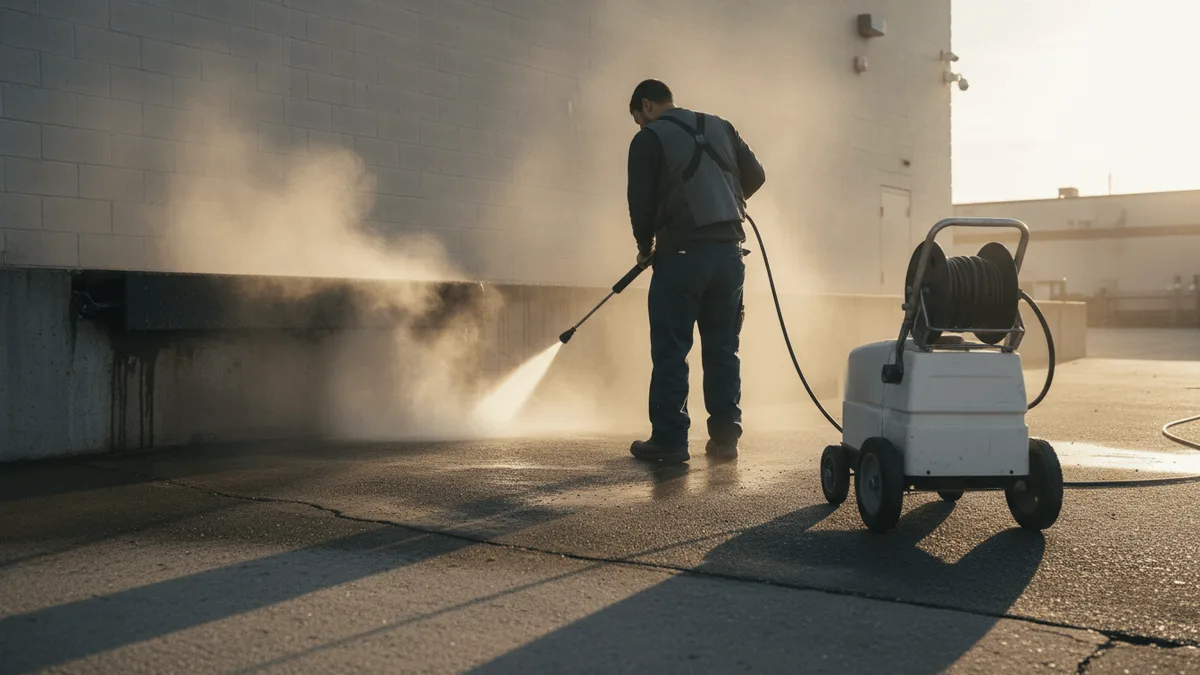
What Elite Metal Tools printed on November 21, 2026 for a Karcher HDS hot-water pressure washer rated 3,500 PSI at 3.5 gallons a minute, with a Honda GX390 engine and a diesel-fired heater. The same seller printed $5,174.52 for a Karcher cold-water HD washer rated 3,500 PSI at 3.7 gallons a minute, with the same engine.
Source: Elite Metal Tools, Karcher HDS Pe Cage Gas Hot Water Pressure Washer listing, read November 21, 2026
Same maker. Same engine. Same pressure. The hot-water unit cost a little more than twice what the cold-water Karcher HD did.
- The startup guides put a commercial washer anywhere from $760 to $6,000. ZenBusiness’s startup table prints $1,200 to $6,000, and a Shopify guide says $760 to $2,000 or more. Neither says where its number came from. The cold-water Karcher at $5,174.52 sits inside ZenBusiness’s range and far above Shopify’s low end, which tells you how little a range says about one machine.
- If your first jobs are houses and driveways, a cold-water washer is the smaller bet while you learn whether the work suits you.
Trailer Weight and the Water Tank
Water is heavy. It weighs about 8.34 pounds a gallon, so a full 200-gallon tank is roughly 1,670 pounds.
Now read the trailer. The Hot2Go package prints a 3,700-pound torsion axle and a 3,500-pound-rated 2-inch ball hitch under its 200-gallon tank. Karcher’s TRK-3500, a single axle sold with a 200-gallon tank, is listed at a 3,500-pound gross vehicle weight rating (GVWR), the most the trailer is rated to weigh loaded. A full tank uses nearly half of that before the washer, the fuel, the reels, and the hose come aboard.
A tandem axle loosens the arithmetic. The 16-foot enclosed trailer from 3R Pressure Washers is rated at 7,000 pounds GVWR and carries a 325-gallon tank, about 2,710 pounds of water, which takes a much smaller share of its rating than a full 200-gallon tank takes from a 3,500-pound single axle. Check the tow vehicle too.
| Rig | Printed price | Seller |
|---|---|---|
| Cold-water Karcher HD, 3.7 GPM | $5,174.52 | Elite Metal Tools |
| Hot-water Karcher HDS, 3.5 GPM | $11,550.86 | Elite Metal Tools |
| Hot-water package, 200-gallon tank | $11,169.00 | Best Buy Auto Equipment |
| Trailer and 200-gallon tank, no washer | $14,544.30 | Elite Metal Tools |
| Hot-water trailer package, 200 gallons | $37,301.06 | Elite Metal Tools |
| 16-foot enclosed, 8 GPM hot washer, soft wash | $43,964.00 | 3R Pressure Washers |
One dealer’s list price, one day each, read November 21, 2026. Not a market range. The packages differ in what’s on the deck, so read each listing’s inclusions before you compare totals.
Elite Metal Tools lists the Karcher trailer and tank alone at $14,544.30, and the same trailer with a hot-water washer, mounting kit, battery, hose reels, and electric brakes at $37,301.06. The gap, $22,756.76, is everything that makes it a working rig.
Wash Water Rules for a Pressure Washing Business
The Clean Water Act sits underneath all of it. The EPA’s summary of the law says it made it unlawful to discharge any pollutant from a point source into navigable waters, unless a permit was obtained, and the EPA’s page on municipal systems describes a storm sewer as one “designed or used to collect or convey stormwater (e.g., storm drains, pipes, ditches).” The statute is federal. The rules a mobile washer actually follows are local.
Portland, Oregon prints its rules where the customer will read them. The city’s guidance for businesses that hire a mobile washer says to check that every storm drain is blocked before cleaning begins, that the washer contains and collects all wash water, that rinse water goes to the sanitary sewer, and that the washer holds a Discharge Authorization with the City. It adds that the city issues a civil penalty if pollutants are discharged. Expect customers to ask.
Call the City’s Stormwater Office First
- Can wash water go to the sanitary sewer, and where?
- Does a mobile washer need a permit or an authorization?
- What drain protection do they expect on site?
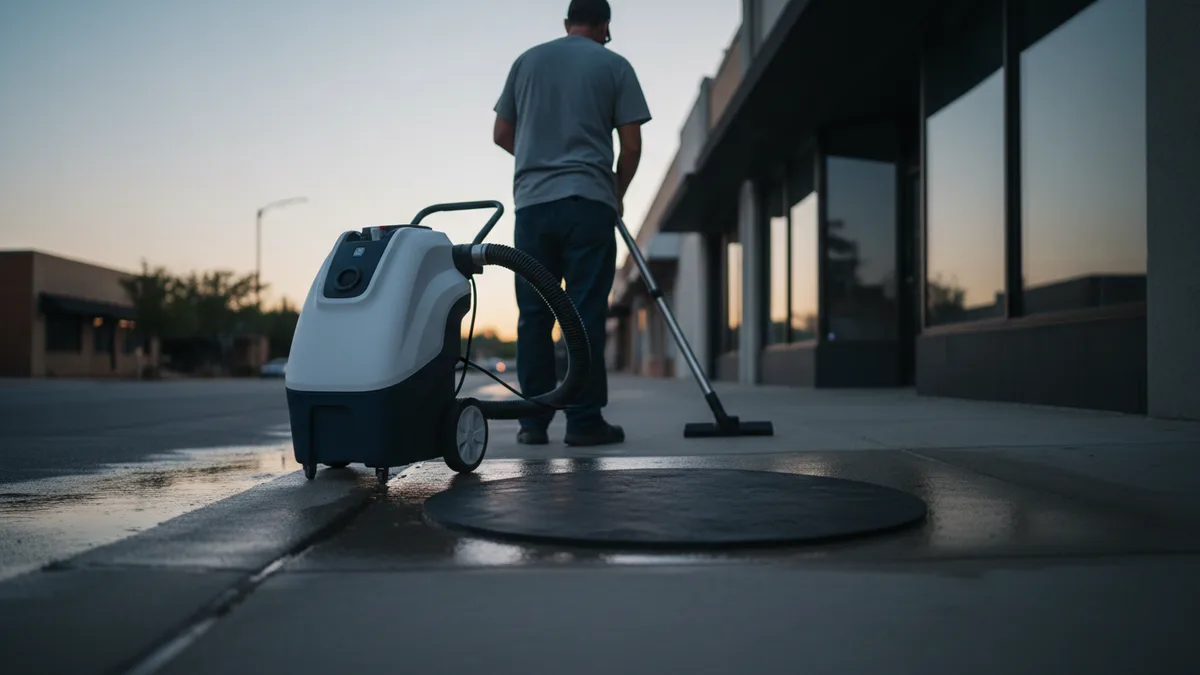
Recovery gear is what makes the answers workable. WebstaurantStore listed a Mi-T-M PWR-10-0ME1 recovery system, a 55-gallon unit that comes with a 20-foot water berm and a 50-foot vacuum hose, at $4,119.00 on November 21, 2026.
Paperwork to Start a Pressure Washing Business
- The SBA’s launch guide gives the order: choose a business structure, pick a name, register, get federal and state tax IDs, apply for licenses and permits, open a bank account, and get insurance.
- It adds: “Local governments determine registration, licensing, and permitting requirements.” For a mobile washer, the office to call is often the stormwater program, not only city hall.
- Insurance is a quote. Not a number to copy from a guide.
- OSHA’s hazard communication page says that “All employers with hazardous chemicals in their workplaces must have labels and safety data sheets for their exposed workers, and train them to handle the chemicals appropriately.”
- Each detergent and soft-wash product comes with a safety data sheet that says whether it’s hazardous. Keep one for everything on the trailer.
Startup Costs for a Pressure Washing Business
Two startup guides we read don’t overlap. A Shopify guide published December 4, 2025 says costs run “between $2,000 and $5,000, according to Jobber,” while ZenBusiness’s cost page, last updated February 9, 2026, says “$6,000 to $50,000 or more,” and neither shows the data behind its range.
The carrier is the gap. ZenBusiness prints vehicle and transportation at $5,000 to $30,000, and Shopify warns its total “will increase if you need to purchase a truck.”
Build Your Own Budget in Three Buckets
- The washer and surface cleaner: a dealer price you can read, like the $5,174.52 and $11,550.86 above.
- The carrier and tank. A truck bed or a used trailer, or the $11,169.00 to $43,964.00 packages in the table. Weigh the tank first.
- Staying legal: insurance, local registration and permits, a recovery unit, safety data sheets. Get quotes.
Paying cash for a $5,174.52 washer is reasonable. So is renting a rig for a season to see whether you like the work, or using a credit line you already have. Price all three. If financing makes the list, start with our pages on trailer financing and startup equipment financing.
Questions New Pressure Washing Owners Ask
Do you need a license to pressure wash for money?
Usually, and your city or county decides: the SBA’s launch guide says local governments determine registration, licensing, and permitting requirements.
Start with city hall and the county, then ask the stormwater office whether mobile washers need anything more. Portland, for one, asks mobile washers to hold a Discharge Authorization. Ask early.
Is a trailer required, or can a truck bed carry the rig?
A trailer is a choice about weight and space, not a rule we found in any source we read.
A truck bed holds a washer and a surface cleaner. A full 200-gallon tank adds roughly 1,670 pounds, so check the truck’s payload rating before you load one.
Hot water or cold water for a first rig?
Wrong question, slightly. Ask which customer you’ll have in the first month.
- House and driveway work is where a cold-water washer starts.
- Grease and fleet work is where hot water earns its price.
- One seller’s list prices show the gap: $5,174.52 against $11,550.86 for two Karcher units with the same Honda engine.
Can a used washer or trailer be financed?
Used equipment can be financed, though a lender reviews it differently from a new machine.
- A used washer or trailer has an age, a condition, and a seller, so expect questions on all three.
- Our used equipment financing page covers machines bought from dealers and private sellers.
What changes the day you hire your first worker?
OSHA’s hazard communication rule starts to matter: all employers with hazardous chemicals in their workplaces must have labels and safety data sheets for their exposed workers, and train them to handle the chemicals appropriately.
Ask your insurance agent what else changes with an employee.
Next Steps
Before you order a rig, call the city’s stormwater office, ask a dealer which water your first customer needs, and set a full tank against the trailer’s rating. Then price the whole package once, in one place.
When you have a number you trust, start an application with us. Other trades use different equipment but follow the same order, and our guides to starting a cleaning business and starting a landscaping business walk through them.