
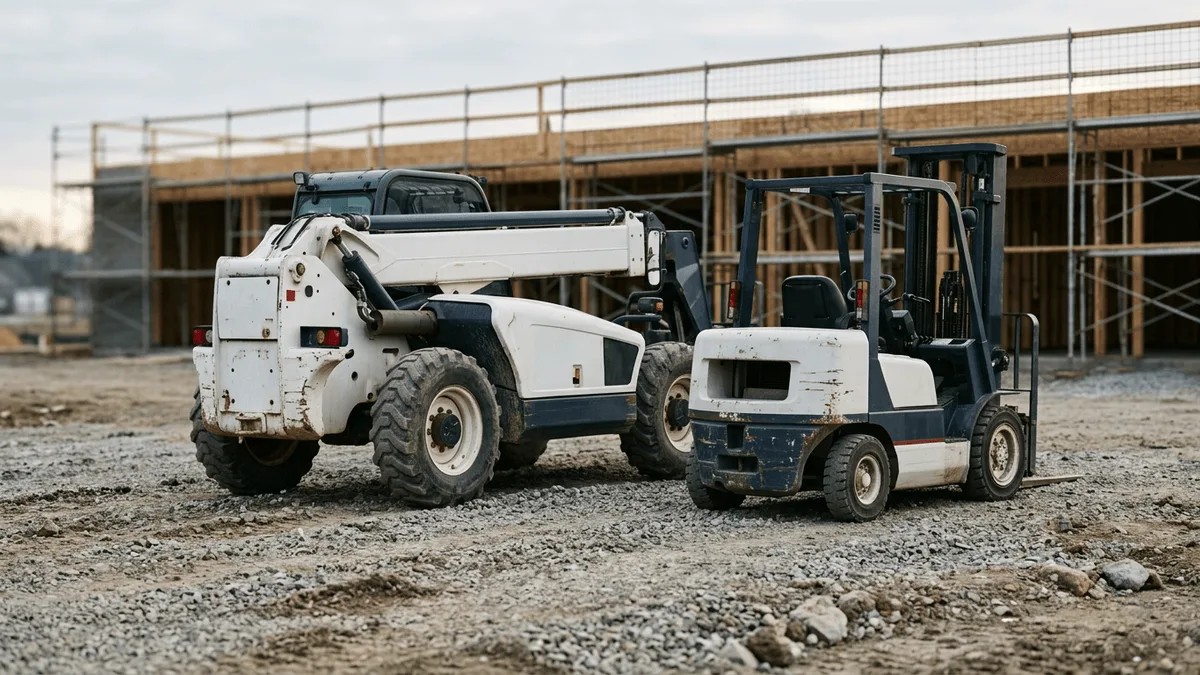
Telehandler vs Forklift: Which Lift Fits the Jobsite

Key takeaways
The telehandler vs forklift question comes down to ground and reach: a forklift lifts straight up from a flat floor, while a telehandler drives rough ground and extends a boom to place the load.
- Reach and ground decide it. Capacity alone doesn’t.
- A forklift’s rating is one number at a 24-inch load center.
- A telehandler’s rating is a chart that shrinks as the boom goes up and out.
- OSHA’s operator-training rule reaches forklifts and rough terrain trucks alike.
- Write down your heaviest, highest, and farthest pick before you price either one.
Hyster’s technical guide lists its H50FT forklift at 5,000 pounds at a 24-inch load center. JLG’s page for its 1055 telehandler lists a 10,000-pound rated capacity and 3,000 pounds at full reach, and both numbers were read on November 22, 2026, which is why a telehandler vs forklift comparison starts with that gap. Capacity alone misleads.
The rest of this post draws on manufacturer spec sheets and OSHA’s rules in 29 CFR 1910.178 and 1926.602. The money side lives on our telehandler financing page. Sources first. We finance equipment, so weigh our view with that in mind, because a rental or a machine already in your yard is sometimes the better fit for the job in front of you.
Telehandler vs Forklift: What Moves the Load
Two machines. Two ways to lift.
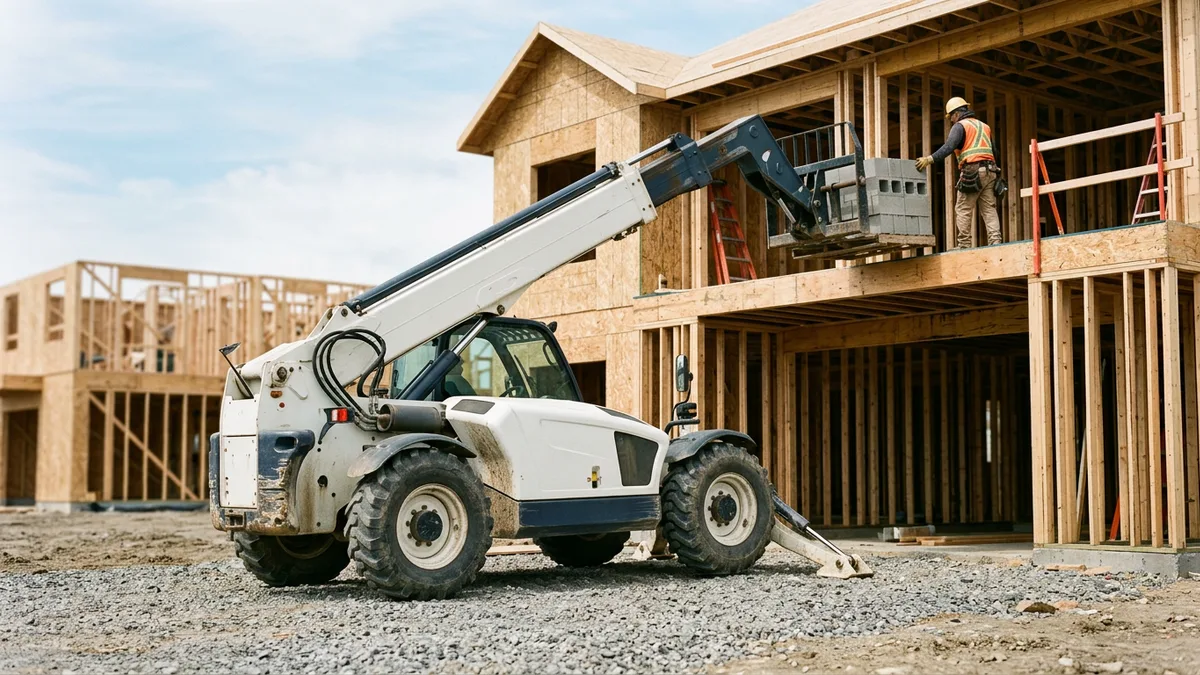
- A telehandler is a rough-terrain machine with a telescoping boom that reaches forward and up from the cab, so its forks can set a load down beyond the front tires.
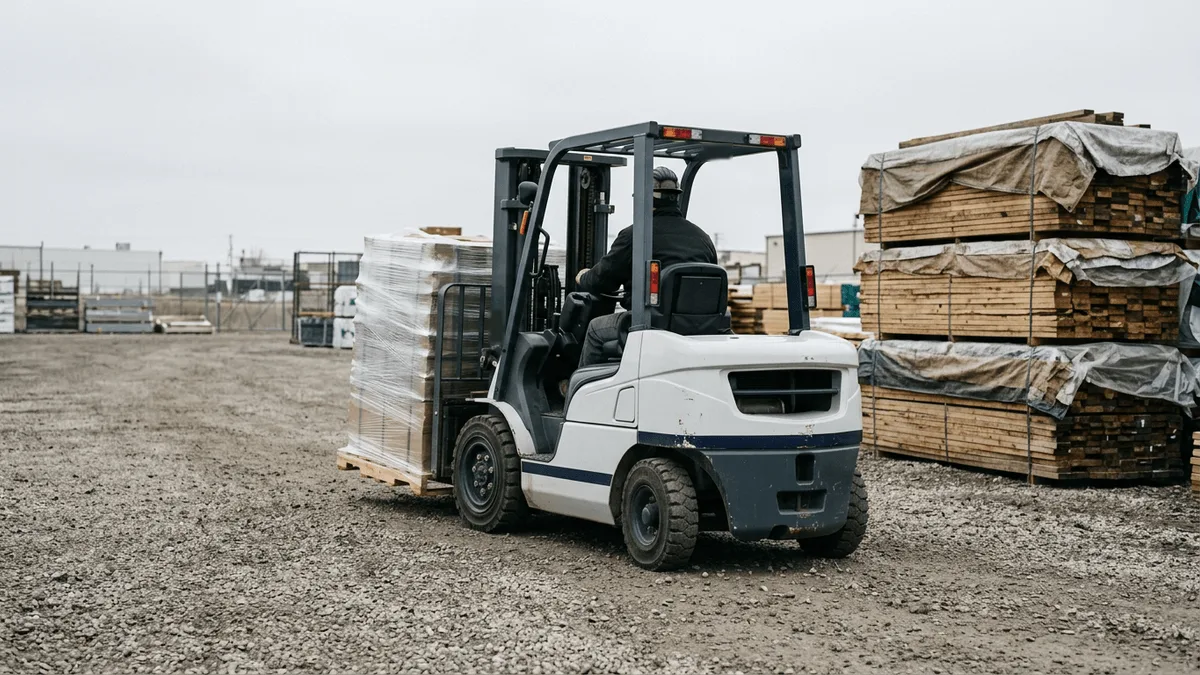
- A forklift carries the load on a vertical mast at the front, and the truck drives up to wherever the load goes.
Reach is the difference.
- A mast goes up.
- A boom goes up and out, so a telehandler can stand on firm ground and put a pallet on a second-floor deck or over a trench.
A Telehandler’s Rating Is a Chart
Start with the forklift. Hyster’s technical guide for the H50FT, a pneumatic-tire forklift, lists:
- 5,000 pounds at a 24-inch load center
- 129 inches of fork height on the standard mast, and 218 on the tallest three-stage mast
- A note that anything above 171.5 inches is a high lift, with reduced capacity and restricted back tilt
One rating. One load center. JLG’s 1055 lists three ratings instead:
- 10,000 pounds, the rated capacity at the base
- 5,000 pounds at the full 55-foot height
- 3,000 pounds at the full 42-foot reach
3,000 lb
What a JLG 1055 telehandler lifts at its full 42-foot reach, against a 10,000-pound rated capacity. Specifications read November 22, 2026.
JLG’s guide to reading a load chart says:
- The chart plots reach from the front tire against height.
- Each attachment gets its own chart.
- A fork carriage normally puts the load center 24 inches out from the face of the forks.
Read the chart at the exact spot where the load will sit. Not at the headline number on the brochure.
Telehandler vs Forklift, Side by Side
| Forklift | Telehandler | |
|---|---|---|
| How it lifts | Vertical mast | Telescoping boom |
| Rating | One number at a load center | A chart by height and reach |
| Ground | Floors, slabs, packed yards | Unimproved and disturbed terrain |
| Reach | None, it drives close | Boom extends out |
| Attachments | Forks, mostly | Forks, buckets, truss booms |
| Operator training | OSHA 1910.178(l) | Same rule for rough terrain trucks |
- Neither column wins.
- A forklift on a slab is hard to beat for pallet after pallet.
- The boom earns its place when the pick is high, far, or over soft ground.
Ground, Attachments, and Training
ITSDF’s B56.6 standard describes rough terrain forklift trucks as machines made for unimproved natural terrain and the disturbed ground of construction sites. A pneumatic-tire forklift handles a packed yard. A rutted pad is another matter.
- Attachments change the chart. Under 29 CFR 1926.602(c)(1)(ii), a change that affects capacity or safe operation needs the manufacturer’s written sign-off, and the capacity plates have to be changed to match.
- Lifting a person takes more than forks. Paragraph (c)(1)(viii) of that rule asks for a firmly secured safety platform, plus a way for the rider to cut power, when a truck’s controls ride up with the carriage.
- Operators need training and an evaluation at least once every three years under OSHA’s operator-training rule, and 1926.602(d) repeats it for construction.
- Switching machines counts. Refresher training is triggered when an operator is assigned to a different type of truck.
A Four-Step Way to Choose
- Write down the heaviest pick, the highest, and the farthest. They’re often three different picks.
- Look at the ground under the machine at each one: slab, packed gravel, or soft fill.
- Check the telehandler’s chart at the high, far point, then check the forklift’s single rating against the heaviest pallet.
- Count the attachments and the people who’ll run it, because training follows the machine you pick.
- Both machines clear every pick: take the simpler one.
- Only one clears them: the choice is made.
Questions Buyers Ask About Both Machines
So can a telehandler replace a forklift?
Sometimes, depending on the ground and the pick.
- Open ground, or a pallet that needs a boom’s reach: often.
- A building with narrow aisles: rarely.
- Pallet after pallet on a slab: the forklift is the simpler machine.
Is a telehandler just a forklift with a boom?
Close, but the boom changes the rating.
- A mast lifts straight up, so capacity is one number at a load center.
- A boom extends out, so capacity falls as it rises and reaches.
- The load chart tells you where.
Do operators need training for either one?
OSHA’s rule at 29 CFR 1910.178(l) covers forklifts and rough terrain trucks.
- The employer trains each operator.
- The employer evaluates and certifies them.
- 1926.602(d) repeats the same rule for construction work.
Can a forklift work on a muddy jobsite?
Only if it was built for it.
- A pneumatic-tire forklift handles a packed yard.
- Mud, ruts, and slopes are the ground ITSDF’s B56.6 assigns to rough terrain trucks.
- Check the data plate before you assume.
Which one costs more to buy?
The spec sets the price more than the machine type does.
- Capacity and lift height.
- Tires, age, and hours.
- Attachments.
Can both machines be financed the same way?
Short answer: both are equipment a lender can finance with a loan or a lease.
The details depend on the machine, its age, and who sells it.
Next Steps
Pick the lift. Then price it. Start with forklift financing or our heavy and construction equipment financing hub, then check the forklift price guide and the used forklift buying checklist, and when you’re ready, start an application.