
How to Start a Commercial Cleaning Business: Equipment, Contracts and Startup Costs

Key takeaways
How to start a cleaning business for commercial clients begins with a signed contract, not a machine: set up the company, insure it, file the chemical paperwork, then buy only the equipment that contract needs.
- The contract sets the equipment list. Not the other way around.
- A house is a customer. An office is a contract, with insurance, keys, and invoice terms.
- Once you hire, OSHA’s chemical rules cover what’s on your cart.
- Rent or lease the big machines until an account pays for them.
2,432,600. That’s how many jobs for janitors and building cleaners the Bureau of Labor Statistics counted in 2025, in an occupation it lists with no formal educational credential and short-term on-the-job training. The work is easy to enter. Accounts are the hard part.
On November 20, 2026, we read five guides on how to start a cleaning business for commercial clients. Nilfisk’s (May 20, 2025) runs eight steps and ends at a quote for its machines. Next Insurance’s (June 23, 2025) runs seven and ends at a policy, and ZenBusiness’s (October 14, 2026) runs eight and ends at an LLC filing.
This post ends at an order of operations. Contract first. Then insurance, paperwork, and machines, with commercial cleaning equipment financing saved for the point where a machine earns its payment.
What a Commercial Cleaning Business Does
A commercial cleaning business, also called a janitorial or building-service business, cleans offices, medical suites, warehouses, and other non-residential buildings under a recurring agreement with the owner or manager. The customer is a company. The work often happens after hours, and payment arrives on an invoice. The floors, not your preferences, decide the equipment.
2 percent
Projected growth in jobs for janitors and building cleaners from 2025 to 2035, slower than the average for all occupations. The 2025 median pay is $36,840 a year, or $17.71 an hour (page last modified August 27, 2026).
Source: Bureau of Labor Statistics, Occupational Outlook Handbook, Janitors and Building Cleaners, 2026
Three buildings, three first questions.
| Building | On the floor | Put in writing before you bid |
|---|---|---|
| Office | Carpet, with hard floor at the entry | Access hours, keys, and alarm codes |
| Medical suite | Sealed hard floors | The client’s infection-control rules |
| Warehouse or shop | Concrete aisles | Which chemicals are already on site |
How to Start a Cleaning Business: Setup
The SBA’s launch guide lists eight steps in order: pick a location, choose a structure, choose a name, register, get federal and state tax IDs, apply for licenses and permits, open a bank account, and get insurance. It adds: “Local governments determine registration, licensing, and permitting requirements.” A cleaning company’s first workplace is a client’s building, so the location step can wait.
- Choose a structure: a sole proprietorship, partnership, LLC, or corporation. The SBA says the choice affects your taxes, your ability to raise money, and the paperwork you file. Ask an accountant.
- Register the business and get a federal tax ID, the Employer Identification Number.
- Ask city hall, and the county, which license a cleaning company needs.
- Open a business bank account. Client payments and personal money never share one.
- Insure the business, then ask the insurer for a certificate you can hand to a building manager.
The SBA’s insurance section lists general liability as coverage any business can carry, and workers’ compensation among the coverage it says a business with employees needs. A certificate of insurance is the proof of coverage an insurer issues.
- Building managers often ask for the certificate before a crew gets a key, and some ask about a bond too.
- Get the client’s wording in writing before you call an agent.
- The quote depends on your state, your payroll, and the buildings.
- A client who hands you a key is trusting your hiring, not your mop.
Contracts, Bids, and the First Account
Walk it first.
- A first account is usually smaller than you’d like: a small office, a medical suite, or one floor of a building a property manager already handles.
- Count the floor types, and the square feet of each.
- Count restrooms, kitchens, and trash runs.
- Ask how many nights a week, who locks up, and who holds the alarm code.
BLS’s 2025 median wage for the job is $17.71 an hour. Twelve labor hours at that wage, a three-person crew for four hours, come to $212.52 before payroll taxes, insurance, supplies, and your own pay.
Three ways to quote.
| Priced by | It rewards | Where it goes wrong |
|---|---|---|
| The hour | Honest tracking of crew time | The client second-guesses every hour |
| A flat monthly fee | A scope you measured well | Extra work creeps in unpaid |
| The square foot | A simple comparison between bids | Square feet say little about effort |
Read the contract.
- The term, and how it renews.
- How either side ends it, and on how much notice.
- Who buys the paper, soap, and trash liners.
- What insurance the client requires, and where the certificate goes.
- Keys, alarm codes, and who may be in the building after hours. What happens when something goes missing?
ISSA’s Cleaning Industry Management Standard, CIMS, says it applies “without respect to the size of the organization, both to cleaning organizations that self-perform cleaning and to cleaning contractors.” Step 6 of its process reads “Receive CIMS certification.” Not a license.
- A building owner may ask whether you hold it. You can bid either way.
- The contract also sets how long a machine has to earn its keep, so match the equipment term to the account term.
- For a new company with no track record yet, the startup equipment financing page describes what lenders typically review.
The Equipment List, Item by Item
Listed prices from WebstaurantStore’s walk-behind scrubber, carpet extractor, and backpack vacuum pages, read on November 20, 2026.
| Machine | Listed price | Notes |
|---|---|---|
| Backpack vacuum, Lavex 8 qt | $274.49 | Corded, HEPA |
| Backpack vacuum, ProTeam Super Coach Pro 6 qt | $504.70 | Corded |
| Carpet extractor, Powr-Flite PFX3S | $1,399.00 | 12 in., 3 gal, corded |
| Carpet extractor, Lavex dual 3-stage heated | $3,389.00 | 12 gal, 500 PSI |
| Walk-behind scrubber, Lavex 13 in. | $1,149.00 | 3 gal, corded |
| Walk-behind scrubber, Lavex 17 in. | $1,899.00 | 9 gal, corded |
| Walk-behind scrubber, Lavex 17 in. | $2,339.00 | 9 gal, AGM battery |
| Walk-behind scrubber, Tornado BR 16/3 | $2,899.00 | 16 in., 3 gal, corded |
- One dealer, one day, machines only.
- Delivery, supplies, and insurance aren’t in the listed prices.
- Carts, rotary floor machines, and burnishers sit on the same site and aren’t in the table.
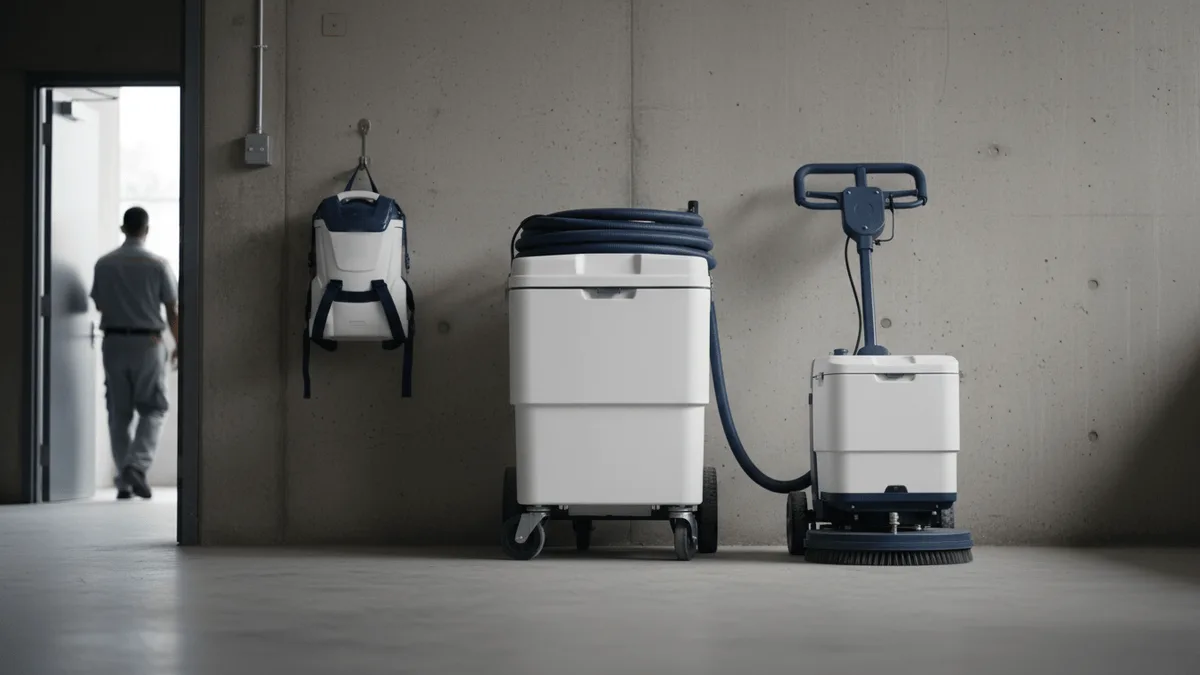
The two 17-inch Lavex scrubbers put the battery at $440.00: $1,899.00 corded, $2,339.00 on an AGM battery, both at 9 gallons.
Add each machine when the contract asks.
- Day one: a vacuum, a cart, and chemicals. Not a ride-on scrubber.
- Backpack vacuum: every building has a floor that needs one.
- Carpet extractor: when the scope names carpet cleaning.
- Walk-behind scrubber: when the hard floors outrun a mop and bucket.
- Van: when the route outgrows a car trunk. A titled vehicle follows different rules than a machine, and our commercial vehicle financing page explains how.
Paying for the Machines
- We finance equipment, so weigh this with that in mind.
- A scrubber tied to a signed account can be paid for out of that account. One bought on hope is a payment with nothing behind it.
- A rented machine is a fair way to learn whether you need one, and plenty of this list can be paid for out of pocket.
- A fair market value lease lets the business return, renew, or buy the machine when the term ends. Leasing versus buying equipment lays out the trade.
- Our page on financing scrubbers, extractors, and vans shows how loans and true leases fit a janitorial contractor.
Chemicals, Safety Data Sheets, and Training
OSHA’s hazard communication standard, 29 CFR 1910.1200, says in paragraph (b)(1) that it requires “all employers to provide information to their employees about the hazardous chemicals to which they are exposed.” Paragraph (e)(1) adds: “Employers shall develop, implement, and maintain at each workplace, a written hazard communication program.”
OSHA’s own summary is shorter: “All employers with hazardous chemicals in their workplaces must have labels and safety data sheets for their exposed workers, and train them to handle the chemicals appropriately.” A safety data sheet follows a specified 16-section format.
- A cart full of floor stripper counts.
- One sheet for every product on the cart and in the closet, kept where a crew member can reach it. Ask for it when you buy.
- Read it before the first use. Not after the first spill.
- Label every bottle you fill. A spray bottle with no label is a mystery to the next person who picks it up.
- Never mix products. Two cleaners that are fine alone can be a problem together, and the sheet says which.
- Train each new hire on the products before the first shift, and write down that you did.
Cleaning Business Startup Costs
Three lists.
- One time: the equipment from the table, a cart and supplies, the license fees your city sets, the first insurance premium, and a vehicle if the work needs one.
- Every month: insurance, payroll and payroll taxes, chemicals and paper, vehicle costs, software, and replacement brushes and batteries as the machines wear.
- The float: a commercial account often pays on invoice terms, so your crew gets paid before your client does. Our working capital page describes how that gap is financed.
- Online startup totals swing widely because they assume different buildings. Get quotes for insurance and licenses rather than estimates.
- If you decide to borrow for any of it, our guide to what documents a lender asks for lists the paperwork to gather.
Questions New Cleaning Contractors Ask
Do you need a license to start a commercial cleaning business?
Usually at the city or county level: the SBA’s launch guide says local governments determine registration, licensing, and permitting requirements.
- Call city hall and the county.
- Check your state’s business website.
Does a cleaning company need a bond?
The client decides. Insureon’s guide to commercial cleaning contracts covers insurance and bonding under one heading, “What types of insurance and bonding do I need for my cleaning business?”
- Get the requirement in writing before you bid.
- Price it with an insurance agent.
Is residential cleaning a cheaper way in?
Different job.
- A house is a customer.
- An office is a contract, with a certificate of insurance, keys, and invoice terms.
Should the first scrubber be rented, leased, or bought?
Wrong order, slightly. The contract comes first.
- A scrubber tied to a signed account can be paid for out of that account.
- One bought before the account exists is a payment with nothing behind it.
What does OSHA expect from a cleaning company that uses chemicals?
Under 29 CFR 1910.1200, employers need a written hazard communication program and, per OSHA’s summary, labels, safety data sheets, and training for exposed workers.
- One sheet for every hazardous chemical.
- Your state may add rules of its own.
Do you need certification to clean commercial buildings?
Not required. BLS says: “Although not required, certification demonstrates competence and may make applicants more appealing to employers.”
- CIMS is a separate certification, for the company.
Before the First Bid
Three calls come first.
- City hall, about the license.
- An insurance agent, with the client’s requirements in hand.
- The building manager, for a walk-through and the scope in writing.
After that, start an application when a signed account needs a machine. Other startup guides on this site cover how to start a laundromat, how to start a restaurant, and how to start a landscaping business.