
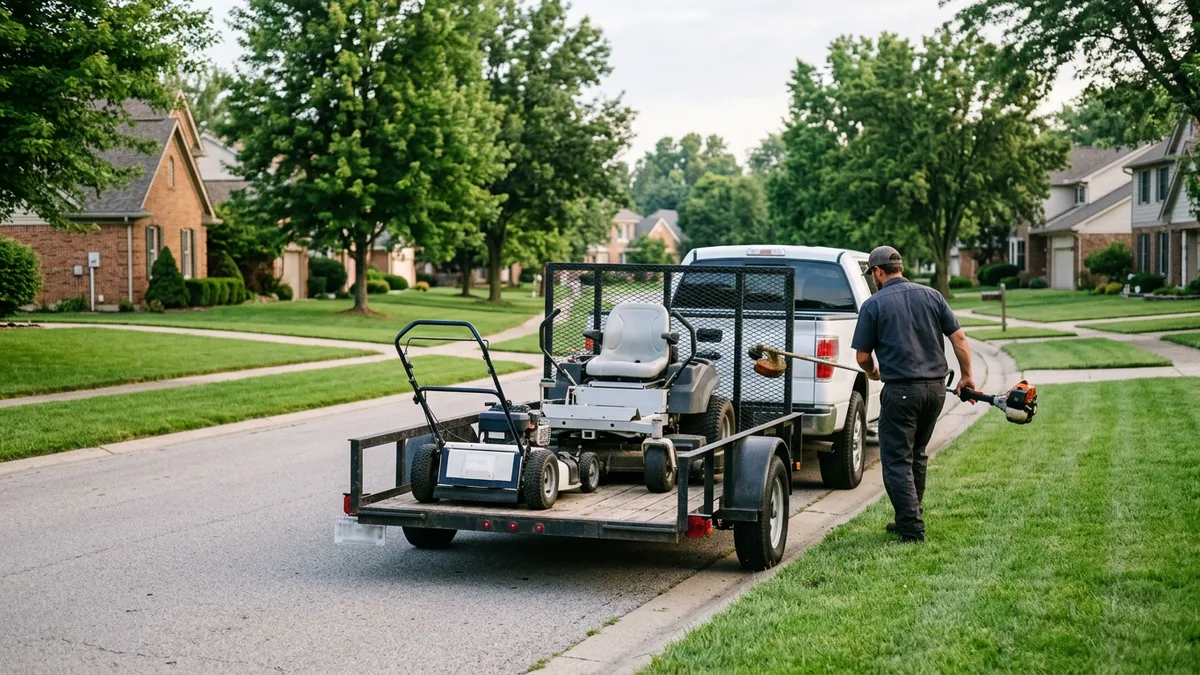
How to Start a Lawn Care Business: Mowers, Trailer, Routes and Startup Costs

Key takeaways
How to start a lawn care business: sign the route first, because a quarter acre takes about four to six minutes to mow on paper and two extra hours of driving costs far more.
- Printed mower prices on November 20th, 2026 ran from $1,999 for a walk-behind to $10,299 for a 60-inch zero-turn.
- On paper, a wider deck saves a couple of minutes per quarter acre. Windshield time can cost hours.
- Two dealers printed trailer prices from $3,698 for an open trailer to $6,495 for an enclosed one.
- The startup guides treat the truck differently, so check what you already own.
- Paperwork comes first: registration, an employer ID number (EIN), insurance, and a pesticide license if you spray.
A quarter acre is 10,890 square feet. Exmark’s mower page prints 2.37 acres an hour for its 42-inch Quest E-Series and 3.87 for its 60-inch Radius E-Series, which works out to a little over six minutes against just under four. Housecall Pro’s October 13th, 2026 route example puts two more hours of driving on one of two routes that bring in the same $720. Many guides on how to start a lawn care business open with the paperwork and skip that arithmetic.
2.37 to 3.87
Acres per hour Exmark printed on November 20th, 2026 for its 42-inch Quest E-Series and its 60-inch Radius E-Series zero-turn mowers. Turns and trimming aren’t counted.
Source: Exmark, Zero-Turn Mowers, checked November 20th, 2026
Landscaping is a different business. This post is about the repeat work: weekly mowing, trimming, and blowing for the same properties all season. If you plan to build patios and plant beds, start with our guide to starting a landscaping business instead. The money side of either is on our landscaping equipment financing page.
A Lawn Care Business Starts With a Route
A lawn care route is the list of addresses one crew mows on a fixed day, in a fixed order, usually every seven days while the grass grows. The order matters as much as the list, because every block between stops is time the crew isn’t billing.
The National Association of Landscape Professionals ties profit to what it calls windshield time. In a September 2019 excerpt from consultant Bruce Wilson’s member resource, NALP says route density cuts the time a crew spends in the vehicle, so more of the day goes to servicing properties. Its example is plain arithmetic. A three-person crew working a 40-hour week has 120 budgeted hours, and a route booked at 116 of them can take a four- to six-hour job to fill the gap.
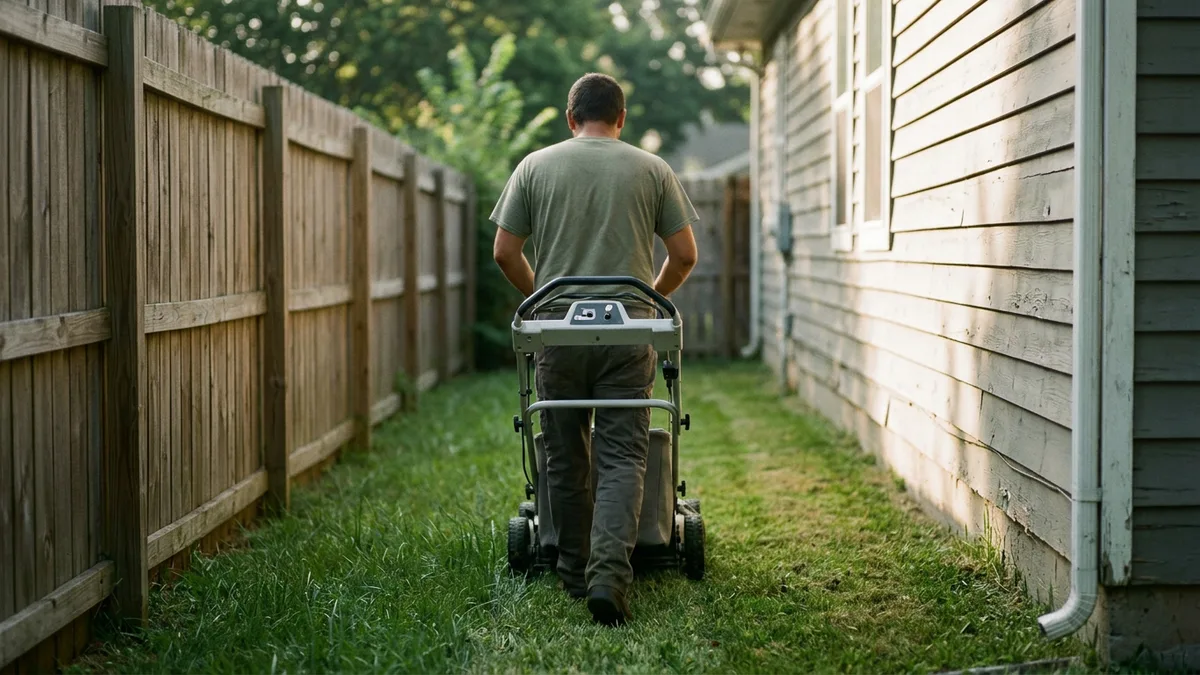
A software vendor, Housecall Pro, put dollar figures on the same idea in a worked example posted October 13th, 2026.
- Two routes, 12 customers each, $60 a visit. Both bring in $720.
- Route A drives three hours. Route B drives one.
- At the $30 an hour labor rate the same page uses in another example, the two extra hours cost one worker $60 a day, or $300 across five days.
Those are the vendor’s illustrations, not survey data, and the vendor sells scheduling software. Still, the arithmetic holds.
- Sign the next account on a street you already mow, then its neighbor.
- A big account across town can still be worth the drive. Price it with the drive included.
- Add a second crew when drive time on the first route starts cutting into billable hours, which is the vendor’s own scaling test.
Mowers: What the Printed Specs Say
What Each Maker Printed, November 20th, 2026
| Machine | Deck | Printed spec | Printed price |
|---|---|---|---|
| Exmark Commercial 21 X, walk-behind | 21 in | Up to 4.2 mph | $1,999 |
| Exmark Quest E | 42 in | 2.37 acres an hour | $3,799 |
| Exmark Quest E | 50 in | 2.82 acres an hour | $3,999 |
| Scag Liberty Z, Kohler | 48 in | 7 mph forward | $6,099 |
| Exmark Radius E | 48 in | 3.10 acres an hour | $6,899 |
| Exmark Radius E | 60 in | 3.87 acres an hour | $7,799 |
| Exmark Radius X | 60 in | 4.84 acres an hour | $10,299 |
- Exmark lists cash prices, and Scag lists a suggested retail price.
- On paper, capacity is deck width in feet times speed in miles an hour, divided by 8.25, which is the square feet in an acre divided by the feet in a mile. Iowa State University Extension’s field-capacity publication names the same inputs, width, operating speed, and field efficiency, and field efficiency is where turns, gates, and trimming take their cut.
- The gap between the 42-inch and 60-inch decks is about two and a half minutes a lot, or roughly 25 minutes across 10 lots. Two hours of driving dwarfs it, so buy width for your biggest lawns and fix the route before you upgrade the deck.
- Prices move. Exmark’s cash price for the 42-inch Quest E-Series read $3,599 on October 30th, when we last checked, and $3,799 on November 20th, three weeks later. The 48-inch Radius E-Series went from $6,699 to $6,899.
- Between makers the gap is narrower than inside one line: at 48 inches Scag lists a Kohler-powered Liberty Z at $6,099 and Exmark a Radius E at $6,899, while Exmark’s own 50-inch Quest E is $3,999 and its 52-inch Radius X is $9,799.
- Measure the narrowest gate on each of your first accounts before you buy anything. A 21-inch walk-behind fits where a 42-inch deck won’t, and open lawns and commercial sites are where the zero-turn pays its way.
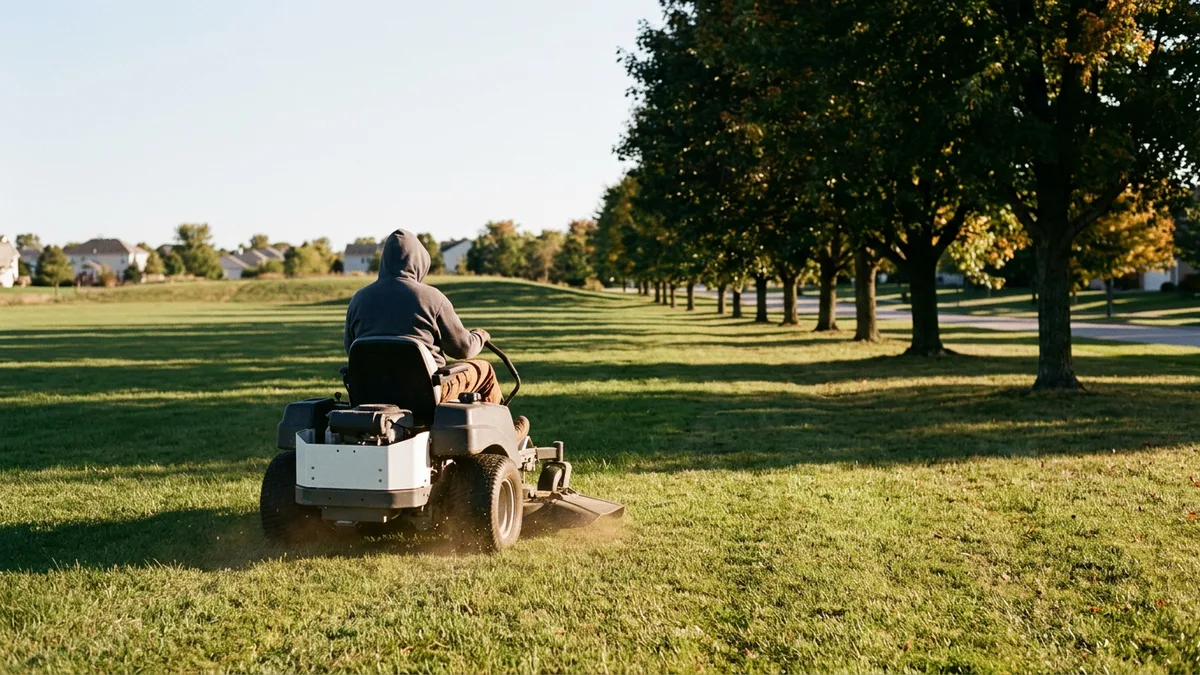
A Trailer and a Truck for the First Crew
Two Dealers, November 20th, 2026
- Nationwide Trailers in Fort Worth: a 12-foot X-ON open landscape trailer, 3,500-pound gross vehicle weight rating (GVWR), $3,698.
- Nationwide in Oklahoma City: a 14-foot open model, same rating, $3,998.
- Nationwide in Kansas City: a 12-foot open trailer rated for 7,000 pounds, $4,898.
- Load Runner Trailers in Florida: a new 2026 Quality Cargo 7-by-14 enclosed trailer, also rated 7,000 pounds, $6,495 under an “Our Price” label.
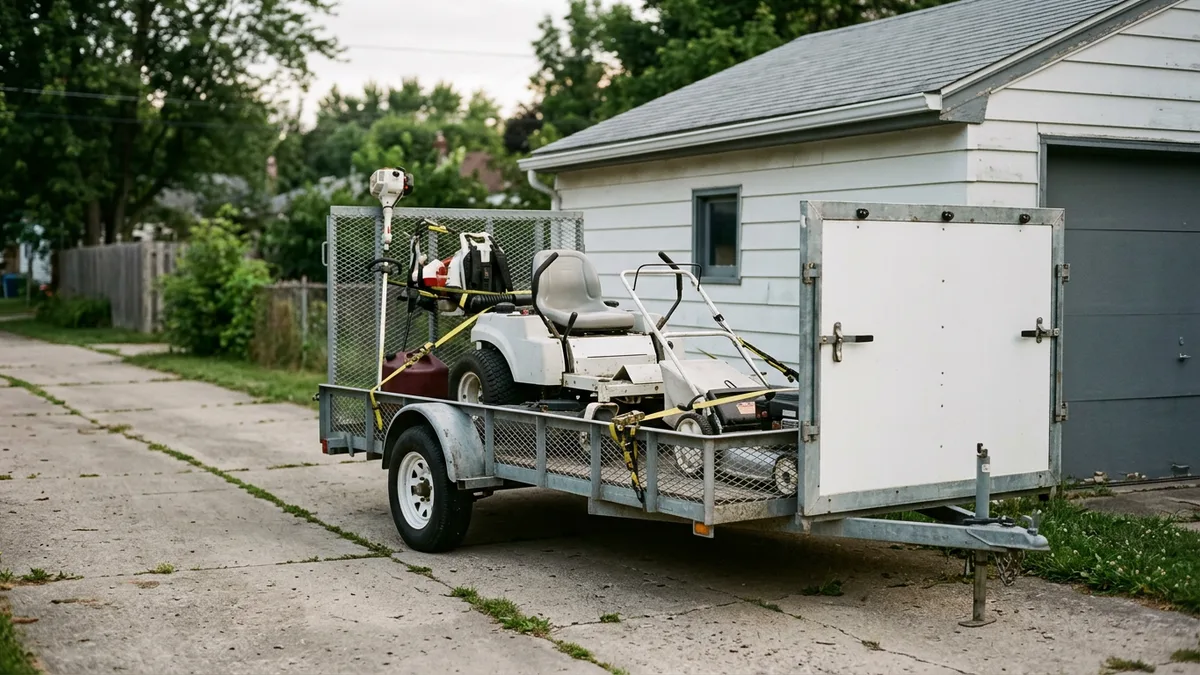
- Open or enclosed comes down to where the equipment sleeps. Open trailers cost less, and an enclosed one locks the mowers away between jobs. The 7-by-14 above lists about $1,600 over the 12-foot open trailer with the same rating, though the sizes differ.
- Match the trailer’s GVWR to what your truck is rated to tow. Nationwide’s own listings tell buyers to verify axles, tires, brakes, load distribution, tongue weight, the coupler, the hitch, and tow-vehicle ratings against the exact trailer.
- Under 49 CFR 383.91, a Group A combination starts at a combined rating of 26,001 pounds, provided the towed unit is rated over 10,000 pounds. All the trailers above sit under it, and federal commercial driver rules use that group definition, so ask your state licensing office where your own truck and trailer land.
- The truck is where the startup guides differ, as the next section shows. A pickup with a tow rating that matches the trailer is a start. A truck you’d have to buy changes every other number.
Crew Size and the Second Mower
- The Bureau of Labor Statistics lists $19.27 an hour as the 2025 median wage for grounds maintenance workers, before payroll taxes and insurance, and that cost runs whether or not the crew has a full day.
- A two-person crew working 40 hours has 80 budgeted hours to fill, and a three-person crew has 120.
- If the stops don’t sit close together, the next worker waits, and so does the next mower.
- A second mower with no second operator just rides on the trailer. Add it when a second person has a full week to run it.
Startup Costs for a Lawn Care Business
Two Guides, Two Totals
- Lawn Love, updated October 27th, 2026: equipment without a truck at $5,000 to $8,000.
- Housecall Pro, posted February 3rd, 2026: $500 to $8,000 for a solo start and $15,000 to $50,000 or more for a commercial one, with a footnote that the ranges assume 2026 pricing. Its equipment list prices a trailer at $800 to $3,000 and no truck.
- Lawn Love leaves the truck out of its total, and Housecall Pro lists a trailer but no truck. Many of their figures name no source, which doesn’t make the ranges wrong, but neither guide knows your truck, your route, or your state’s fees.
- Build your own number: the mower for the first accounts, the trailer that carries it, the trimmer and blower, insurance, and registration. Our first-year landscaping budget walks the paperwork and the costs in order.
- Paperwork comes first. The Bureau of Labor Statistics says grounds maintenance workers typically need no formal educational credential and are trained on the job, and that most states require licensing for workers who apply pesticides. Mowing is the easy case. Spraying isn’t.
Where Financing Fits in a Lawn Care Startup
- Paramount Financial finances equipment, so this section has a stake in the answer. A walk-behind, a trimmer, and a blower can come out of savings, and a rental covers the one-time job.
- A zero-turn and a trailer are two of the biggest single items on a first-route list, and the two a lender can describe by make, model, and serial number.
- A loan makes you the owner while you repay it. A lease lets you use the machine for a term, then return it, renew, or buy it on the terms the lease sets, so ask which one the quote is.
- When a lender finances a specific machine, it commonly files a UCC-1 filing describing that machine, and that public record is how other lenders see the claim.
- How does a lender value a mower with hours on the meter? That varies, so ask. Our guide to used equipment financing covers what to raise.
- The trailer has its own page on trailer financing. For a first-year business, our startup equipment financing guide lists what lenders commonly ask to see, and each lender sets requirements.
- Section 179 of the Internal Revenue Code lets a business elect to expense qualifying equipment in the year it goes into service, within limits, and IRS Publication 946 carries the rules, including the figures for tax year 2026. Our Section 179 deduction guide covers the mechanics. Whether a mower or a trailer qualifies for you is a question for your accountant, so consult your tax advisor before you buy.
Questions New Lawn Care Owners Ask
No experience: is that a dealbreaker for a mowing business?
Not on the mowing side, though the licensing question changes once you spray. The Bureau of Labor Statistics says grounds maintenance workers typically need no formal educational credential and are trained on the job, but most states require licensing for workers who apply pesticides, and that’s a separate application with your state. Check yours.
Does a mowing route make money, or just keep you busy?
The drive matters more than the mower, because the same $720 of visits in Housecall Pro’s example costs two more hours of driving on one route than on the other. At the vendor’s $30 an hour labor rate that’s $60 a day before fuel, though no guide can promise what your route will earn. Price the drive.
Walk-behind first, or straight to a zero-turn?
Whichever one fits through the narrowest gate on your first five accounts, because a machine that can’t reach the lawn doesn’t save any minutes. Exmark printed a $1,999 cash price and a 4.2 mph top speed for its 21-inch walk-behind on November 20th, 2026, against 2.37 acres an hour and $3,799 for a 42-inch Quest E-Series zero-turn, so open lawns favor the wider deck. Measure first.
What does one stop have to bring in?
Work backward from cost, because Housecall Pro’s example lands on $36.50 a visit: 45 minutes at a $30 an hour labor rate is $22.50, with $6 of materials and $8 of equipment overhead. For a 30% margin the page arrives near $52 to $55, though those are one vendor’s illustrations, so swap in your own drive time before you quote anyone. Rerun it yourself.
Is lawn care the same business as landscaping?
They overlap on the truck and not much else, because lawn care sells the same property a visit every week while landscaping sells projects: designs, installs, and hardscape. The machines differ too, since installs bring in skid steers and mini excavators, so a patio job belongs with our landscaping guide. Pick your trade first.
Next Steps
- Write down the first 10 stops and price the equipment those stops need.
- When you’re ready to talk it through, see how Paramount Financial handles financing for lawn care companies, or start an application.