
How to Start an HVAC Business: Licensing, EPA 608 and Service Van Costs

Key takeaways
How to start an HVAC business begins with EPA Section 608: federal rules require technicians who service equipment that holds refrigerant to pass an EPA-approved test, and the state contractor license comes next.
- The Bureau of Labor Statistics put the May 2025 median annual wage for HVAC mechanics and installers at $61,010.
- EPA says Section 608 credentials do not expire, and only approved certifying organizations give the tests.
- Ford lists a new Transit cargo van at $48,400, plus a $2,095 destination fee, before any shelving.
- A recovery machine, a digital manifold kit, and a vacuum pump together printed at $2,136.90 on November 22, 2026.
- Arizona, California, and Texas license HVAC contractors three different ways.
On November 22, 2026, the Bureau of Labor Statistics showed a May 2025 median wage of $61,010 for HVAC mechanics and installers, and projected 11 percent job growth from 2025 to 2035. The same page says EPA requires nearly all HVAC technicians to be certified in proper refrigerant handling. Guides lead with a plan. Here, the card comes first.
- Prices here were read off seller pages on November 22, 2026, and the date sits beside the figures.
- Where two sellers carry the same tool, both are named.
- The money side of the van and the tools lives on our HVAC equipment financing page.
Start an HVAC Business With EPA Section 608
- EPA Section 608 certification is a federal credential for technicians who maintain, service, repair, or dispose of equipment that could release refrigerants. EPA writes the rule in 40 CFR Part 82, Subpart F, and approved certifying organizations give the test. It belongs to the person, not the company.
- The credential doesn’t expire, according to EPA’s certification page, last updated November 16, 2026.
- A core test taken open book can’t be used toward Universal certification. Universal needs a proctored core test.
- Apprentices are exempt only while a certified technician closely and continually supervises them, per EPA’s requirements page.
| Certification | What it covers |
|---|---|
| Type I | Small appliances |
| Type II | High- or very-high-pressure appliances, except small appliances and motor vehicle A/C |
| Type III | Low-pressure appliances |
| Universal | All types of equipment |
$61,010
Median annual wage for HVAC mechanics and installers in May 2025, with 11 percent job growth projected from 2025 to 2035
- The same page counts 440,900 HVAC mechanics and installers in 2025 and about 40,600 openings a year on average over the decade. It says some technicians train through apprenticeships that usually last several years, and that postsecondary programs generally last from 6 months to 2 years.
What the Venting Rule Does to a Toolbox
- EPA’s venting page says Section 608 prohibits intentionally venting refrigerants while maintaining, servicing, repairing, or disposing of air-conditioning or refrigeration equipment.
- Only three kinds of release are permitted: de minimis amounts let go during a good-faith effort to recapture refrigerant, emissions during normal operation, and substitutes EPA has found don’t threaten the environment.
- Equipment holding 50 pounds of refrigerant or more carries leak-repair rules on top of that.
- That’s why a recovery machine turns up in the tools section below.
- Hiring? Count the people who will open a refrigerant circuit, check that each holds a card, and write down who supervises the rest.
Three States, Three Contractor Licenses
| State | License | Experience |
|---|---|---|
| Arizona | CR-39 air conditioning and refrigeration | Four years, two in the last ten |
| California | C-20 warm-air heating, ventilating and air-conditioning | Four full years at journey level |
| Texas | Class A or Class B contractor | 48 months of supervised work in the past 72 |
- Arizona’s A.R.S. 32-1122 asks the qualifying party for at least four years of practical or management trade experience, two of them within the last ten. Credited training can’t exceed two of the four years.
- The CR-39 classification, per Arizona’s administrative code, allows the scopes of the commercial C-39 and the residential R-39R licenses together.
- California’s C-20 classification covers warm-air heating systems and water heating heat pumps, ventilating systems, and air-conditioning systems, along with the ducts, registers, flues, and controls tied to them.
- The contractors board wants four full years at journey level, or as a foreman, supervisor, or contractor, within the ten years before filing. Its application page adds that a license is required once a project’s labor and materials reach $1,000, or whenever the work needs a building permit.
- The contractor’s bond is $25,000, and it must be in place before an active license is issued.
- Texas splits its license by size. TDLR’s page says Class A allows work on any size unit, and Class B stops at cooling systems of 25 tons and under and heating systems of 1.5 million BTUs an hour and under.
- The same page lists 48 months of air-conditioning and refrigeration work under a licensed contractor in the past 72 months, or a technician certification held for 12 months plus 36 months of supervised work in the past 48. Then an exam, a $115 application fee, and a license that runs for one year.
- Texas also sets minimum general liability coverage: $300,000 per occurrence and $600,000 aggregate for Class A, and $100,000 and $200,000 for Class B.
- The Bureau of Labor Statistics keeps it plain: some states and localities require HVAC technicians to be licensed, so check yours.
- Size matters. Pick the class by the largest job you’d bid in year one, because a Class B in Texas ends at 25 tons of cooling.
Refrigerant Rules and Your First Tools
- EPA’s technology-transitions table, updated August 28, 2026, lists a global warming potential limit of 700 for residential and light commercial air conditioning and heat pump systems, with a January 1, 2025 date.
- Its footnote sets no installation compliance date for systems whose specified components were all manufactured or imported before January 1, 2025.
- A final rule published May 26, 2026, and effective July 27, 2026, “allows the inventory of residential and light commercial air conditioning and heat pump equipment that was manufactured in the United States or imported into the United States before January 1, 2025, to continue to be installed.”
Read together, those lines say your first year of service calls can include equipment from both sides of that date. So the machine in the van has to cope with either. Check the label.
| Tool | Printed spec | Printed price |
|---|---|---|
| Fieldpiece MR45 recovery machine | 1 HP motor, A2L compatible, 14.9 inHg final vacuum | $1,174.70 |
| Testo 550s basic kit, digital manifold | Two clamp probes and a case, no hoses | $424.15 |
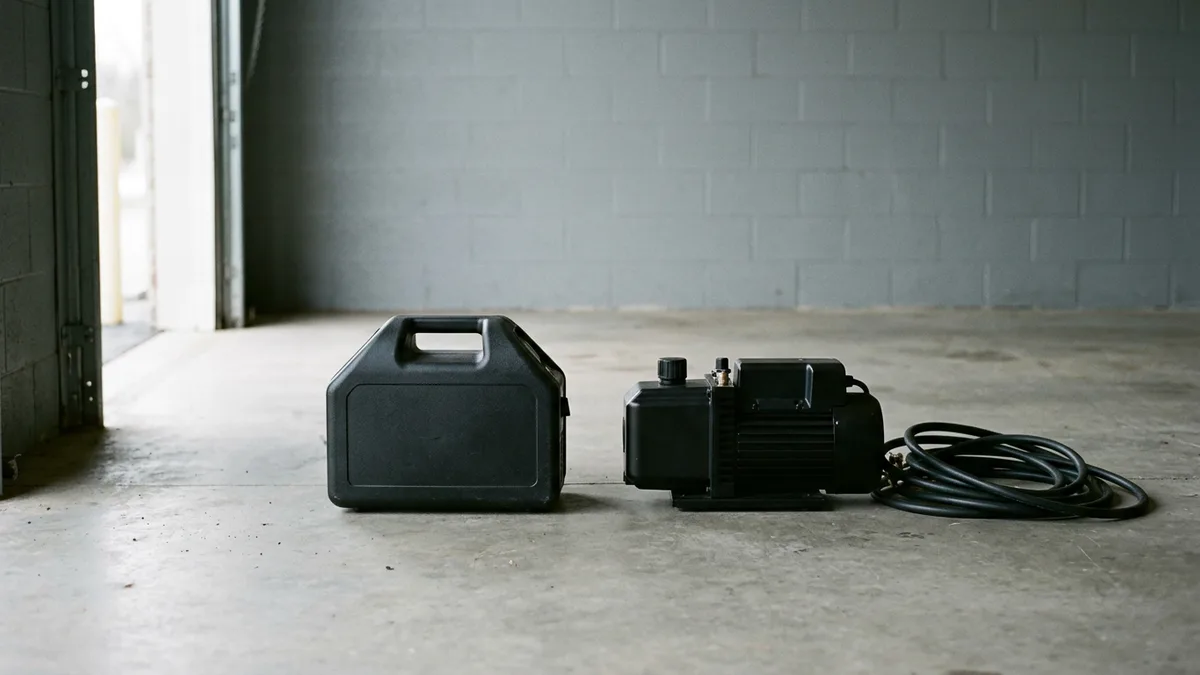
| Fieldpiece VP67 vacuum pump | 6 CFM, two-stage, 1/2 HP, A2L certified | $538.05 |
- Global Test Supply and Test Equipment Depot both print $1,174.70 for the MR45, against a regular price of $1,382.00.
- They agree on the other two as well. The Testo 550s basic kit is $424.15 on both, down from $499.00, and the VP67 is $538.05, down from $633.00.
- Two sellers agreeing to the cent is one price seen twice. Ask a supply house for a third.
- The MR45’s listing says “A2L compatible,” and the VP67’s says “A2L certified.” Those are the sellers’ words. Read each machine’s manual for the refrigerants it covers.
- Test Equipment Depot’s listing for the Testo kit says “No Hoses,” so a hose set is its own line. The same page shows a Yellow Jacket three-pack of hoses at $171.86 as a related item.
- Start with the gauges and the recovery machine, since every refrigerant call needs them. Add the rest when a job asks for it.
The Service Van
| Van | Printed price | Printed spec |
|---|---|---|
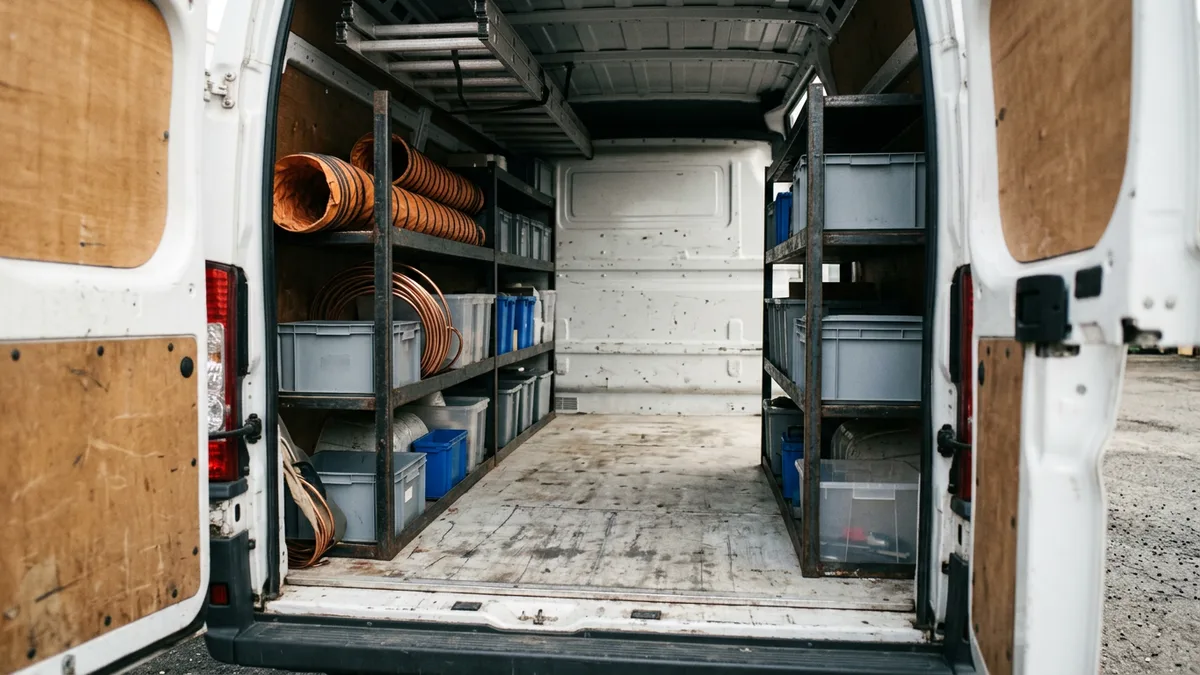
| Ford Transit cargo van | $48,400, plus $2,095 destination | Up to 5,103 lb payload, 246.7 to 487.3 cu ft |
| Ram ProMaster 1500 Tradesman, low roof, 118 in. | $48,965 MSRP | 304 to 463 cu ft across the model, 8,550 lb GVWR |
- Ford’s launch page for the 2026 Transit, posted November 19, 2025, prints the $48,400 starting price. It gives the payload as “when properly equipped,” and the cargo volume as a range behind the seats.
- The Ford Pro fact sheet adds the $2,095 destination and delivery fee. That makes $50,495, before any shelving or racking.
- Kelley Blue Book prints $48,965 for the ProMaster and, beside it, a $46,000 “fair purchase price” it calls a national average. That’s an estimate, not a dealer’s quote. Its cargo volume covers the whole model, and its GVWR is a weight rating, not a payload.
- The guides put the van somewhere else. Housecall Pro’s equipment line, updated October 29, 2026, runs $5,000 to $15,000 for “tools, gauges, and a service vehicle,” and adds that it runs higher for a new, branded one. Workyard, last updated October 26, 2026, puts a used van or truck at up to $40,000.
- Ford’s $50,495 sits $35,495 above the top of Housecall Pro’s line, and that line also has to cover the tools.
- For the financing side, see our service truck financing page, and commercial vehicle financing for the wider category.
Safety Rules That Ride Along
- The Bureau of Labor Statistics says HVAC technicians “have one of the highest rates of injuries and illnesses of all occupations.” It lists burns from electrical parts or chemicals, and muscle strains or sprains from handling heavy equipment.
- OSHA’s construction fall-protection rule, 1926.501(b)(1), calls for guardrails, safety nets, or personal fall arrest systems when a worker is at an unprotected side or edge 6 feet or more above a lower level.
- Whether a service call falls under that construction rule or a general industry one is OSHA’s call, so ask its area office before you assume.
- Housecall Pro’s insurance line runs $2,000 to $6,000 a year. Ask your insurer which safety steps it expects for roof work before you price the first job.
HVAC Business Startup Costs, Added Up
What the Guides Print
- Housecall Pro: licensing and permits $500 to $2,000, and insurance $2,000 to $6,000 a year, besides that $5,000 to $15,000 equipment line.
- Workyard: tools $2,000 to $12,000, a used van or truck up to $40,000, and a new one “typically priced between $125,000 and $150,000,” which is more than twice Ford’s printed Transit price.
- Durable, last updated December 18, 2025: a lean start at “$8,500-$12,000 total” with a used van at $3,000 to $5,000. It calls the usual $10,000 to $50,000 range “useless.”
- Simpro, published March 24, 2026, lists the cost categories and prints no dollar figure.
A Build From the Printed Prices
| Line | Printed price |
|---|---|
| Ford Transit cargo van with destination fee | $50,495.00 |
| Fieldpiece MR45 recovery machine | $1,174.70 |
| Testo 550s basic kit | $424.15 |
| Fieldpiece VP67 vacuum pump | $538.05 |
| Total of the four | $52,631.90 |
- The three tools come to $2,136.90, which sits inside Workyard’s tools range. The van is what pulls the guides apart.
- The build leaves out hoses, shelving, hand tools, the license fee, Texas’s insurance minimums, the premium on a $25,000 California bond, sales tax, and any month with no customers.
- Housecall Pro puts licensing and permits at $500 to $2,000. The years of supervised work behind a license don’t appear in any guide’s total.
Where Financing Fits for a New HVAC Company
- We finance equipment, so weigh this section with that in mind. Paying cash is a sound answer for a $424.15 manifold kit. A $50,495 van is a different size of decision.
- Ask whether a quote is a loan or a lease. With a loan, you own the van as you repay it. With a lease, you use it for a term, then return it, renew, or buy it on the terms the lease sets. Our guide to operating and finance leases covers the difference.
- A lender financing a van or a recovery machine usually records its claim with a UCC-1 filing that describes the equipment. That public record is how the next lender sees it.
- Plenty of HVAC gear is bought used, and our used equipment financing page covers what to raise about age and hours.
- For a first-year company, our startup equipment financing page lists what lenders commonly ask to see. Each lender sets its own requirements.
- Section 179 of the Internal Revenue Code lets a business elect to expense qualifying equipment in the year it’s placed in service, within limits. IRS Publication 946 carries the rules and the figures for tax year 2026, and our Section 179 deduction guide covers the mechanics. Whether a given van or recovery machine qualifies for you is a question for your tax advisor, so consult your tax advisor before you buy.
- If you also work the plumbing side, our guide to starting a plumbing business covers the licenses and prices for that trade.
Questions New HVAC Owners Ask Before Launch
Does the 608 card belong to you or to the company?
It belongs to the technician. EPA’s Section 608 rules certify individuals, so each person who services refrigerant-bearing equipment needs their own, unless they’re an apprentice under close and continual supervision by a certified technician. Your card doesn’t cover the hire you make next spring.
Do you need a contractor license before your first job?
California’s contractors board requires one once a project’s labor and materials reach $1,000, or whenever the work needs a building permit. The Bureau of Labor Statistics says some states and localities require HVAC technicians to be licensed. Read your board’s page. The line moves by state.
Realistically, how many years of field work do the states want?
Four years. That’s the number in Arizona, California, and Texas, though each counts them differently. Arizona wants two of the four within the last ten, California wants four full years at journey level within the ten before filing, and Texas wants 48 months of supervised work within the past 72. Ask whether apprenticeship time counts.
Is pre-2025 equipment still going in under EPA’s 2026 rule?
EPA’s final rule of May 26, 2026, allows residential and light commercial air conditioning and heat pump equipment manufactured or imported before January 1, 2025, to continue to be installed. Equipment made after that date falls under EPA’s global warming potential limit of 700. Read local rules too.
Is a recovery machine optional at launch?
Plan on one. EPA prohibits intentionally venting refrigerant while servicing equipment, with three narrow exceptions, and recovering it is how a technician keeps it out of the air. Check the machine’s listing against the refrigerants you’ll see, since a seller’s A2L label isn’t a manual.
Next Steps
- Look up your state board’s HVAC page, and write down the license class, the years of experience, and the bond or insurance it asks for.
- Price the van and the recovery machine from two sellers, with the date beside each price.
- When you’re ready to talk equipment, see how Paramount Financial handles financing for HVAC contractors, or start an application.