
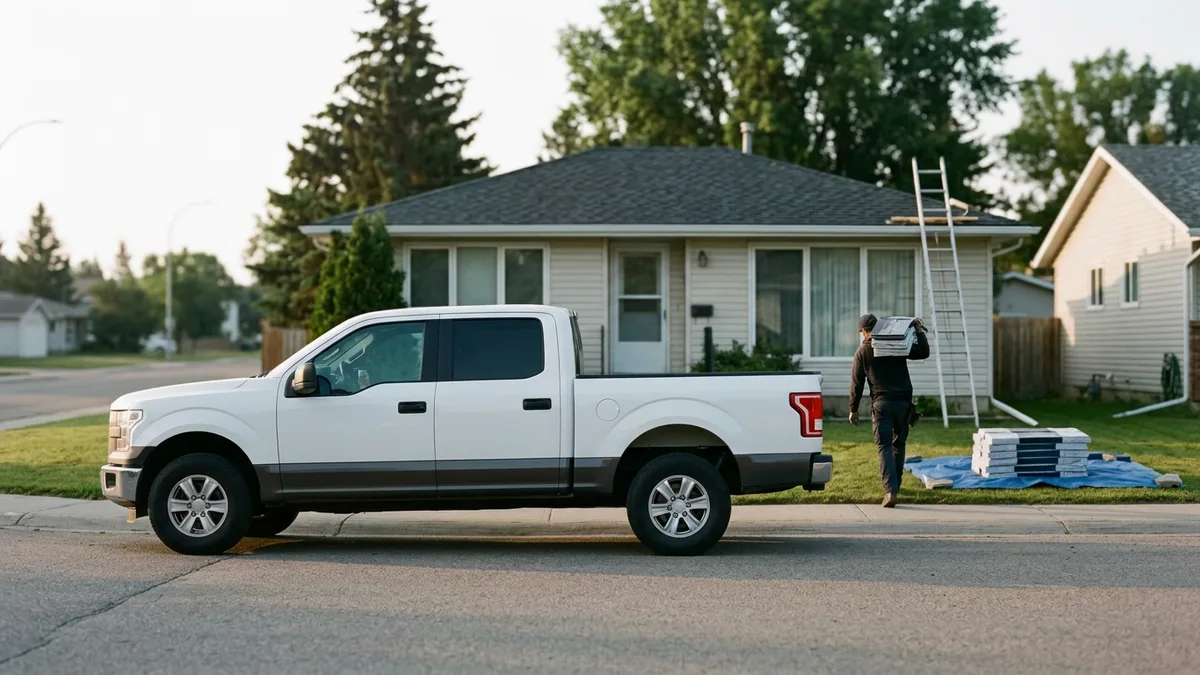
How to Start a Roofing Company: Licensing, Insurance and Equipment Costs

Key takeaways
How to start a roofing company comes down to three early calls: which state license the work requires, which insurance your first crew needs, and how you’ll buy the truck, trailer, and fall protection.
- The Bureau of Labor Statistics put the May 2025 median pay for roofers at $55,440 and counted 166,900 roofing jobs in 2025.
- California won’t let a roofing licensee skip workers’ compensation, even with no employees.
- OSHA’s fall rules start at an unprotected edge 6 feet or more above a lower level, before the first bundle of shingles goes up.
- The startup guides print totals from $6,000 to $50,000 and up, and the truck explains most of the gap.
- Arizona, California, and Florida each license roofers differently.
The Bureau of Labor Statistics page for roofers, last modified September 14, 2026, lists no formal educational credential and no related work experience for the job. The license is another matter, and its rules change at every state line. Nobody asks to see your nailing speed.
Here’s how to start a roofing company in the order the pieces bite: the license, the insurance, OSHA’s fall rules, then the truck, trailer, and hoist. Seller prices are the ones printed on pages we read on November 23, 2026, and every guide’s figure is labeled as that guide’s. Pricing the gear? Our roofing equipment financing page covers how loans and true leases fit crew trucks, trailers, and lifts.
Start a Roofing Company at the Licensing Board
The BLS calls roofing training moderate-term and on the job, with apprentices usually starting at 50 percent of what journey workers earn. Easy to enter. The contractor license is where it gets hard.
$55,440
Median annual pay for roofers in 2025 with 166,900 roofing jobs and 5 percent projected growth from 2025 to 2035
Source: Bureau of Labor Statistics, Occupational Outlook Handbook, Roofers, last modified September 14, 2026
- A roofing license classification is the state’s label for the work a contractor may legally take on. California’s C-39 covers products and repairs that seal, waterproof, and weatherproof a structure. Arizona’s CR-42 combines commercial and residential roofing in one license. The label decides which jobs you can bid, so read its scope before the first estimate.
| State | License | The rule that bites |
|---|---|---|
| Arizona | CR-42 Roofing, a dual license | Four years of trade experience, two in the last ten |
| California | C-39 Roofing | Four full years at journey level, plus a $25,000 bond |
| Florida | Certified or registered roofing contractor | A board exam, and general contractors can’t roof without it |
- Arizona’s statute, A.R.S. 32-1122, asks the qualifying party for at least four years of practical or management trade experience, two of them within the last ten, and it caps credited technical training at two of the four years. The administrative code says CR-42 allows the scopes of the commercial C-42 and the residential R-42. Two licenses in one.
- Read the R-42 scope before you bid a tear-off. Under R4-9-103, a residential licensee can replace up to 10 percent of the roof substrate if it turns out bad after the contract is signed. Past that, the work goes to a properly licensed subcontractor.
- California’s contractors board requires a license once a project’s labor and materials reach $1,000, or when the job needs a building permit or additional workers. Its application page asks the qualifying individual for four full years at journey level, or as a foreman, supervisor, or contractor, within the ten years before filing. A $25,000 bond has to be in place before the license issues, and the C-39 page sets the scope at products and repairs that seal, waterproof, and weatherproof structures.
- Florida carves roofing out on its own. The state’s construction industry page defines a roofing contractor as one whose services are unlimited in the roofing trade, certified (code CC) or registered (RC). Under Florida Statutes 489.113, competence is shown by passing the board’s exam, and no general, building, or residential contractor certified after 1973 may act as or advertise as a roofing contractor without that certification or registration.
Our rule? Before you price a single machine, write down which license class the work requires and whose experience the state counts on it. Everything else waits for that answer.
Insurance, Bonds, and Workers’ Comp
California goes further for roofers than a lot of owners expect. Roofing licensees have to carry workers’ compensation insurance, or a certificate of self-insurance, whether or not they have employees, and the contractors board says a C-39 holder can’t file the exemption that some other classifications can. The source is Business and Professions Code section 7125. No solo exemption.
Florida ties coverage to the license itself. Section 489.114 makes evidence of workers’ compensation coverage a condition of issuing or renewing a certificate or registration. Coverage first, license second.
What does it cost? The guides sketch it loosely. Jobber, last updated June 15, 2026, prints $250 to $650 or more a month for roofing insurance, which comes to $3,000 to $7,800 a year by our arithmetic, while ZenBusiness, last updated October 6, 2026, splits it into general liability at $2,000 to $5,000 a year and a workers’ compensation initial premium of $1,500 to $4,000. Guide figures, not quotes. Your own quote is the only number that counts.
Keep the bond separate in your head. California’s $25,000 is the amount of the bond, and what the premium costs is a different question for a surety agent. Two numbers, two questions.
OSHA Fall Rules Set the Safety Budget
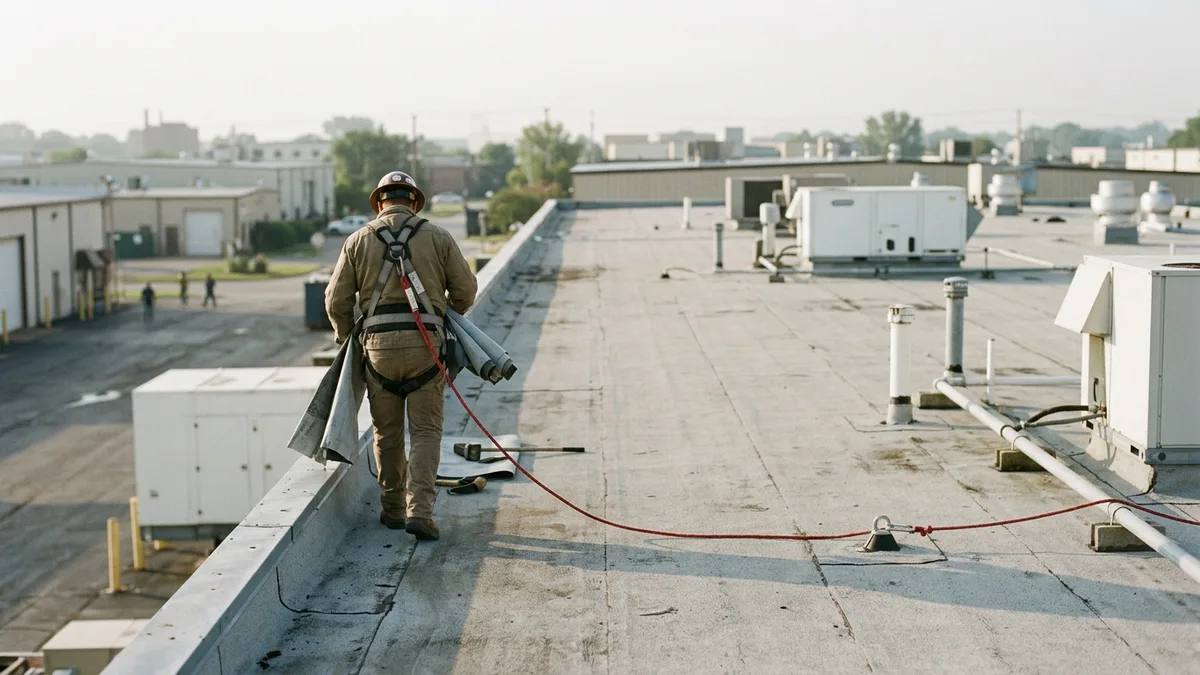
OSHA’s construction fall-protection rule, 29 CFR 1926.501, begins at an unprotected side or edge 6 feet or more above a lower level. Measure first. Roofing gets its own paragraphs on top of that.
- Low-slope roofs fall under paragraph (b)(10). An employer can use guardrails, safety nets, personal fall arrest, or a warning line combined with another system, and on roofs 50 feet or less in width a safety monitoring system alone is permitted.
- Steep roofs, paragraph (b)(11), list guardrails with toeboards, safety nets, and personal fall arrest systems.
- Residential construction has (b)(13). A fall protection plan is allowed there only when the standard systems are infeasible or create a greater hazard, and OSHA presumes they’re feasible.
If a crew picks personal fall arrest, 1926.502(d)(15) wants each anchorage to support at least 5,000 pounds per employee attached, or to be designed with a safety factor of at least two under a qualified person. A load, not a suggestion. Read it twice. The BLS adds that most employers require roofers to complete safety certification that meets OSHA guidelines.
ZenBusiness puts safety equipment, meaning harnesses, anchors, and hard hats, at $500 to $1,500, and that one line has to stretch across every person on the crew who steps on the roof. Count heads, not trucks.
Truck, Trailer, and Hoist: Printed Prices
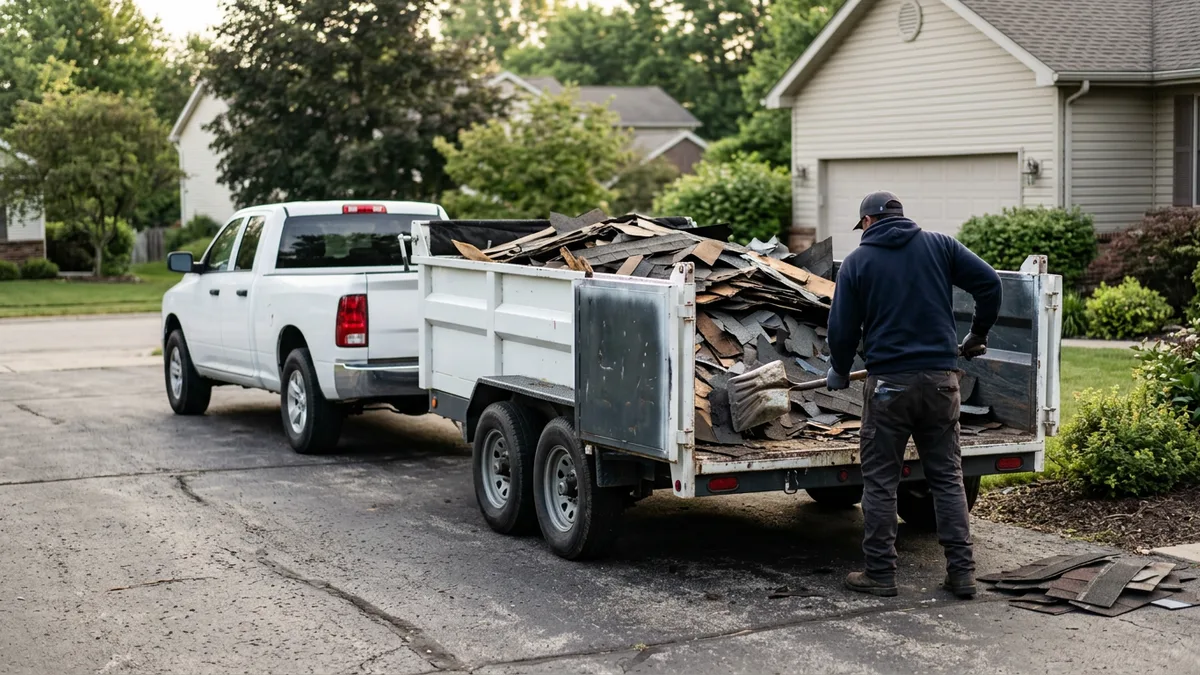
Three purchases do most of the damage to a startup budget: something to tow with, something to haul debris in, and something to lift bundles. These are the prices the sellers printed on November 23, 2026. Dated prices only.
| Item | Seller | Printed price |
|---|---|---|
| 2027 Ford F-250 XL | Ford | $46,125 starting at |
| 7 by 14 dump trailer, 14,000 lb GVWR | Texas Pride | $9,195 factory pickup |
| 7 by 14 dump trailer, 14,000 lb GVWR | Load Runner | $14,595 |
| TranzSporter TP250 hoist, gas | Big Rock Supply | $2,695 with a Lifan engine |
| TranzPorter TP400 hoist, gas | SuperArbor | $3,007.62 |
Ford’s build page prints $46,125 as the starting price for the 2027 F-250 XL. It doesn’t name a cab, drive, or box for that figure, and no destination fee appeared in the text we read. A starting point only. For the financing side of work trucks and vans, see our commercial vehicle financing page.
The guides price the truck another way entirely. ZenBusiness lists a work truck at $5,000 to $25,000, as a used purchase or a lease down payment, and IKO says a good used one can run under $10k. The distance between that and a new truck at Ford’s starting price is bigger than the trailer and the hoist put together. That’s a wide gap.
- Texas Pride’s page prices its 7 by 14 with 24-inch sides at $9,195 for factory pickup and $11,494 as the market price, with state pickup prices on the page running from $9,195 to $11,445. Its own body copy says “starting at just $7,745,” which doesn’t match its table, so we used the table.
- Load Runner prints $14,595 as “Our Price” for a 2026 Load Trail with a 3 stage telescopic hydraulic lift and a 9,730-pound payload, with $15,095 beside it.
- Delivery isn’t priced on either page.
- The two sellers sit $5,400 apart on trailers with the same size and GVWR. Compare payload, not the rating, and read what the lift is. Our dump trailer financing page covers the financing side.
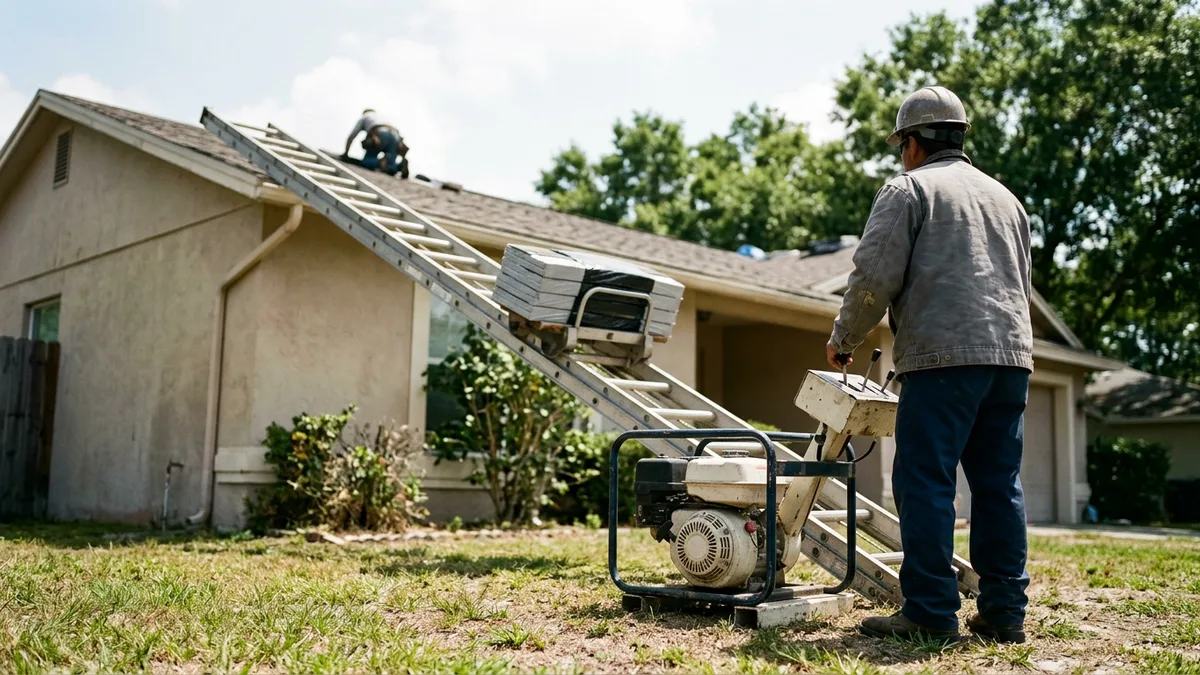
A gas ladder hoist moves bundles up a track instead of up a ladder on someone’s shoulder. Big Rock Supply lists the Tie Down TranzSporter TP250 at 250 pounds on a 28-foot track that extends to 44 feet, with the engine as a priced option, $2,695 for a 4 hp Lifan and $3,280 for a Honda. SuperArbor prices the TranzPorter TP400, a 400-pound unit on a 28-foot track with a Lifan engine, at $3,007.62. One line on the Big Rock page is easy to miss. Mind the power lines. The page says to keep at least 10 feet from electrical lines.
Some crews skip the track and bring in a telehandler. Bigger machine, bigger decision, and it has its own page on our site, telehandler financing.
Roofing Company Startup Costs, Added Up
The guides don’t agree. They say so in different dollar amounts. Jobber prints $6,000 to $15,000 or more for a bare-minimum start if you already own a work vehicle, and $15,000 to $50,000 or more once a truck or van, insurance, equipment, safety gear, software, and first materials go in. ZenBusiness says roughly $10,000 to $50,000 or more. Thryv, updated July 2, 2026, says most new contractors spend $10,000 to $25,000 on equipment, insurance, licensing, marketing, and payroll.
| Line | The guides | The sellers |
|---|---|---|
| Work truck | $5,000 to $25,000 used | $46,125 new, starting at |
| Dump trailer | $4,000 to $8,000 | $9,195 to $14,595 new |
| Ladder hoist | Not a line in the table | $2,695 to $3,280 |
| Safety equipment | $500 to $1,500 | Not priced from a page |
Add the new truck, trailer, and hoist from the sellers’ pages and you land between $58,015 and $64,000. That’s the low end, $46,125 plus $9,195 plus $2,695, and the high end, $46,125 plus $14,595 plus $3,280. It leaves out the destination fee, sales tax, a fall-arrest kit, nailers, ladders, insurance, the bond premium, and the weeks before the first payment.
Both totals top the guides’ ceiling of $50,000 and the truck is why, because swapping in ZenBusiness’s $25,000 used-truck figure puts the same trailer and hoist at between $36,890 and $42,875. Neither path is wrong. Which one fits your numbers is yours to decide. Make the gap visible when you do.
Funding Your First Big Contract
A signed contract isn’t cash. Crew payroll, materials, a dumpster or a dump trailer, and the equipment itself can come due before the first progress payment arrives. Some roofing and construction contractors use short-term working capital to cover that stretch and repay it from the contract’s payments as they come in.
We’re not quoting amounts, terms, or timing here, because each lender sets its own. Our construction business loans page explains in general terms how working capital for contractors works.
Before you sign, list the first stretch of the job’s payroll, materials, and equipment costs, and mark the date the first progress payment is due. The distance between those two lines is the gap you’d be funding. Map it early.
Where Financing Fits for a New Roofer
- We finance equipment, so weigh this section with that in mind. Paying cash is a sound answer for a hoist or a fall kit. A truck is a different size of decision.
- Ask whether a quote is a loan or a lease. With a loan, you own the truck or trailer as you repay it. With a lease, you use it for a term, then return it, renew, or buy it on the terms the lease sets.
- A lender financing a truck or trailer usually records its claim with a UCC-1 filing that describes the equipment. That public record is how the next lender sees it.
- Plenty of roofers buy the first truck used, and our used equipment financing page covers what to raise about age and condition.
- For a first-year company, our startup equipment financing page lists what lenders commonly ask to see. Each lender sets its own requirements.
- Section 179 of the Internal Revenue Code lets a business elect to expense qualifying equipment in the year it’s placed in service, within limits. IRS Publication 946 carries the rules and the figures for tax year 2026, and our Section 179 deduction guide covers the mechanics. Whether a given truck, trailer, or hoist qualifies for you is a question for your tax advisor, so consult your tax advisor before you buy.
- If you’re planning a wider company than roofing, our guide to starting a construction company covers licensing, equipment, and cash flow.
Questions New Roofing Owners Ask Before Launch
Whose field experience does the license count?
The license counts the experience of the person it names. California calls that person the qualifying individual and Arizona’s statute calls them the qualifying party, and each asks for four years of field time. If the person with the experience isn’t the owner, read the board’s rules on who can hold that role.
Realistically, how many years of field work do states want?
Four years. That’s the minimum in Arizona’s statute and in California’s application rules, though each counts the time its own way. Arizona wants at least two of the four within the last ten, and training credit can cover no more than two years. California wants four full years at journey level, or as a foreman, supervisor, or contractor, within the ten years before filing.
Can a one-person roofing company skip workers’ compensation?
Not in California, where roofing licensees must carry workers’ compensation whether or not they have employees. The contractors board says a C-39 holder can’t file the no-employee exemption that some other classifications can. Check your own state’s board before you assume anything, since Florida, for one, makes proof of coverage a condition of its certificate or registration.
Does a one-story house need fall protection?
Measure the edge. OSHA’s trigger in 1926.501(b)(1) is an unprotected side or edge 6 feet or more above a lower level, and residential work has its own paragraph, (b)(13). A fall protection plan is allowed there only when the standard systems are infeasible or create a greater hazard.
Should the first truck be new or used?
Price both. The guides differ by tens of thousands of dollars on this one line. ZenBusiness puts a used work truck or a lease down payment at $5,000 to $25,000, and Ford’s page starts a new F-250 XL at $46,125. A used truck brings mileage and a title to check, and our used equipment financing page lists the questions to raise.
Next Steps
- Call your state’s contractor board, or open its site, and ask which roofing class covers the jobs you’ll bid.
- Get an insurance quote with your payroll in hand, and ask the agent which fall-protection steps the policy expects.
- Price one truck, one trailer, and one hoist from two sellers each, with the date beside every price.
- When you’re ready to talk equipment, see how Paramount Financial handles financing for roofing contractors, or start an application.