
Last updated: November 25, 2026
Bucket Truck Financing for Utility, Tree Service and Telecom Contractors
What a bucket truck quote should list, what to check on a used boom, and loan versus lease.
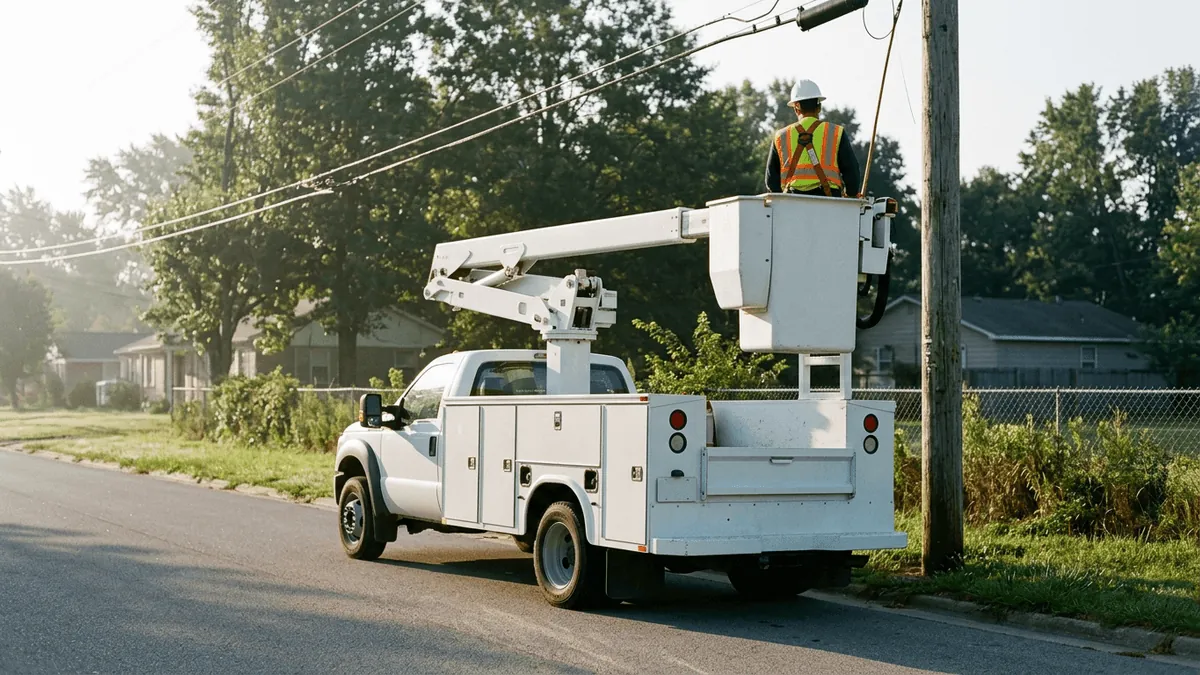
Bucket truck financing covers two machines in one purchase, a truck chassis and the aerial device mounted on it. A useful quote prices each, states the insulation rating, and shows the boom’s last test date.
Say a line-clearance crew wins a three-year contract that needs a second boom truck. The cab and the wheels are easy to judge. The boom is harder, because nothing on the outside shows whether its insulation is still rated for the work. Easy to miss.
This page sits under our commercial truck financing guide, while trucks with a crane or a compressor on the body are on service truck financing and a tree crew’s other machines are on forestry equipment financing.
What a bucket truck quote should list
Call it a bucket truck, because that’s what the trade calls it. Strip the nickname and you have an aerial device, a boom with a platform on the end, bolted to a truck. OSHA gives the whole rig a name in its rule for these machines: a mobile unit, meaning the aerial device, its vehicle and the related equipment.
Lines to see on the quote
Two prices, then. One for the truck, one for the boom. If a quote shows a single number for the whole unit, ask for both lines before you set it beside another quote.
Bucket truck insulation: what the plate and the test date tell you
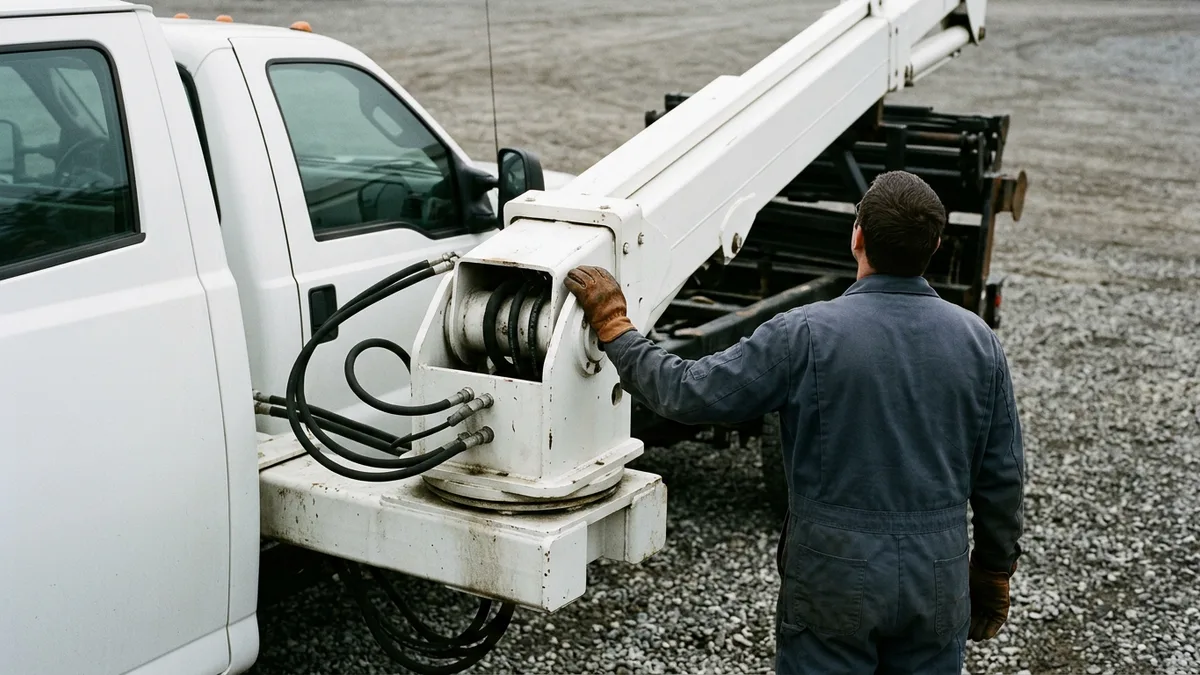
You can’t see insulation. Terex Utilities’ Jim Olson wrote in EC&M that a unit has to be tested to prove what it provides, and the plate near the lower controls records the result as a qualification voltage and a test date. Four situations cover most of what a buyer meets.
| The unit | What the plate and file show | What it means for the quote |
|---|---|---|
| Insulated, test current | A qualification voltage, and a periodic test inside the last 12 months | The rating holds. Keep the report with the paperwork. |
| Insulated, test lapsed | A qualification voltage, but no periodic test within 12 months | Terex Utilities says it can no longer be considered insulated until it’s tested again. |
| New fiberglass boom fitted | A test date that predates the replacement | The original qualification test is no longer valid, so a new one is needed. |
| Non-insulated aerial device | No qualification voltage | Not designed for work on energized lines. Daily control checks and periodic boom inspections still apply. |
A test is also due after repairs to the insulated sections, such as hoses or leveling components, and after any unintended contact with an energized line. Ask the seller which row the truck sits in. Get the answer in writing. Don’t skip that.
Used bucket truck financing starts with the file on the boom
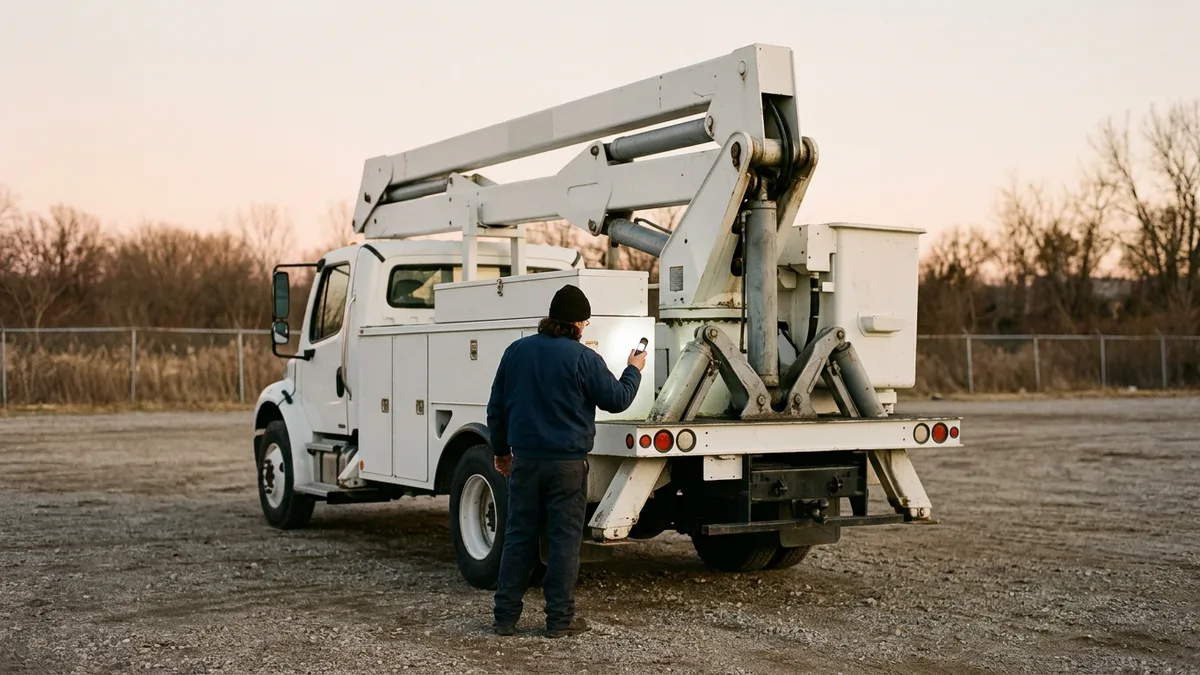
Used units sell as-is. Terex Utilities, which builds these booms, tells buyers to schedule a comprehensive inspection by a qualified person before the unit goes to work, because it may not be safe until it’s inspected and repaired. That’s the buyer’s job.
Two housekeeping rules follow. The operator’s manual has to ride on the vehicle, and Terex wants each new owner reported to it within 60 days. Check the maker’s version.
Papers to ask the seller for
Hand that file over early. It’s also the file the next owner will ask you for at resale. Our guide to used equipment financing covers buying secondhand more broadly.
Two assets, two lifespans, one purchase
Terex Utilities puts a chassis’s expected life at 10 to 12 years, depending on mileage, and says its aerial devices may last much longer, so a sound boom can outlive the truck it came on. The truck wears out first. The boom might not.
Equipment managers then have three options, according to that same article: sell and buy new, transfer the aerial device to a new or rebuilt chassis, or rebuild the original package. Transfers aren’t casual. IPAF calls a remount a specialist job, and without the maker’s approval the company that does it becomes legally responsible as the manufacturer.
Loan or lease on a titled truck
The chassis carries a certificate of title, and UCC section 9-311 says a financing statement isn’t necessary or effective for goods under a title statute, so a lender’s claim on the truck is noted on the title instead. Under a loan or an equipment finance agreement, the business owns the truck and the lender holds that claim.
Paramount Financial writes true equipment leases, operating leases among them, alongside loans. Whichever structure a crew picks, ask what the contract says about moving the boom to a newer chassis.
What a bucket truck answers to
Three intervals from OSHA and Terex Utilities, none of them a price or a rate.
Each day
The lift controls get tested before use, on every day the boom works
Source: OSHA, 29 CFR 1910.67
12 months
The longest an insulated boom can go without a periodic dielectric test and still count as insulated
Source: Terex Utilities in EC&M, 2025
5 years
The minimum time ANSI says periodic inspection and test records are kept
Who rides in the bucket, and what to confirm
Bucket truck financing questions, answered
So what’s the difference between a bucket truck loan and a lease?
The business owns the truck under a loan, and the lessor owns it under a true lease. Say the boom fails its next dielectric test partway through the term. Who pays for the repair, and who holds the test file? Put both answers in the contract.
What financing options are available for bucket trucks?
Short answer: a loan, an equipment finance agreement, or one of three lease structures, fair market value, $1 buyout and TRAC. Each handles the title, the boom and the end of the term in its own way. Our guide to how to get equipment financing walks through the application.
What does a lender want to see on a used bucket truck?
Expect to show the boom’s file first: the latest dielectric test report, the last periodic inspection and the service history. The chassis details come second. A missing page in that file reads as a question mark over the whole truck. Whether a lender takes the truck is that lender’s call, so ask before paying for an inspection.
What sets the repayment period on a used bucket truck?
Terex Utilities puts a chassis’s expected life at 10 to 12 years depending on mileage, and says the boom can outlast it. Each lender sets its own term and age limits, and none is quoted here. Ask how it weighs the chassis’s age against the boom’s test file.
What slows bucket truck financing down?
A missing test report is a common snag, because someone has to chase it down. An unsigned inspection does the same, and so does a quote that prices the truck and the boom as one number. Past the paperwork, timing depends on the lender, the amount, how complete the application is and whether the seller is a dealer or a private party. No web page can promise days.
What happens to the boom when the truck underneath it wears out?
The boom can often move to another chassis, a job the trade calls a transfer or a remount. IPAF calls a remount a specialist job: done without the maker’s approval, it makes the company doing it legally responsible as the manufacturer, and the finished device has to be certified to the standard for the region. Ask a lender or lessor how its paperwork handles a boom that changes trucks.
Have a bucket truck to talk through?
Leave your details and a Paramount Financial specialist will call to talk through the truck and the structure. Prefer the application? Start the credit application.