
How Much Does an ATM Machine Cost for a Business?

Key takeaways
How much does an ATM machine cost for a business? Dealer pages read November 25, 2026 listed new freestanding units from $2,425, a countertop or wall-mount unit from $2,859, and a through-the-wall unit at $4,545.
- One Genmega GT3000 printed at $3,999, $4,545, and $4,599.99 at three sellers.
- Through-the-wall cost $2,120 more than the freestanding Genmega at the same dealer.
- A certified pre-owned Triton RL2000 listed from $1,899, with a six-month warranty.
- No machine price includes the cash that goes inside it.
A countertop ATM weighs 121 pounds. A freestanding Hyosung Halo II weighs 265 and stands 56.4 inches tall. Each comes with a price. Neither price includes a dollar of the cash that goes inside.
This guide prices the machine and what surrounds it. Cost only. What a machine earns depends on the location and on the terms of whatever agreement puts it there, and nothing in this guide estimates that, because no dealer price page can tell you. For the wider picture of buying equipment, start with our commercial equipment financing page.
What Sets an ATM Machine Cost
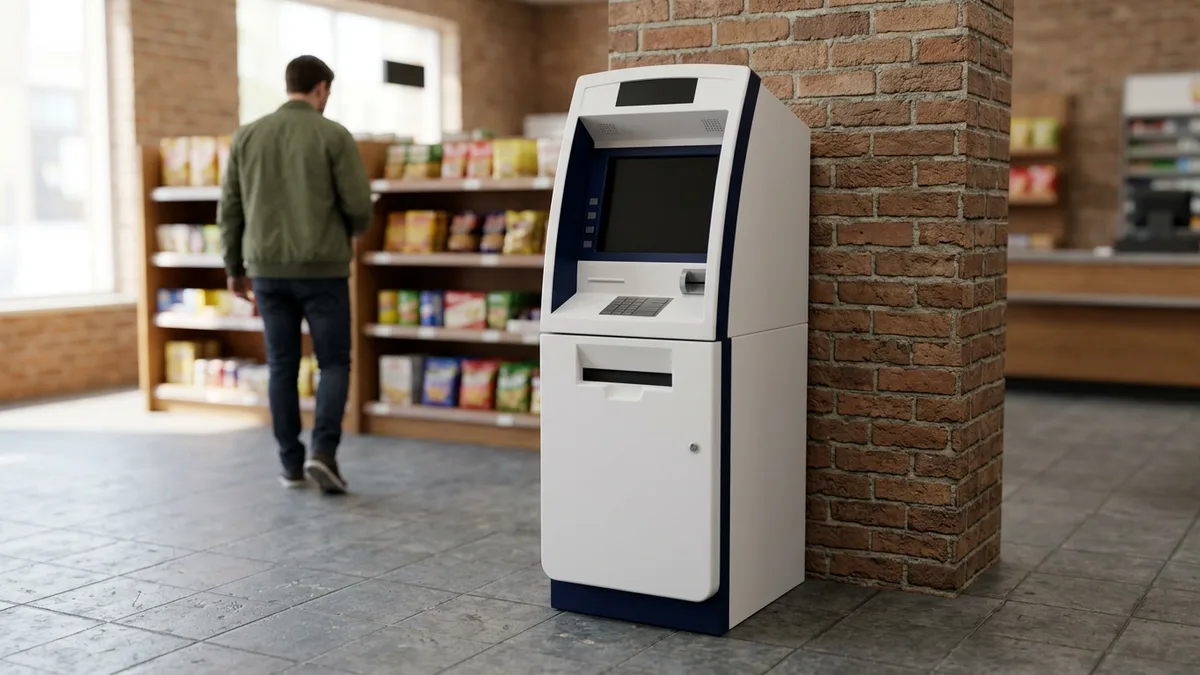
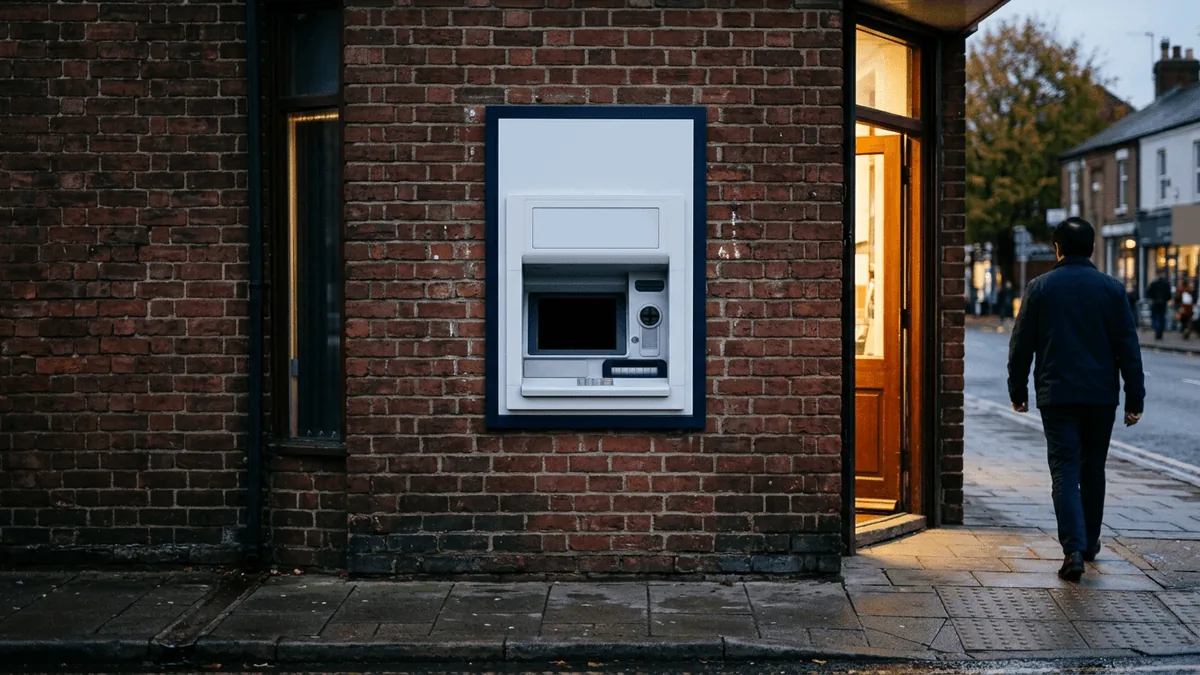
An ATM sold to a business is a cash-dispensing terminal that reads a card, takes a PIN, and talks to a processor’s network. Its price follows the form: a countertop or wall-mount unit, a freestanding cabinet on the floor, or a through-the-wall unit set into the building with its cash loaded from inside.
| Countertop or wall-mount | Freestanding | Through-the-wall | |
|---|---|---|---|
| Example | Genmega Onyx-W | Hyosung Halo II | Genmega GT3000 |
| Weight | 121 lbs | 265 lbs | 145.6 lbs |
| ATM Depot price | From $2,859 | From $2,469 | $4,545 |
- Prices: ATM Depot’s Onyx-W page, its Halo II page, and its GT3000 page, read November 25, 2026.
- Weights: ATM Depot for the Onyx-W, Hyosung’s Halo II page, and Genmega’s GT3000 page.
Weight costs money. A 265-pound cabinet needs a delivery plan and a floor that takes it, while a through-the-wall unit needs someone to open the wall, build the opening, and reach the back of the machine to load it.
New ATM Machine Prices Seller by Seller
Three sellers printed a price for the same Genmega GT3000 on November 25, 2026. They don’t match.
| Model | Type | Seller | Price |
|---|---|---|---|
| Genmega G2500 | Freestanding | ATM Depot | From $2,425 |
| Hyosung Halo II | Freestanding | ATM Depot | From $2,469 |
| Hyosung Halo II | Freestanding | C.E.S. ATM | From $2,549.99 |
| Genmega Onyx-W | Countertop | ATM Depot | From $2,859 |
| Genmega Onyx-W | Wall-mount | Lieberman | $2,999 |
| Genmega GT3000 | Through-the-wall | Lieberman | $3,999 |
| Genmega GT3000 | Through-the-wall | ATM Depot | $4,545 |
| Genmega GT3000 | Through-the-wall | C.E.S. ATM | $4,599.99 |
$600.99
The gap between the lowest and highest price printed for one Genmega GT3000 through-the-wall ATM on November 25, 2026
Source: Lieberman Companies, How Much Does it Cost to Buy an ATM Machine? and C.E.S. ATM, Genmega GT 3000, 2026
- These are listing prices from product pages, not quotes. ATM Depot prints “as low as” on four of its five listings, and only the GT3000 carries a flat price.
- Lieberman’s $3,999 is the page’s “average cost” for the GT3000, and its $2,999 is the Onyx-W. The page is undated.
- C.E.S. ATM’s pages are undated, too. Its Halo II reads “from $2,549.99.”
- Same dealer, same maker, different form: ATM Depot’s GT3000 is $2,120 above its freestanding G2500.
Quote by model number. Two sellers can print prices for the same machine $80.99 or $600.99 apart, and only a model number makes the quotes comparable.
Used and Certified Pre-Owned ATM Prices
ATM Depot’s certified pre-owned Triton RL2000 lists “as low as” $1,899. Limited quantities. The warranty runs six months against 24 on its new units, and the page says the unit ships without its topper. Lieberman says a used ATM “will generally cost between $1,600-$1,800,” a figure from an undated page.
Age cuts both ways. ATM Depot’s page for the Hantle 1700W calls the machine “discontinued and non-compliant,” says Hantle is out of business, and says running a non-compliant ATM is “against network regulations.” A machine the network won’t accept is a liability at any price.
- The make, the model, and the serial number on the nameplate.
- Whether the maker still supports it with software and parts.
- Which PIN pad it carries, and whether that pad is PCI-listed.
- Whether the card reader reads chips, or only swipes.
- What the warranty covers and who honors it.
- Whether your processor will activate that model, in writing.
Costs Outside the Machine Price
Some lines are free at one seller and billed at the next. Compare them line by line.
- Shipping. ATM Depot’s new-unit pages print “Free Shipping ($350 Value),” except to Alaska and Hawaii.
- Installation and training. ATM Depot lists $99 to $375 across its pages, $199 to $350 on the Halo II, and says the range assumes the location is ready with power and communications.
- Options. An NFC reader is $400 on the Halo II and $450 on the Onyx-W and GT3000. A 2,000-note cassette is $325 on the Halo II and $365 on the Onyx-W.
- Power. Genmega lists the GT3000 at 110/220 VAC and 145 watts.
- The wall. No page we read prices the opening. Genmega’s GT3000 page links a “GT3000 Through-The-Wall Construction Guide,” so get that before you ask a contractor for a number.
- Processing. C.E.S. ATM lists installation, setup, training, and tech support as free in a program with a per-transaction processing fee. The fee reads $0.25 in one place on the page and $0.35 in another.
- Cash loading. No seller page priced it.
The largest line is the cash itself. ThePricer’s October 5, 2026 update says self-funded operators commonly need $2,000 to $8,000 per ATM in rotating vault cash. It isn’t a fee. It’s money sitting in a machine, and it isn’t in any price above.
Three Checks Before a Deposit
- Accessibility. The ADA’s 2010 Standards say that “at least one of each type provided at each location shall comply with 707.” Section 707 is where “Machines shall be speech enabled” appears, with tactile input controls and Braille instructions for starting the speech mode. Get the seller to confirm in writing that the exact model and setup meets it, and ask an attorney or accessibility consultant what applies to your location. Read the text on the ADA’s 2010 Standards page.
- The PIN pad. The PCI Security Standards Council’s PTS POI standard covers devices that protect cardholder PINs, including encrypting PIN pads that go into other devices “such as ATMs.” Ask which pad the machine carries.
- Chips. Hyosung’s Halo II page lists a “Dip Hybrid Card Reader” that is “EMV Level 1,2 Compliant.” Genmega’s GT3000 page says “EMV Optional.” One seller may count that as an add-on and the next as standard.
Paying for the ATM Machine
- We finance equipment for a living, so weigh this section with that in mind.
- A loan or an equipment finance agreement makes the business the owner, with a lien on the machine until it’s paid.
- A lease keeps title with the lessor during the term. A fair market value lease prices the buyout at what the machine is worth at the end, and a $1 buyout lease is built so the business keeps it.
- Lenders differ on whether delivery, installation, and the first cash load can sit inside the amount financed. Ask before you sign the seller’s quote.
- The cash isn’t equipment, so plan for it separately.
Buying used from a private seller is a different file. Our used equipment financing page explains how. Another machine that sits in a location and takes cards is priced the same way in our vending machine cost guide, and a business adding card acceptance may be weighing POS system financing alongside it.
ATM Machine Questions Owners Ask Before Buying
Does a certified pre-owned ATM still make sense next to a new one?
Short answer: only if the model is still supported. ATM Depot lists its pre-owned Triton RL2000 from $1,899 with a six-month warranty, while its new units carry 24 months.
The same seller calls the Hantle 1700W “discontinued and non-compliant.” Support is the question, not the price.
How much cash has to go in before the first withdrawal?
$2,000 to $8,000 per ATM. That’s the rotating vault cash ThePricer says self-funded operators commonly need, in its October 5, 2026 update.
It isn’t a fee. Nor is it part of any machine price. Who loads it, and what that costs, is a separate quote.
Is installation included in the price?
Not on ATM Depot’s pages. Shipping is free, but professional installation and training is an add-on, $99 to $375 across the listings.
- That range assumes power and communications are already in place.
- C.E.S. ATM folds installation into a program that carries a per-transaction fee.
Which accessibility rules reach an ATM in a store?
Sections 220.1 and 707 of the ADA’s 2010 Standards. Section 220.1 sets the scoping, and 707 holds the technical requirements, including speech output.
Whether they apply to your location is a question for an attorney or accessibility consultant.
What does a through-the-wall ATM need that a freestanding one doesn’t?
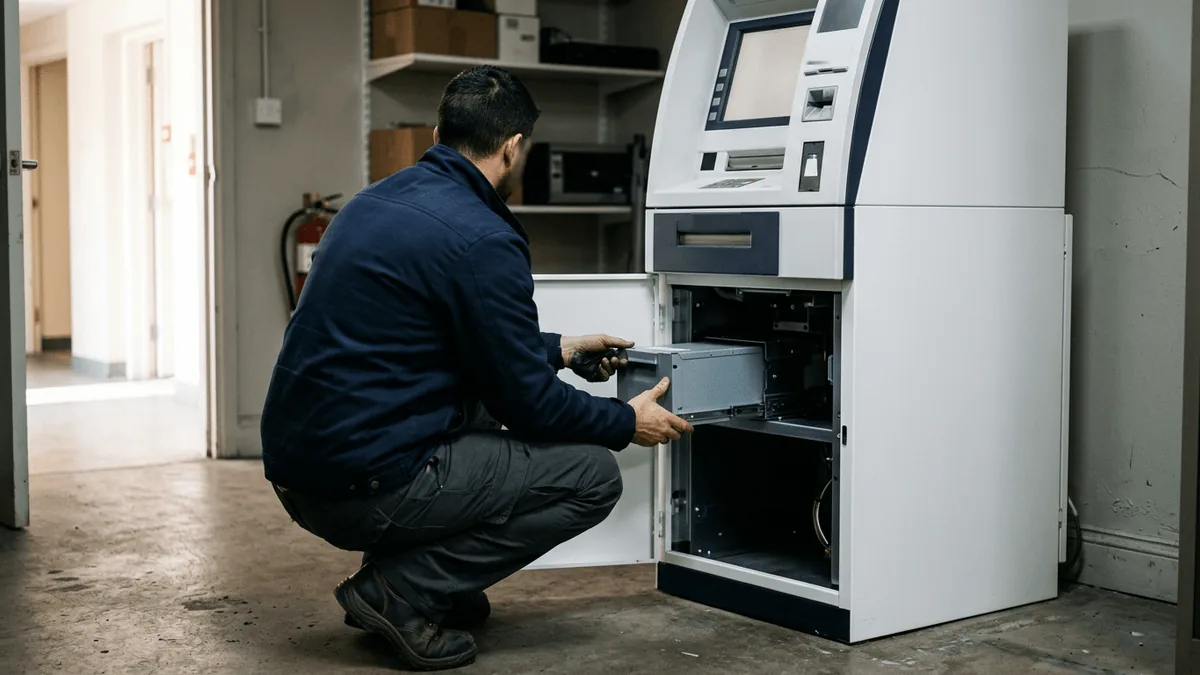
An opening in the building and a room behind it. Genmega lists the GT3000 at 35.4 by 15 by 29.9 inches without packing, the cash loads from inside the building, and the page links a construction guide for the wall.
No page priced that work. Ask a contractor.
Can an ATM be leased instead of bought?
A lease can cover an ATM, and its end-of-term option sets who owns the machine afterward.
- A fair market value lease prices the buyout at the machine’s worth then.
- A $1 buyout lease is set up so the business keeps it.
- Whether installation and cash can be included varies by lender.
Next Steps
Ask two or three sellers to quote the same model number, with shipping, installation, the card reader, the cassette, and the processing terms on separate lines, so every total describes one purchase. Then compare the totals. When you’re ready to talk about paying for it, start a credit application.