
Last updated: November 25, 2026
Laser Engraver Financing for Awards and Personalization Shops
How lenders read a laser engraver quote for an awards or personalization shop, new or used.
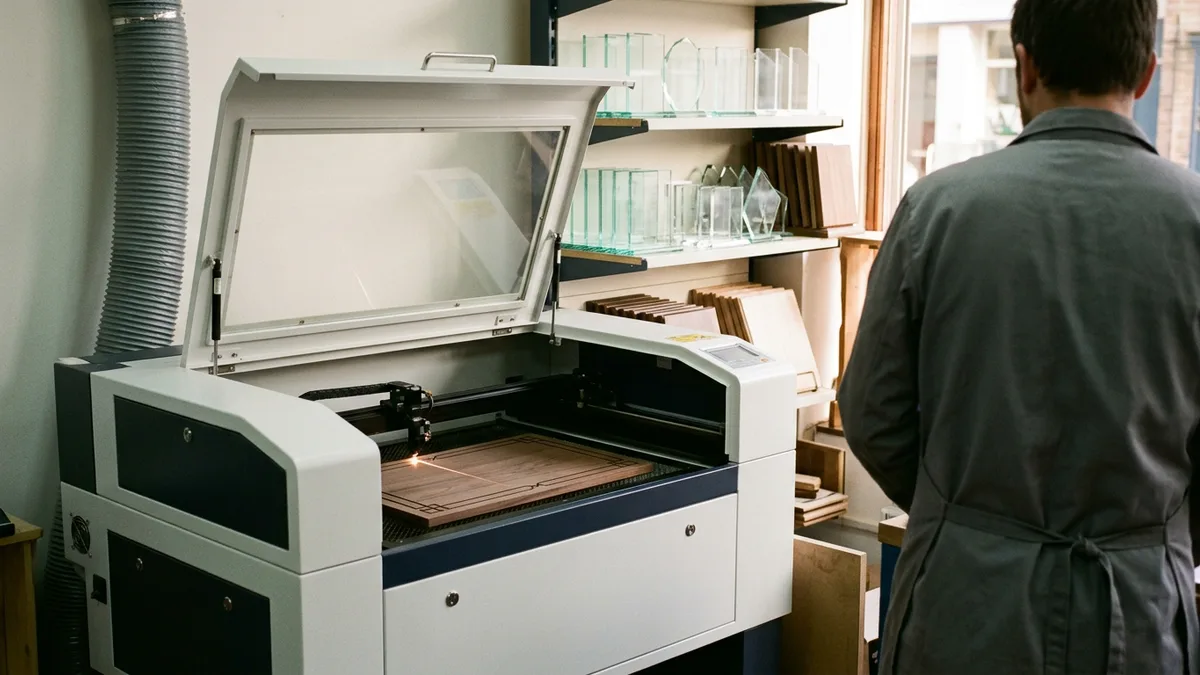
Laser engraver financing is a loan, equipment finance agreement or lease that pays for an engraving system, with each machine and accessory named on the seller’s quote.
Picture two shops. One runs CO2 machines on acrylic awards and walnut plaques, and the other marks steel tumblers all day, so the two never want the same laser. That choice sets the exhaust, the enclosure and every line of the quote.
This page sits under our laser cutter financing guide, which is about cutting steel on a fabrication floor, while on this page the shop sells a finished piece such as an award or a plaque. Stitched goods belong to our embroidery machine financing page.
What laser engraver financing covers
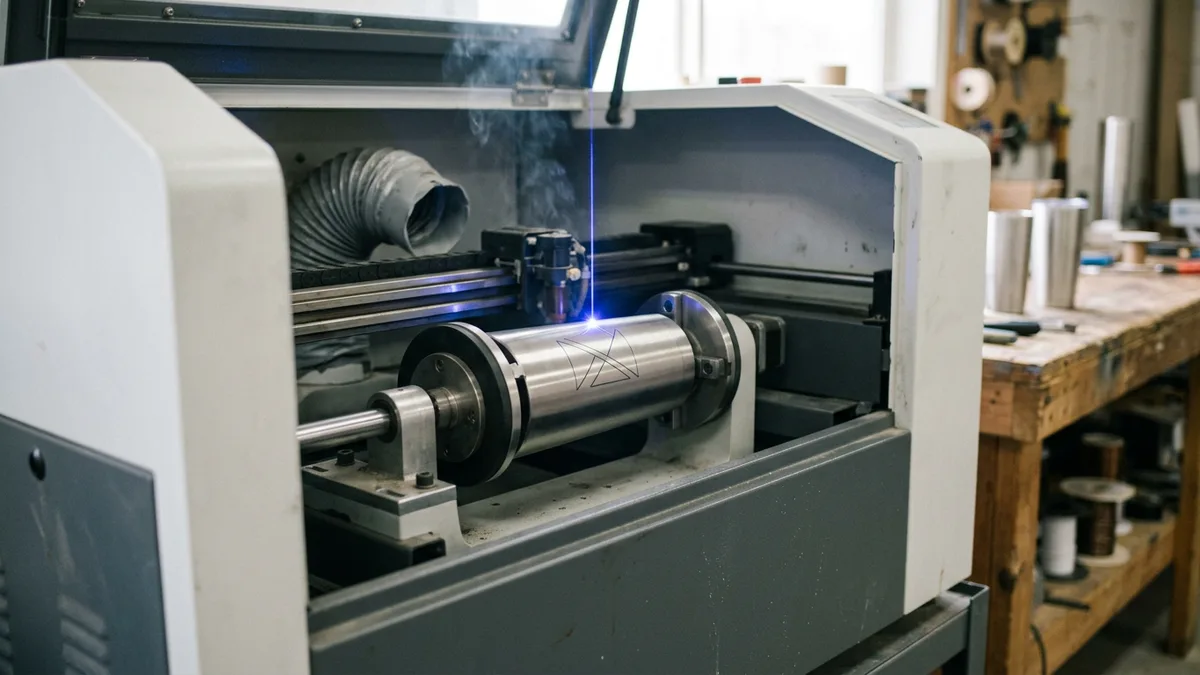
Laser engraver financing spreads the price of an engraving system across a loan, an equipment finance agreement or a lease. The system is more than the laser itself: the exhaust, any rotary attachment for bottles and glasses, and the design software each show up as lines on the seller’s quote. Our laser engraver cost guide prices engravers from dated purchase records.
Lenders start with:
Match the laser source to your job mix
Trotec’s laser comparison guide puts the split plainly: CO2 lasers suit wood, acrylic, leather and glass, and fiber lasers mark every metal. Buy for your best seller.
CO2 for wood, acrylic and glass
The workhorse for plaques, acrylic awards and glassware.
Skips: bare metal. Trotec says a CO2 engraver can’t mark it without sprays or coatings.
On the quote: tube type, watts, bed size.
Fiber for bare and coated metal
Epilog says its fiber systems can permanently mark nearly all types of bare metal. Trotec adds coated metals and high-contrast plastics.
Skips: transparent and organic materials, which Trotec says fiber handles less well.
On the quote: source watts, galvo or flatbed, lens.
Dual-source for both on one table
Epilog’s Fusion Pro pairs a CO2 laser with a fiber laser in one machine. Trotec’s Flexx technology switches between the two sources by material, with no manual change of tube, lens or focus, so a single job can mix wood and metal on the same table.
Skips: single-source simplicity. Two sources mean two sets of hours to check on a used machine.
On the quote: both sources, each with its watts.
Galvo is how the beam moves
Think of a galvo head as a fast pen: it sweeps the beam across a small field at high speed, which is why galvo systems are marking machines, while a flatbed moves the whole laser head over a bed and takes big plaques and sheets. Speed or size. Epilog’s Fusion Galvo is a fiber marking system for metal and plastic, and every Trotec SpeedMarker has a galvo head.
| Machine | Work area the makers publish | Laser source | The quote lists |
|---|---|---|---|
| Flatbed CO2 | Epilog Fusion Pro: 24 by 24 inches up to 48 by 36 | CO2 tube | Tube type, watts, bed size, rotary |
| Galvo fiber marker | Trotec SpeedMarker: 190 by 190 millimeters up to 1300 by 450 | Fiber, with a CO2 option on some models | Source watts, lens, workholding, enclosure class |
| Dual-source flatbed | Epilog Fusion Pro: the same beds, with a 30 or 60 watt fiber laser added | CO2 plus fiber | Both sources and their watts |
Fume extraction and the enclosure go in the budget
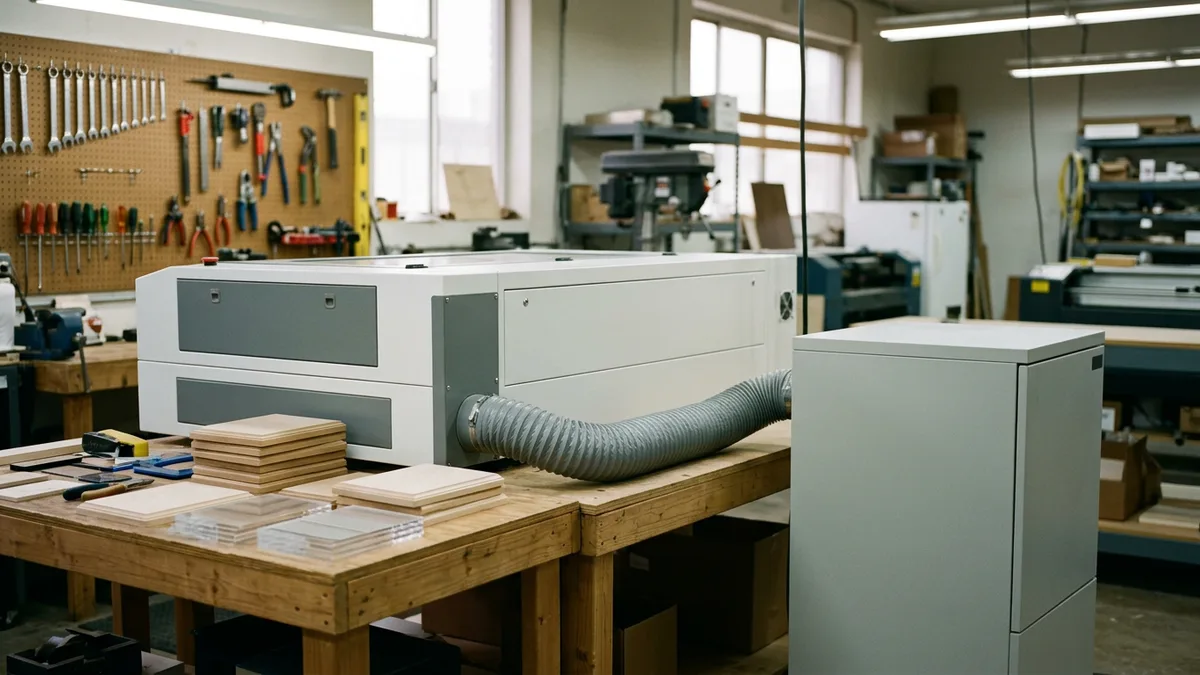
Epilog’s exhaust requirements table lists 350 to 400 cubic feet per minute for a Fusion Pro 24 or 36 and 850 for the large-format Legend 36EXT, and the blower or filter unit that moves that air is usually its own line on the quote. Budget for it.
Check what the shop will burn
Read the safety data sheet for every new blank. Both makers publish a do-not-run list.
Closed machine, or open beam?
One machine can come in two versions.
The FDA’s hazard classes run from I to IV. Ask which version the quote prices.
A laser shop in four numbers
Each figure comes from a published page, read on November 25, 2026. Models vary.
$27.1B
Billion dollars in U.S. promotional products sales in 2025
Source: PPAI, 2025 Sales Volume Estimate
350
Cubic feet per minute, the low end of Epilog’s exhaust range for a Fusion Pro 24 or 36
2
Laser sources in one dual-source machine, a CO2 and a fiber
Source: Epilog, Fusion Pro series page
Used laser engraver financing: what to check first
On a used engraver the laser source is the wear item. Trotec’s technical comparison puts the average life of a glass DC tube at around two years and an RF tube at around six, and its guide lists fiber sources at 25,000 hours or more. Those are one maker’s figures. Ask for actual hours.
Our page on used equipment financing covers how lenders look at an older machine and a private seller. A shop buying its first engraver has a thinner history to show, and our startup equipment financing page covers that.
Own the engraver, or lease it?
Sources wear. Software moves on. A shop planning to trade up in a few years can lean toward a lease that prices the buyout at what the machine is worth then, while a rotary or an exhaust unit that will outlast the laser looks more like ownership, through a loan or a $1 buyout lease. Our page on leasing vs buying equipment weighs the two.
Where an engraver earns its place
Laser engraver financing questions from shop owners
Is a CO2 or a fiber engraver the better buy for an awards shop?
Match the source to the material you sell most: CO2 for wood, acrylic and glass, and fiber for metal. Say a shop engraves 20 acrylic awards a week and the occasional brass plate. CO2 comes first, then a fiber source or a dual-source machine if the plates grow.
What should a laser engraver quote list?
Every item gets its own line: the engraver with its laser source and watts, the rotary, the exhaust or filter unit and the software. Say a dealer sends one line and one price. A lender can’t tell what that covers, and serial numbers have nowhere to go.
Can I finance a used laser engraver?
A used engraver gets judged on its laser source: the type, the age, the recorded hours and who will service it. Say the seller can’t show hours. That is the first thing to settle, ahead of the serial number and the bill of sale.
What does the enclosure class mean for a shop that runs an engraver?
Short answer: a closed, interlocked engraver is the simpler case, and Epilog builds its machines that way as Class 2 products. Say a shop wants to feed a six-foot board through. That takes the Class 4 conversion kit, a laser safety officer, warning lights and training. Ask which version the quote prices.
What happens when a laser engraver lease ends?
The lease says: the shop returns the engraver, renews, or buys it at the price written into the agreement. Say the term ends in June and the shop wants to keep the machine. A fair market value lease prices that purchase at the machine’s value then, and a $1 buyout lease sets it at a dollar.
Can I apply for laser engraver financing online?
Paramount Financial’s credit application is online, and the button at the top of this page opens it. Prefer a call first? The form below reaches a specialist. Keep the seller’s quote handy.
Talk through an engraver quote before you sign
Leave your details and a Paramount Financial specialist will call to talk through the engraver, the exhaust, the software and the structure. Prefer to start now? Start the credit application.