
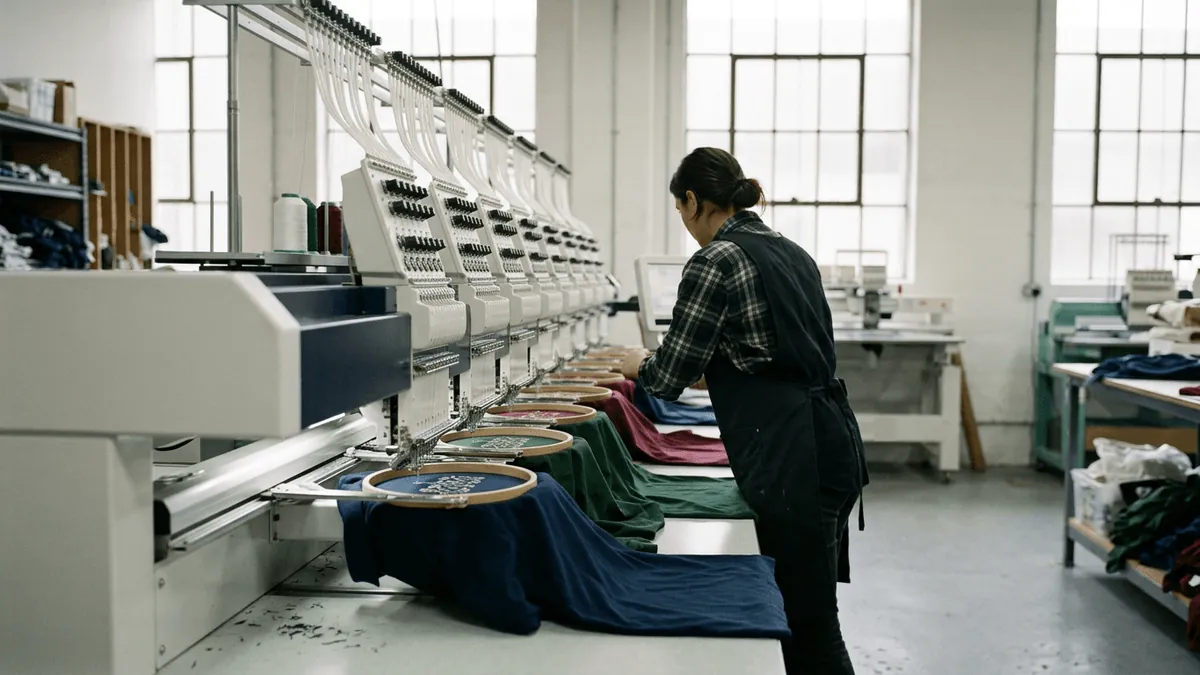
How to Start an Embroidery Business: Multi-Head Machines, Software and Startup Costs

Key takeaways
How to start an embroidery business is mostly a question of what you’ll sew, since contract runs, uniform accounts, and one-off names each call for a different head count, power supply, and floor plan.
- Barudan lists its six-head frame at 163 inches long. Measure the room first.
- Stitch count divided by running speed gives sewing minutes per cycle, and each head turns out one piece per cycle.
- Get the logo owner’s written OK before anyone digitizes it.
- Can zoning reach a spare bedroom? It can.
- Machine, software, hoops, power work, and supplies each get their own quote line.
A monogram machine on the kitchen table makes a fine hobby. We’re talking about how to start an embroidery business that sews other companies’ logos all week, on frames that can run longer than a pickup bed, with invoices to send and a landlord to pay. Different job, different plan.
We finance equipment, so keep that in mind wherever money comes up. How lenders read the machine itself is on our embroidery machine financing page. Here we stay on the shop around it.
How to Start an Embroidery Business in Order
A commercial embroidery business stitches logos, names, and artwork onto garments, caps, and bags for paying customers, usually on multi-needle machines with one or more heads. Some shops sew for printers and promotional distributors. Others sell straight to the schools, teams, contractors, and offices that wear the finished goods.
Seven steps, in order. Skip none.
- Pick the kind of work you’ll sew and who sends it.
- Run the cycle math to settle head count.
- Measure floor space and check power for that machine.
- Confirm zoning, register the business, and ask about sales tax.
- Quote the machine, software, and setup line by line.
- Set up digitizing and a written logo permission step.
- Sew samples, price the work, and take the first paid order.
Pick the Work a Commercial Embroidery Business Will Sew
Who’ll send you garments? Settle that before you set foot in a dealer’s showroom, because a shop laid out for three thousand identical polos from one printer is a poor fit for a booster club that wants forty hoodies with forty names on them.
| Work | What arrives | Ask first |
|---|---|---|
| Contract | Long runs on blanks from printers and brands | Who pays for a spoiled blank |
| Uniforms | One logo on workwear, with reorders that must match | Who keeps the stitch file |
| Promo and team | Bursts of caps, bags, and names for schools and events | When the season peaks |
Watch the contract side. Those garments aren’t yours. One bird’s nest of thread inside a good softshell jacket and somebody’s paying for it, so write down who, before the first carton lands on your floor.
Selling direct? Plan to knock on doors. Find out from each prospect how often they reorder, what they pay now, and which person gets to say the sample looks right.
2,241
Employer establishments in 2023 in NAICS 314999, the textile class where Census files contract embroidery alongside other work. 1,287 of them had fewer than five employees.
The class is wider than embroidery. Treat the count as a rough picture. Mostly small outfits.
Single-Head or Multi-Head: Do the Cycle Math First
A head is one sewing station. A multi-head machine puts several on a shared frame, and they all stitch the same design at the same moment.
That one fact decides a lot.
Forty-eight polos with one logo? Six heads suit that. Twelve jackets with twelve different names? One head at a time.
Pencil time. The design’s stitch count, divided by the speed you really run, gives sewing minutes per cycle. One head, one piece.
Say a left-chest logo is 8,000 stitches and you run at 800 stitches a minute. That’s 10 minutes of sewing per cycle. For 48 polos, a single head needs 48 cycles, or 480 sewing minutes, while a six-head needs 8 cycles, or 80 sewing minutes, before anyone counts the time spent hooping, trimming, or rethreading.
- Printed speeds are maximums. Barudan lists 1,100 stitches a minute on flats and 1,000 on caps for most of its 2- to 8-head LY machines.
- Plan with a slower figure than that, then time a test run on your own garments.
- Count hooping on its own. A second set of hoops lets someone load while the machine sews.
- A pile of one-offs wipes out most of the multi-head’s edge.
Bragging rights don’t enter into it. Count the identical pieces that show up together. And park a single head beside the big frame, so a rush sample or one nurse’s name never stops a run of two hundred.
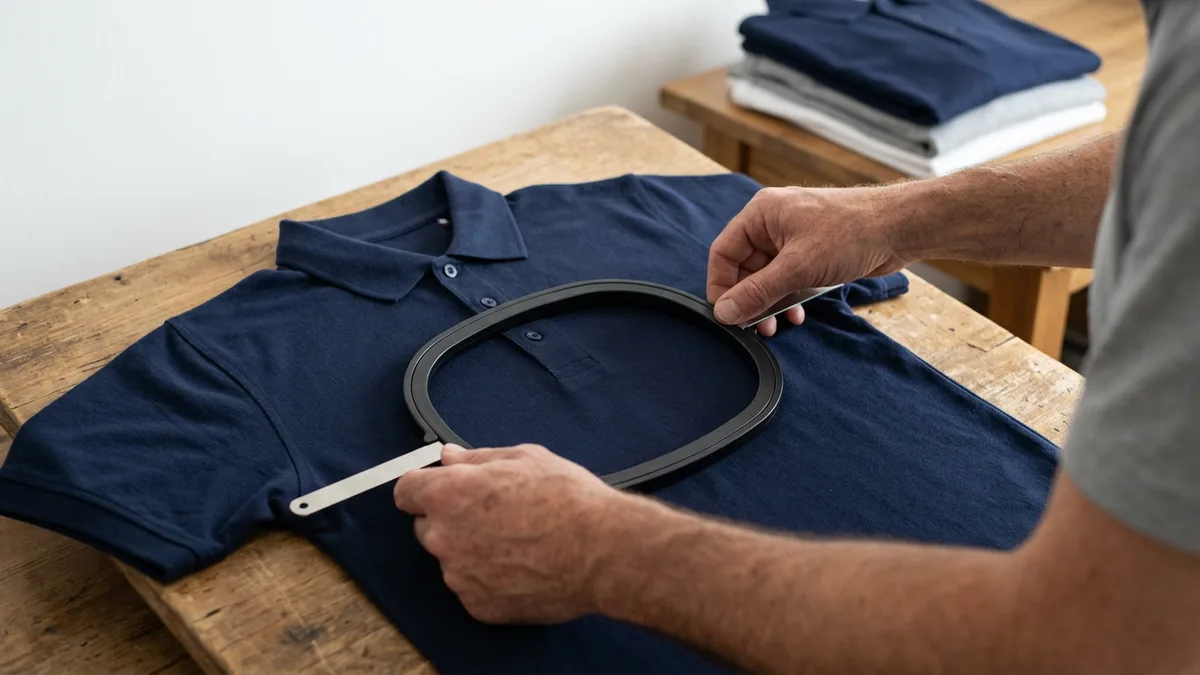
Floor Space and Power for a Multi-Head Embroidery Machine
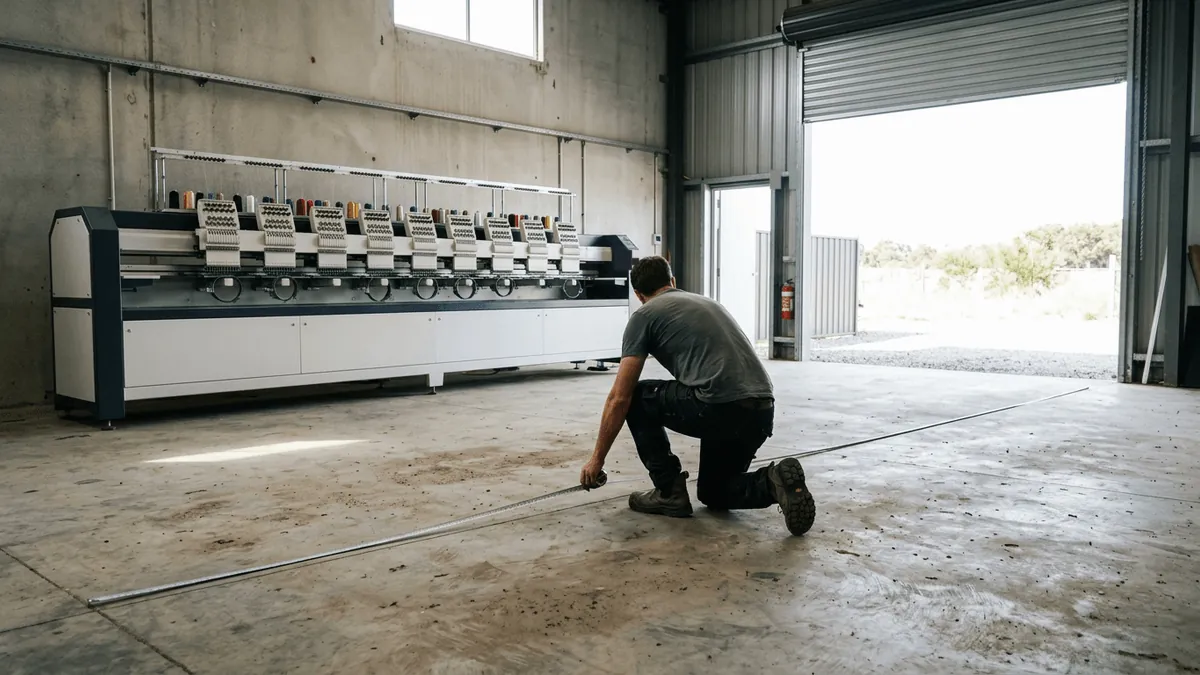
Got a tape measure? Frames are long. Rooms often aren’t.
| Machine and heads | Size in inches | Net weight |
|---|---|---|
| Brother PR680W, 1 | 20 x 23 x 23 | 83.8 lb |
| Barudan LY, 2 | 81 x 49 x 67 | 1,168 lb |
| Barudan LY, 4 | 122 x 49 x 67 | 1,726 lb |
| Barudan LY, 6 | 163 x 49 x 67 | 2,361 lb |
| Barudan LY, 8 | 207.3 x 49 x 67 | 2,992 lb |
- Single head: Brother’s PR680W page shows six needles and an 8 x 12 inch embroidery area.
- Multi-heads: Barudan America’s 2- to 8-head page gives length, width, and height for the models with the 450 x 520 mm sewing field, each with 15 needles.
Tajima shows the same thing from another angle. Tajima’s TFMX-IIC spec table runs from 56.5 inches of overall width on a two-head to 192.9 inches on a wide-spaced eight-head. Head spacing, 360 or 500 mm, is the choice that moves it.
Jacket backs want elbow room. Caps and chest logos don’t. Buy the spacing your busiest garment needs, since you’ll be living with it for years.
Then power.
- Barudan’s LY machines list single-phase 100 to 240 volts as standard, with three-phase as an option, at 0.35 to 0.4 kW.
- The TFMX-IIC draws 420 W, and Tajima lists both three-phase and single-phase versions.
- Brother rates the PR680W at 116 W on 100 to 240 volts.
Which version is on the quote? Ask. A used frame pulled out of a big plant may be wired for three-phase, your rented unit may have nothing of the kind, and an electrician can tell you in one visit.
Then walk the route. Barudan lists the six-head’s shipping crate at 171 x 45 x 72 inches and 2,992 pounds, which means the door, the ramp, and every corner between the truck and the final spot need a tape on them before the carrier shows up.
What Ships With the Machine and What Doesn’t
Barudan says a purchase of its 2- to 8-head models includes a cap frame system with two cap frames per head, standard hoops in several sizes, tools, manuals, and a USB stick. Other makers and dealers bundle differently. Used machines bundle whatever’s left in the corner.
Warranties hide conditions. Barudan’s 5-3-2 plan, for one, covers the main motor for five years, electronic parts and boards for three, and the remaining parts for two, but only with regular service by a Barudan technician, and consumables sit outside it.
Ask the dealer these before you sign.
- Which hoops, cap drivers, tables, and thread stands are in the price?
- Is operator training included, and where does it happen?
- Who services this model near you, and what does a visit cost?
- How much clearance does the maker want around the frame? Get a layout drawing.
- On a used machine, what are the stitch count and run hours, and does every head sew under power?
Price is its own subject. We put dated dealer and public-record figures, single heads through twelve-head frames, in our post on embroidery machine prices.
Digitizing Software, Stitch Files, and Logo Permission
Your customer emails a JPEG. Useless, so far. Somebody has to redraw it as stitches, telling the needle where to go, in what order, how densely, and what underlay holds it all flat.
That’s digitizing. You can learn it, or you can pay somebody by the design. No wrong answer here. Count the new logos in a normal week and the choice mostly makes itself.
- Send it out while new designs are rare and a sample can wait a bit.
- Bring it in once small edits keep piling up.
- Either way, ask who keeps the stitch file and whether your machine reads that format.
- On the software quote, is it a one-time purchase or a subscription?
Now the part that gets skipped. The person who emails you a logo may not own it. Get written permission from the business that owns the mark before anyone digitizes it, and file that note with the order. School crests and team names get the same treatment.
Sew one first. Always. A thin performance polo can pucker badly, and you’d much rather learn that on a single scrap shirt than on a carton of forty-eight the customer has already counted.
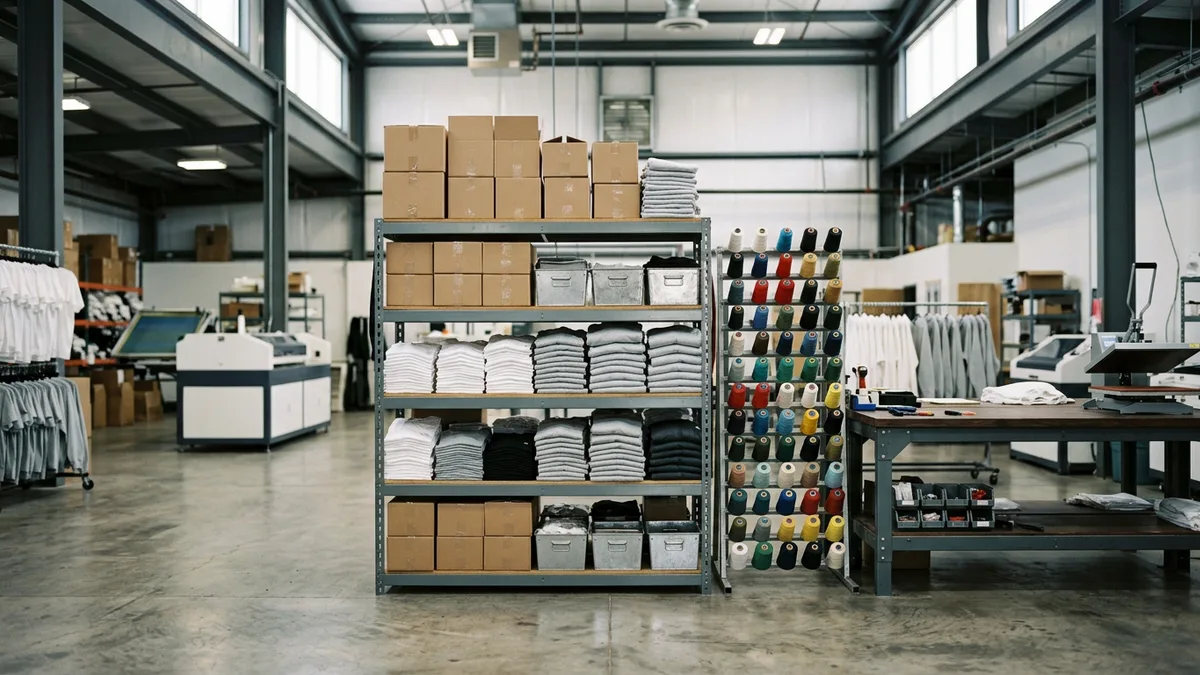
Location, Registration, and Sales Tax Questions
Where the shop sits sets more than rent. SBA’s launch guide says your location determines the taxes, zoning laws, and regulations your business answers to, and that zoning ordinances can apply even to home-based businesses, so a spare room isn’t automatically in the clear. Zoning is usually local. Call the planning office before you plug anything in.
The same guide says most businesses need a tax ID number plus licenses and permits. Which ones? That depends on your state, county, and city.
- A business structure, registered with the state where required
- An Employer Identification Number
- A local business license, and a home occupation permit if the city asks
- Sales tax registration or a seller’s permit, where your state has one
- Insurance that covers customer garments while they’re in your shop
Phone the state, too. Ask the tax agency whether embroidery on garments the customer supplies is taxable, and how a resale certificate applies to blanks you buy, decorate, and then sell on to a customer. Rules differ. Don’t borrow another state’s answer.
Startup Costs When Starting an Embroidery Business
What’s the total? No web page knows. Its writer hasn’t seen your floor, your breaker panel, or your customer list, so you’ll build it out of quotes.
| Cost line | How it’s paid | What moves it |
|---|---|---|
| Machine and cap setup | Up front or over a term | Head count, new or used |
| Extra hoops and frames | Up front | Garment sizes you run |
| Digitizing | Software, or per design | New logos per week |
| Freight, rigging, wiring | Up front | Crate size and power |
| Space | Deposit and rent | Frame length and zoning |
| Blanks, thread, backing | Ongoing | Order volume |
| Insurance and licenses | Monthly or yearly | Your city and state |
| Wages | Every payroll | Hooping and trimming help |
Then find your break-even count. Add up a month of fixed costs, meaning rent, wages, insurance, software, and any machine payment. Next, take the price of one finished piece and subtract its thread, backing, and handling labor.
Divide the first number by the second. The answer is how many pieces a month the shop has to sew just to cover itself, and you can hold it against the cycle math above to see whether your head count and your week can really produce that many.
- Run it once with your hoped-for order volume, then again at half.
- Supplies and payroll don’t wait for customers to pay. Plan that working capital apart from the machine.
- If you file Schedule C, IRS Publication 334 (the 2025 edition, for 2025 returns) is the IRS’s general guide to small business income and expenses. A machine and a box of thread aren’t treated alike, so consult your tax advisor.
Price the Work and Write the Order Form
Open the stitch file first. The count sets your machine time, and machine time is what you’re really selling. Hooping and handling ride on top of it.
- A setup or digitizing charge for new artwork, shown on its own line
- A per-piece price tied to a stitch count band and an order quantity
- An extra for names, caps, bags, or anything slow to hoop
- Who supplies the garments, and what you owe if one is spoiled
Put the same facts on every order, from the garment count by size and the placement to the thread colors, the logo permission note, the signed-off sample, and the date the customer expects it. Boring? Yes. It’s also what settles the argument when a left chest comes back as a right chest.
Who’s on the floor matters as much as the frame. One person can watch the heads. Hooping, trimming, folding, and boxing still need hands, and on a six-head those jobs can stack up well before the sewing does, so time each one of them during your test runs.
Buying or Leasing the Embroidery Machine
Remember our interest here, since we finance equipment. Cash is a sound choice, too, if what’s left over still buys blanks and covers wages through a slow month.
- A loan or equipment finance agreement makes the shop the owner, with a lien on the machine until it’s paid.
- Leasing leaves title with the lessor during the term.
- A fair market value lease prices the buyout at what the machine is worth when the term ends.
- A $1 buyout lease is set up so the shop keeps the equipment.
Software, training, and freight may or may not go in with the machine. Lenders differ. Ask early. Our page on startup equipment financing describes what lenders review when a business is new.
Adding print later? Read our pages on screen printing equipment financing and DTF printer financing.
Straight Answers for New Embroidery Shops
Can a commercial embroidery business run from home?
Sometimes. A compact single head can sit on a sturdy table, but a multi-head frame needs a real room.
Check zoning first, since SBA notes it can apply to home businesses. Then check the circuit, the noise, and where blanks and finished boxes will live.
Which machine should a new embroidery shop buy first?
The one that matches the orders you can already name, not the longest frame the room will hold.
Mostly names and small mixed batches? Start with a single head. If a contract customer sends the same logo by the carton, price a four-head or six-head and run the cycle math against it.
How much does it cost to start an embroidery business?
The total comes from your own quotes for the machine, hoops, software, freight, wiring, space, supplies, and wages.
Head count moves it most. So does new versus used. Collect the quotes in one week so the figures can be compared.
How many shirts can a six-head machine sew in a shift?
Count cycles, then multiply by six.
At 8,000 stitches and 800 stitches a minute, each cycle is 10 sewing minutes and yields six shirts. Hooping, thread breaks, and trimming pull the real number down, so a timed test run on your own garments beats any brochure.
Should you learn digitizing or send it out?
Short answer: send it out at first, unless you already digitize.
You’ll see what a clean stitch file looks like on your fabrics. Once edits start eating your week, price the software and the learning time against what you’ve been paying.
Do you need permission to stitch a company’s logo?
Get it in writing before the artwork is digitized.
A friendly employee isn’t always allowed to say yes. Ask who holds the mark, keep their answer with the order, and pass on jobs where nobody can say.
Next Steps
Write down who’ll send work in your first three months. Run the cycle math on their actual designs. Then measure the room, call the planning office, and collect quotes with every line separate. Once you’ve chosen a machine, you can start a credit application with Paramount Financial.