
Boom Lift vs Scissor Lift: Reach, Platform Capacity, and Jobsite Fit

Key takeaways
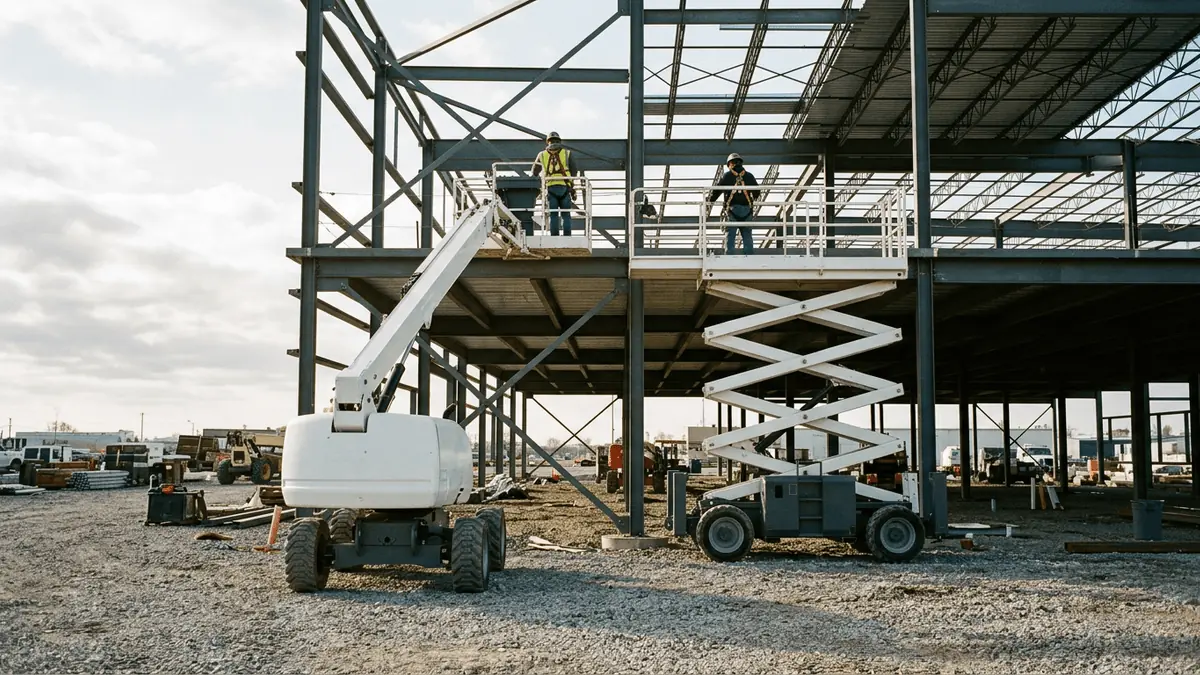
The boom lift vs scissor lift choice comes down to where the work is: a scissor lift raises its platform straight up inside its own tipping lines, while a boom lift can place the platform beyond them.
- Straight overhead points to a scissor. Out or over points to a boom.
- Lifts that drive while raised are usually 3a scissors or 3b booms.
- Compare platform height with platform height, not with working height.
- A lighter lift isn’t always easier on a floor.
Picture a duct run over a clear warehouse aisle, and then the same duct tucked behind a row of pallet racking, where the first job could use either machine and the second needs a platform that can get over the racks. That’s boom lift vs scissor lift in one building.
The money side sits on our scissor lift financing page, which covers boom lifts too. We finance equipment. Keep that in mind.
Boom Lift vs Scissor Lift in Plain Terms
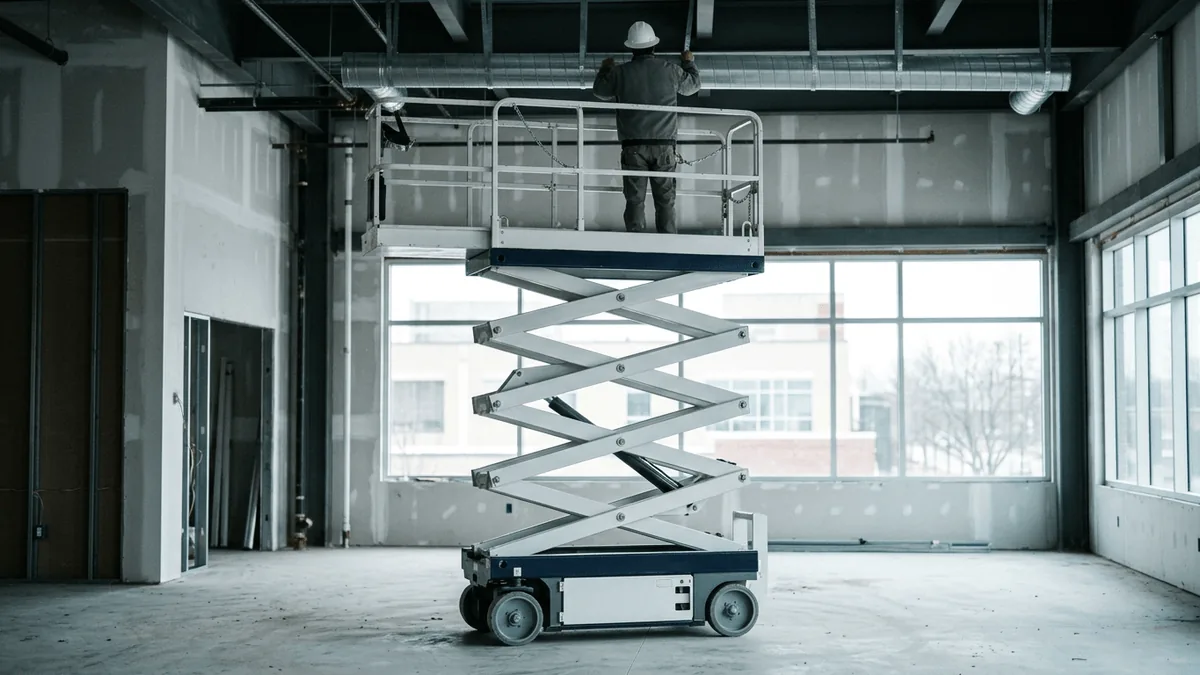
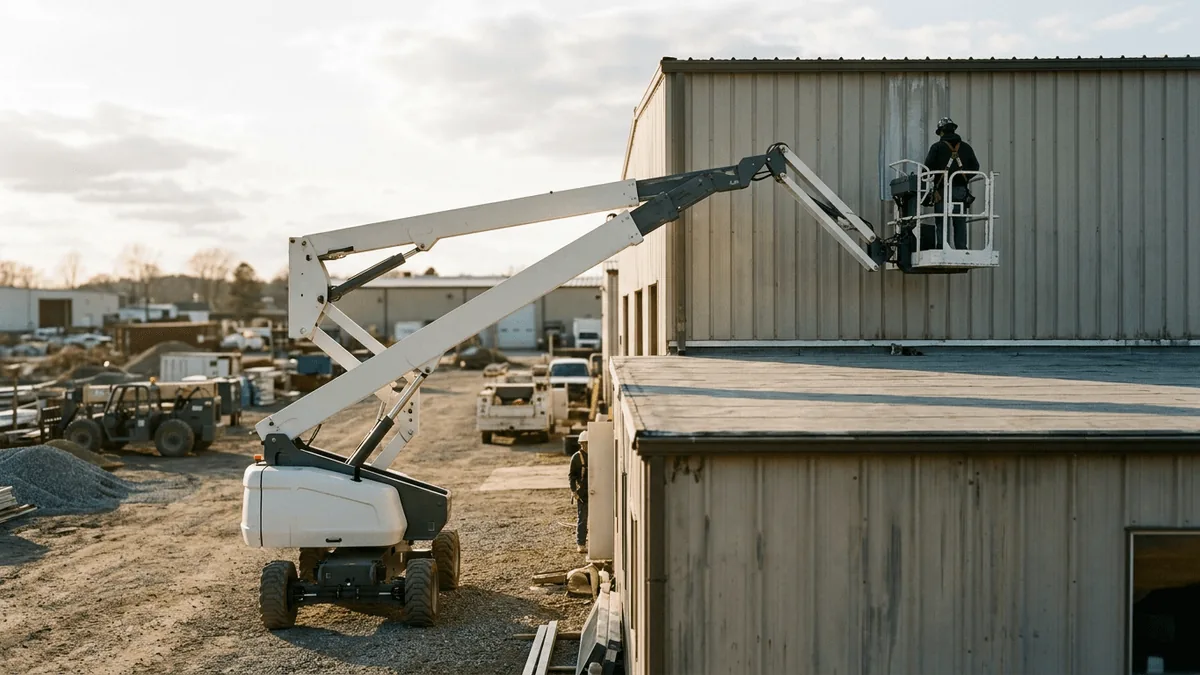
A scissor lift rides up and down on crossed, folding arms. A boom lift hangs its platform at the end of an arm: a telescopic boom reaches straight out, and an articulating boom folds at joints to go up and over. The A92 standards call both mobile elevating work platforms, or MEWPs.
MEWP Groups and Where 3a and 3b Come From
The IPAF user guide to the ANSI A92 standards explains the code. The letter asks whether the platform center can move past the tipping line, the edge the machine would tip around. The number describes travel.
- Group a: the platform always stays inside the tipping line, as on a scissor lift.
- Group b: the platform can be positioned past it, as on a boom lift.
- Type 1 can’t travel unless the platform is stowed.
- For type 2, travel is controlled from the chassis.
- Type 3 can travel with the platform raised.
So a scissor that drives with its deck raised is usually a 3a. A self-propelled boom that does the same is usually a 3b. Check the manual.
The guide says the suite, published in December 2018, covers design (A92.20), safe use (A92.22), and training (A92.24). Check for newer editions.
Height, Reach, and Capacity on Four Spec Sheets
Two scissors come first, electric and rough terrain. Two booms follow, articulating and then telescopic.
| Lift | Height | Reach | Load |
|---|---|---|---|
| SJ3219 micro scissor | 18 ft 1 in | 20-in deck | 500 lb, 2 people |
| SJ6832 RT scissor | 32 ft | 5-ft deck | 1,000 lb, 4 people |
| 450AJ boom | 45 ft | 25 ft | 550 lb |
| 600S boom | 59 ft 8 in | 50 ft 2 in | 600 or 1,000 lb |
Height means platform height, and reach means sideways reach. Read on November 26th, 2026: Skyjack’s SJ3219 micro, SJ6832 RT pages, plus JLG’s 450AJ and 600S sheets.
25 ft
horizontal outreach on the JLG 450AJ articulating boom, 2026
Source: JLG, 450AJ articulating boom lift specification sheet, 2026
Watch the height label. Skyjack’s working height runs exactly 6 ft above platform height on both pages, so a quote that mixes the two labels can make one machine look taller than it really is.
Capacity counts people, tools, and material. The 600S prints 1,000 lb restricted and 600 lb unrestricted, so ask which one applies.
Terrain, Weight, and the Floor Underneath
- SJ3219 micro: solid, non-marking tires, 32 inches wide, 25% gradeability
- SJ6832 RT: foam-filled tires, 69.5 inches wide, 40% gradeability
- JLG 600S and 450AJ: 45% gradeability, or 30% on a two-wheel-drive 450AJ
Gradeability is about driving, so a 45% figure says the machine can climb toward the work, but it says nothing about raising the platform on that slope.
Then there’s pressure on the floor:
- SJ3219 micro: 2,675 lb, 117 psi ground bearing pressure with rated load
- JLG 450AJ: 14,150 lb, 65 psi maximum ground bearing pressure
- JLG 600S: 21,647 lb, 83 psi maximum
Look again. The lightest machine here has the highest figure. The makers label it differently, so ask for figures measured the same way and give them to whoever knows your floor.
Outdoors, add wind. Under the newer design standard, the maximum wind rating is posted at the controls.
Fall Protection and Training Under OSHA
On construction sites, this is the biggest split.
| Scissor lift | Boom lift | |
|---|---|---|
| OSHA’s category | Mobile scaffold | Aerial lift |
| Rules to read | 29 CFR 1926.451 and 1926.452(w) | 29 CFR 1926.453 |
| Tie-off | Not required by those sections with maintained guardrails | Lanyard attached to the boom or basket |
| Who runs it | People trained for scaffold hazards | Authorized persons only |
Scissor lifts got their answer in OSHA’s letter of August 1st, 2000. The agency said they aren’t aerial lifts, even with a deck that slides past the wheelbase, so the construction scaffold rules in Subpart L apply to them, including the section on mobile scaffolds.
Boom platforms fall under 29 CFR 1926.453:
- Lift controls are tested each day before use.
- Nobody belts off to a nearby pole or structure.
- Boom and basket load limits aren’t exceeded.
- Brakes are set, and outriggers, when used, sit on pads or a solid surface.
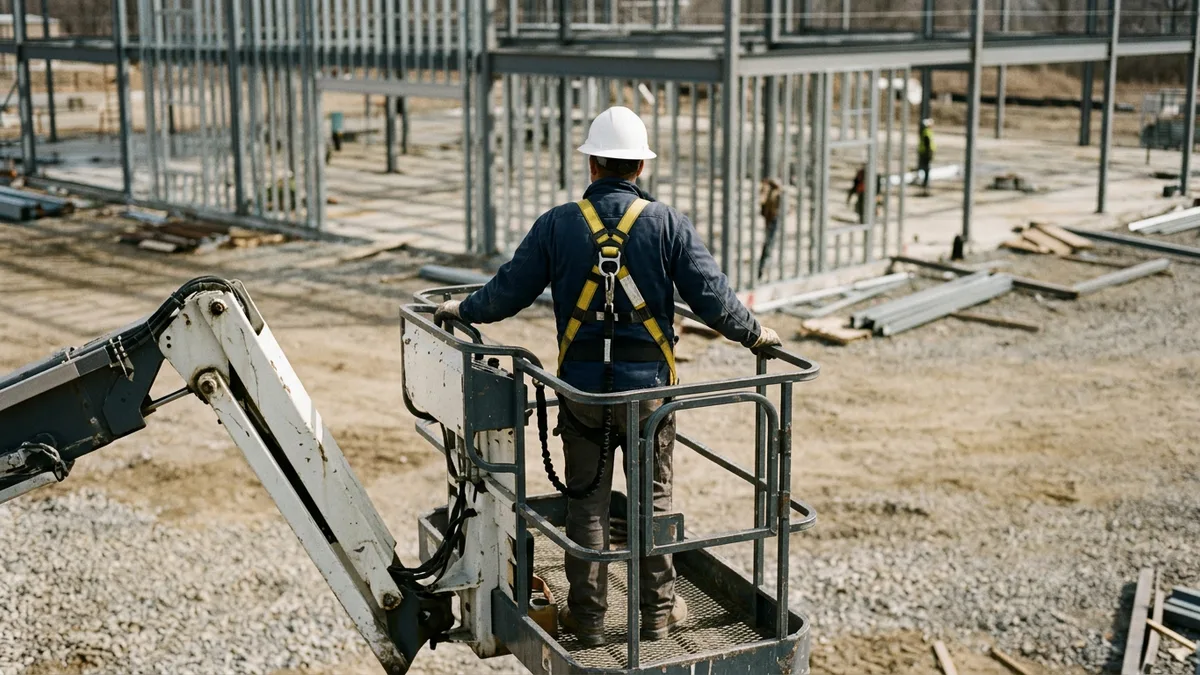
- A body belt is worn with a lanyard on the boom or basket.
That last line has a catch. A note in the rule says a body belt can’t be part of a personal fall arrest system, only restraint or tethering, so ask your safety lead what to wear.
Choosing a Boom Lift or Scissor Lift in Four Questions
- Can the machine park right under the work? If it can, a scissor stays in play.
- How high is the work? Convert every quote to platform height.
- What goes up? Count it against the rating.
- What’s under the wheels? Name the floor or ground, any grade, and the wind.
Overhead work with a crew and material on a wide deck favors the scissor. Out or over favors the boom. Need both? Rent the one you’d use less.
Moving pallets, not people? See telehandler vs forklift.
Questions Crews Ask Before Picking a Lift
So is a scissor lift an aerial lift?
Not on a construction site, because OSHA’s letter of August 2000 files a scissor lift under scaffolds. Rental counters may still call it aerial.
Do you need a harness on a scissor lift?
Short answer: OSHA’s scaffold sections don’t require a tie-off when the guardrails are properly maintained. An employer, a maker, or a site can still require one. Ask first.
Which one belongs indoors?
Usually the slab scissor. The SJ3219 micro is only 32 inches wide. Some booms fit inside as well. Measure the narrowest door.
Can a boom lift reach over a roof edge or a wall?
An articulating boom often can, when its numbers clear your obstacle. The 450AJ sheet lists 24 ft of up and over height. Measure the obstacle first.
Does scissor lift training carry over to a boom lift?
Don’t count on it. The IPAF guide says the training classes combine group and type, which puts a 3a scissor and a 3b boom in separate boxes. Ask your trainer.
Next Steps
Pick the machine first, then price it with our dated listings on what a scissor lift costs and what a boom lift costs.
Buying? When you ask about financing, say whether the lift is new, used, or coming from a private seller, since that can change what a lender wants to see. See our heavy and construction equipment financing, or start an application.