
How to Start a Bar: Licenses, Build-Out and Equipment

Key takeaways
How to start a bar comes down to order: confirm the address can hold a liquor license, file with your state, build to the health code, register with TTB, and only then pour the first drink.
- Some states cap bar licenses by county. Check before signing a lease.
- TTB registration comes before the first sale, for each location.
- Ice counts as food, which shapes the plumbing behind the counter.
- How far the kegs sit from the taps picks the draft system.
Your liquor license names an address. County caps, school distances, and health inspectors all attach to that one room, so anyone working out how to start a bar should learn what a location’s paperwork will take before choosing a single stool for it.
Paramount Financial finances business equipment, so read the money section knowing that. Our restaurant equipment financing page covers loans and leases for food-service gear. This guide covers what comes ahead of it.
Cooking too? See how to start a restaurant. Brewing? Our brewery start-up guide walks through the federal brewer’s notice.
How to Start a Bar in the Right Order
A bar is a business licensed to serve beer, wine, or spirits that guests drink on the premises. Whether it also has to serve food depends on the license type. In most places the owner files with a state alcohol agency, a city or county, and a health department, often in the same months.
- Choose the concept and find out which license type it needs.
- Check the license cap and the distance rules for the address.
- Negotiate the lease with a license contingency in it.
- File the state and local license applications.
- Submit plans for health review and pull building permits.
- Build out, install the equipment, and pass inspections.
- Register with TTB and set up supplier accounts.
- Train the staff, then open.
Steps four and five overlap, so draw the plans while the license application is pending.
Rent usually starts before the license does. A lease clause that lets you walk away, or holds off rent, if the license is refused can protect those months. Get it in writing.
Liquor License for a Bar: Check the Cap First
Ask your state alcohol agency two things. Which license type covers a bar? Does the state limit how many of them a county can have?
A limit changes the budget. New quota licenses tend to appear only with population growth or after an old license is revoked or reverts to the state, so an owner may have to buy one from a current holder. That purchase has its own price, paperwork, and calendar.
| State | How the cap works | How a new one comes up |
|---|---|---|
| Arizona | One more bar license per 10,000 residents a county adds over its July 1, 2010 count | Priced at fair market value, drawn at random if applicants outnumber licenses |
| California | Type 48, the bar and nightclub license, is tied to county population ratios | A priority drawing, with one application period a year |
| Florida | One quota license per 7,500 county residents, for the vendor classes the statute lists | Added as the county’s population grows |
The Arizona numbers come from A.R.S. 4-206.01, which also lets the director reissue revoked or reverted licenses. California describes its yearly application period on the ABC priority drawing page. Florida’s ratio is in Florida Statutes 561.20.
Other states differ. Some have no cap.
Distance Rules Can Rule Out an Address
Distance is the second test. Arizona’s A.R.S. 4-207 says a retailer’s license can’t be issued for premises within 300 horizontal feet of a school building with kindergarten or grades 1 through 12, or of a fenced recreation area beside it.
Restaurant licenses are exempt. Bar licenses are not on the statute’s list of exempt license types, although it carves out certain already-licensed premises and lets cities exempt schools inside entertainment districts.
Measure first. Sign second.
What Filing Looks Like in Arizona
Arizona’s process is public. A.R.S. 4-201 has the city or town clerk post the application on the front of the premises for twenty days, and residents within a one-mile radius may file written arguments for or against the license.
Next comes the local vote. The governing body has sixty days after filing to recommend approval or disapproval, and the statute says the application shall be approved or disapproved within 105 days of filing. Protests and hearings are covered in the same section.
Meet the neighbors early. Before the notice.
The Federal Registration Comes Before the First Sale
The federal step is a registration with the Alcohol and Tobacco Tax and Trade Bureau (TTB). According to TTB’s retailer page, nobody may sell or offer to sell distilled spirits, wine, or beer without first filing form TTB 5630.5d, and the filing is due before engaging in business, for every location. A new one is due by July 1 only when the registered information has changed.
This isn’t the liquor license. You need both.
TTB also expects retail dealers to keep records of the alcohol received, showing quantities, suppliers, and dates, and purchase invoices can serve as that record.
Start the folder early. Keep every invoice.
Health Permits, Plan Review, and the Music
The FDA Food Code 2022 defines food to include ice and beverages. A drinks-only bar can therefore count as a food establishment wherever a state or county has adopted that definition, and the local version of the code is the one that applies.
The model code asks for plans before a food establishment is built or a space is converted to one. It also asks for the permit application at least 30 calendar days before the planned opening date. Call the health department before the plumber starts.
Expect separate filings for building permits, the certificate of occupancy, sales tax, signs, and any patio. The SBA’s launch guide lists the general business registrations.
Music has its own rule. Under 17 U.S.C. §110(5)(B), a drinking establishment under 3,750 gross square feet may play licensed radio or television broadcasts under the exemption, while larger rooms face limits on speakers and screens.
Either way, nobody may be charged directly to hear or watch the broadcast. A playlist falls outside the exemption. Ask the performing rights organizations about licensing.
Bar Build-Out Starts Behind the Counter
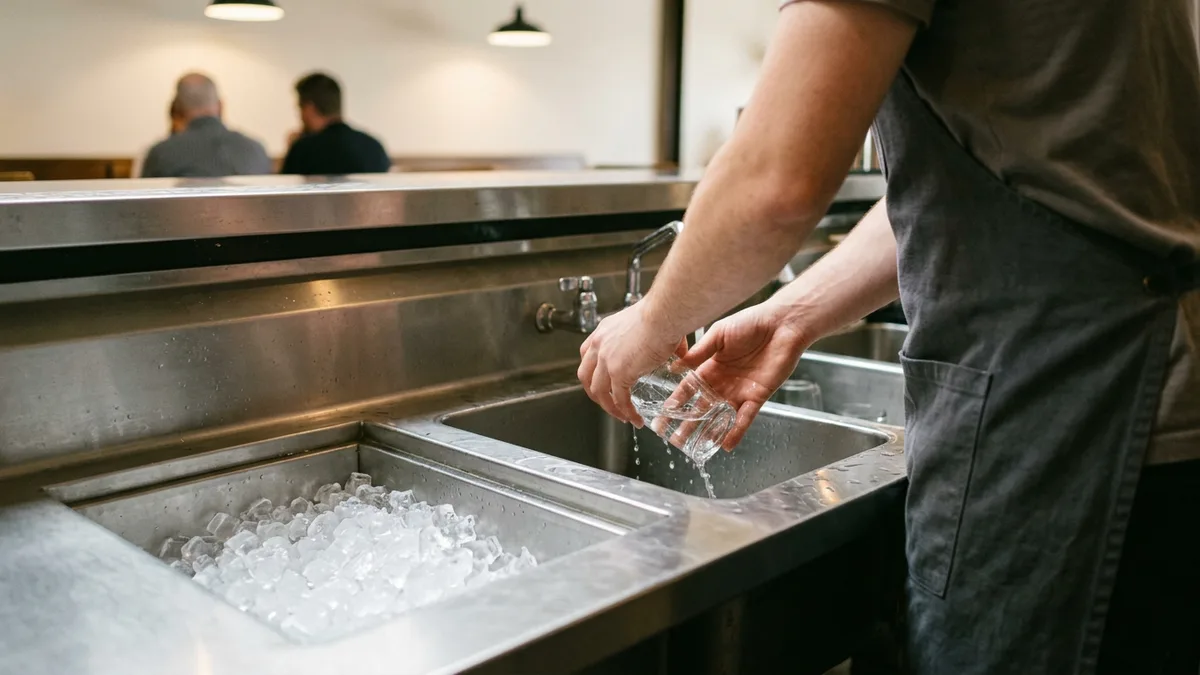
Draw the back of the bar first. Sinks, floor drains, hot water, floor surfaces, and electrical circuits belong on the plans before demolition, because a drain that moves after the concrete is patched costs far more than a drain that moves on a drawing.
Four Food Code rules shape an underbar:
- Manual dishwashing takes a sink with at least three compartments, each big enough to submerge the largest utensil.
- Beverage tubing and cold-plate cooling devices stay out of stored ice, except a cold plate built as one piece with the ice bin.
- No liquid waste drain line may pass through an ice machine or ice bin.
- Ice bins, dispensing nozzles, and beverage lines get cleaned on the maker’s schedule, or often enough to keep soil and mold from building up.
Ask the plan reviewer where handwashing sinks go. Don’t guess. A sink added on paper is cheap. A sink missing at inspection can push back an opening date.
Bar Startup Equipment List
Quote the bar station by station. A single lump-sum number hides the gaps. Six short lists show what each vendor includes and what’s left for the plumber, the electrician, and you.
| Station | On the quote | Ask the vendor |
|---|---|---|
| Draft | Tower, faucets, lines, regulators, gas, cooling | What’s the longest run you’ll warrant? |
| Underbar | Ice bin, speed rail, drainboards, sinks | Where does each drain go? |
| Glass washing | Glass washer or three-compartment sink | What water and power does it need? |
| Cold storage | Back bar coolers, keg cooler or walk-in | Is it certified to NSF/ANSI 7? |
| Ice | Ice machine head, storage bin, filter | How much ice a day, at what room temperature? |
| Point of sale | Terminals, printers, card readers | What’s hardware and what’s subscription? |
Furniture, glassware, and sound are separate lines. For two of the six stations, we have pages on ice machine financing and POS system financing.
Draft Beer Systems: Measure the Run First
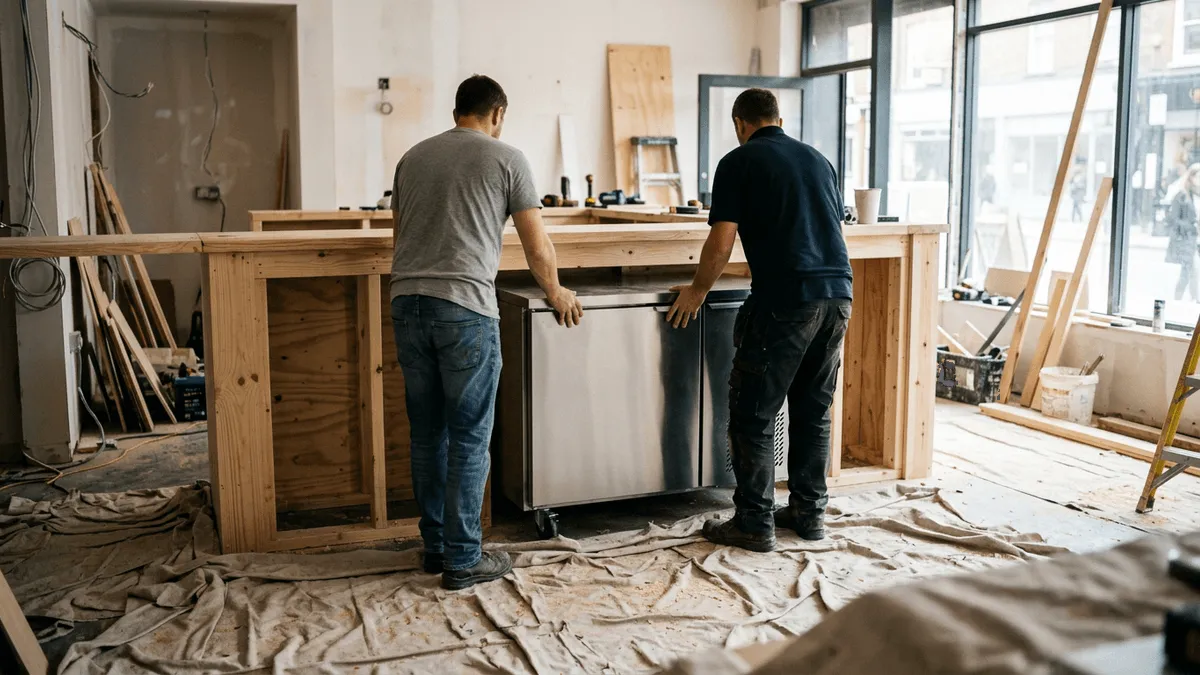
Measure from the keg cooler to the tap tower along the route the lines will travel. Count the bends. That distance narrows the choice to one or two of three systems.
- Direct draw: kegs sit right at the taps, in a kegerator or against the cooler wall. Short lines, little beer lost at cleaning.
- Air-cooled: a blower pushes walk-in air along the lines. Practical for short remote runs only.
- Glycol: a chiller circulates a cold propylene glycol mix beside the beer lines, for the long routes from a basement or back room.
For air cooling, Micro Matic’s air-cooled guide puts the recommended maximum at 25 feet for a double-duct system and 15 feet for a single duct, with the walk-in held between 34 and 38°F. Perlick gives the same 25-foot ceiling for its towers.
Longer run? Price glycol.
Micro Matic’s draft maintenance guide says to clean the system at least every 14 days and to hold beer at 38°F. Budget the time. Budget the chemicals.
What Draft Hardware Costs, From Two Sellers
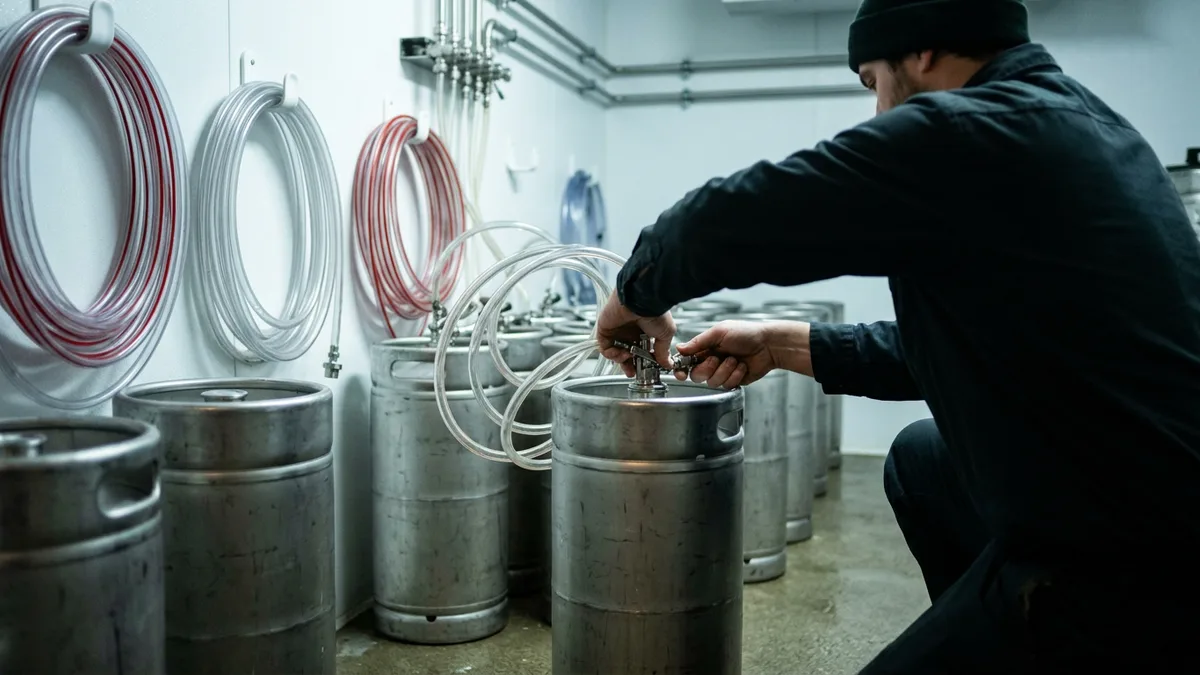
We’d rather show figures you can trace than a startup total nobody can explain. Draft is a good place to start, and both sources below were read on November 26, 2026.
| Source | What it covers | Published figure |
|---|---|---|
| Micro Matic | Basic direct draw system, per tap | About $1,000 or more |
| Micro Matic | Long draw glycol system, per tap | $1,300 to $1,500 |
| WebstaurantStore | True TDD-2CT-HC direct draw cabinet with two taps | $4,601.30 |
The per-tap estimates are on Micro Matic’s tap system page. The cabinet price comes from a dealer listing, which also notes a price increase from the maker on January 1, 2027.
The two don’t line up neatly. Split across its two taps, that cabinet comes to about $2,300 a tap, well above the maker’s starting figure. Count your taps. Then get quotes that include installation.
Food on the menu? We’ve priced kitchen equipment costs by station. Our walk-in cooler prices guide helps with the keg room.
How to Open a Bar Without Draining the Cash
Split the opening budget in two. Equipment goes in one column: coolers, ice machines, glass washers, and draft hardware. Rent during the license wait, deposits, training payroll, and the first liquor order go in the other.
The equipment column is what equipment financing is built around. A loan leaves the business owning the gear as it repays, and a lease gives it the use of the gear for a set term, followed by return, renewal, or purchase on the terms written in the contract. Ask any financing company how it treats a liquor license, since a license isn’t equipment.
Paying cash for small items is one option. Buying used is another.
On a used cooler or ice machine, check the compressor, the door gaskets, and the serial plate, and ask the seller in writing whether anyone else has a claim on it.
Keep a cushion. Glycol pumps fail. Glass washers leak. Opening month is a poor time to be out of cash.
Bar Questions Before the First Pour
Is $100,000 enough to open a bar?
Nobody can say until the license in your county has a price. In a capped state it can be a large line of its own, and Arizona charges fair market value for a newly issued quota license. Price that and the build-out first, then equipment, inventory, and a cushion.
Does buying an existing bar bring its liquor license along?
Not automatically, because a license transfer is its own filing. In Arizona, A.R.S. 4-203 lets a bar license move within the same county if the transfer meets the requirements of an original application. Make the purchase depend on the transfer clearing, and have an attorney write that clause.
Can a bar open without a kitchen?
Often it can, depending on the license. California’s Type 48 license for bars and nightclubs says food service isn’t required, and it doesn’t let minors stay on the premises. Other license types tie alcohol sales to meals. The health department still has a say, since ice and drinks count as food.
Do bartenders need alcohol server training?
California requires it for that same bar license: servers and their managers have to hold Responsible Beverage Service certification. Arizona lets its liquor director require approved training for servers and managers. Check your own state’s rule and build the course dates into the hiring plan.
How often should draft beer lines be cleaned?
Every 14 days at a minimum, by Micro Matic’s maintenance guidance. Put the date on the calendar before opening, decide who does it, and ask your installer which cleaner the lines and faucets can take. Some bars hire a line cleaning service.
How can a bar owner protect against liability?
Start with insurance, training, and records. Ask an insurance agent about liquor liability coverage, which a general policy may not include, and ask an attorney what your state’s law says about serving intoxicated or underage customers. Then write the house rules down and train to them.
Next Steps
First, call the state alcohol agency about license type and caps. Then measure to the nearest school. Then talk lease.
Holding a vendor quote for coolers, ice, or draft hardware? Start an application with the quote in front of you.
Still comparing? The food-service equipment page sets out loans and leases for this kind of gear.