
How to Start a Bakery: Commercial Kitchen Equipment and Startup Costs

Key takeaways
How to start a bakery, in practice: choose a format, find out what your state lets you sell from that format, confirm the space can supply an oven’s gas, power, and hood, and only then price equipment.
- Cottage food laws let some home bakers sell goods that aren’t potentially hazardous. Each state writes its own.
- Published startup totals disagree wildly, so build yours from quotes.
- An oven can drag a gas line, three-phase power, and a hood into your lease talks.
- The health department wants equipment model numbers before you build.
- A used oven isn’t automatically harder to finance than a new one.
Plenty of checklists file equipment near the end, after the business plan and the branding. Odd place for the one purchase that can reach back into your lease. An oven may want a gas line, heavier electrical service, or an exhaust hood the building has never had. A landlord can say no to any of them. So the room and the rules come first below, then prices, with bakery equipment financing covered once, near the end.
Seven Steps to Open a Bakery
- Choose a format: home-based under a cottage food law, a shared kitchen, wholesale, or a storefront.
- Find out what your state and county let you sell from that format.
- Write a budget that keeps one-time costs apart from monthly ones.
- Form the business and get an EIN.
- Walk the space with an electrician, a gas contractor, and your building and fire officials before you sign.
- Send plans, the menu, and the equipment list to the health department before you build.
- Pass the inspection, get the permit, and open.
Two of those steps are rules, not advice. The FDA Food Code 2022, a model that states and counties adopt in their own editions, asks for plans and specifications before a food establishment is built or converted (section 8-201.11) and wants the permit application in at least 30 calendar days before opening (8-302.11). Your county may keep its own dates. Ask.
Pick a Bakery Format Before You Price an Oven
A bakery format is the way you sell what you bake: from a home kitchen under a cottage food law, out of a shared commercial kitchen, wholesale to cafes and grocers, or across a counter in a storefront. The format decides your square footage, the rules you answer to, and most of the budget.
Home-based is the cheapest door. In many states it’s a legal one. The National Agricultural Law Center’s compilation says cottage food laws rest on the idea that foods such as baked goods, jams, dry mixes, and candies aren’t potentially hazardous, and that the states show “much variation” in how they handle it. Believe that.
$150,000
Texas’s annual cottage food sales cap after Senate Bill 541, enacted in 2025.
Vermont set an annual cap of $30,000 the same year. Same idea, five times apart. A cap is a ceiling on the home format. It’s also the point where a shared kitchen or a storefront enters your budget, so read your own state’s number before you plan around it. Look it up.
A shared commercial kitchen swaps the oven purchase for rented hours. Worth pricing against buying, if you’d bake a few days a week. Wholesale and storefront both mean buying or leasing the equipment yourself. That’s where the rest of this guide goes.
What Bakery Startup Costs Look Like
Totals vary by format and by publisher: ZenBusiness, which sells business formation services, gives a total for each format in an article last updated September 2, 2026, and it cites no source for any of them. One company’s guess.
| Format | ZenBusiness total estimate |
|---|---|
| Home bakery | $15,500 to $23,500 |
| Online bakery | $26,800 to $30,000 |
| Bakery or cafe | $62,500 to $77,500 |
| Commercial bakery | $71,700 to $102,700 |
Hold the equipment line against a second source. SBDCNet publishes small business research reports, and its bakery page quotes other publishers rather than offering numbers of its own.
$20,000 to $100,000
GrowThink’s range for bakery equipment and machinery, as quoted on SBDCNet’s bakery business page, updated May 12, 2026.
Build-out gets its own line on that page, $10,000 to $100,000, so it can rival the equipment, and the totals scatter just as widely: one publisher says $10,000 to $50,000, while another says $700,000 for a “medium scale but standard bakery,” with three months of staff pay folded in. That top end is fourteen times the other’s.
Format explains plenty of the gap. The rest is what each total includes, such as a rent deposit, payroll, or a build-out, which is why two numbers this far apart can’t both be a budget. Neither is. Yours comes from a contractor’s quote, a dealer’s price on your actual oven, and your county’s permit fee.
Keep two lists.
- One time: the oven, mixers, refrigeration, build-out, permits and plan review, opening inventory, deposits.
- Monthly, for as long as the doors stay open: rent, payroll, flour and butter, insurance, utilities, and the service call on equipment you just bought.
What the Oven Asks of the Room
Open the listing for any oven you’re considering. Read the power line first. It tells you what the room has to supply.
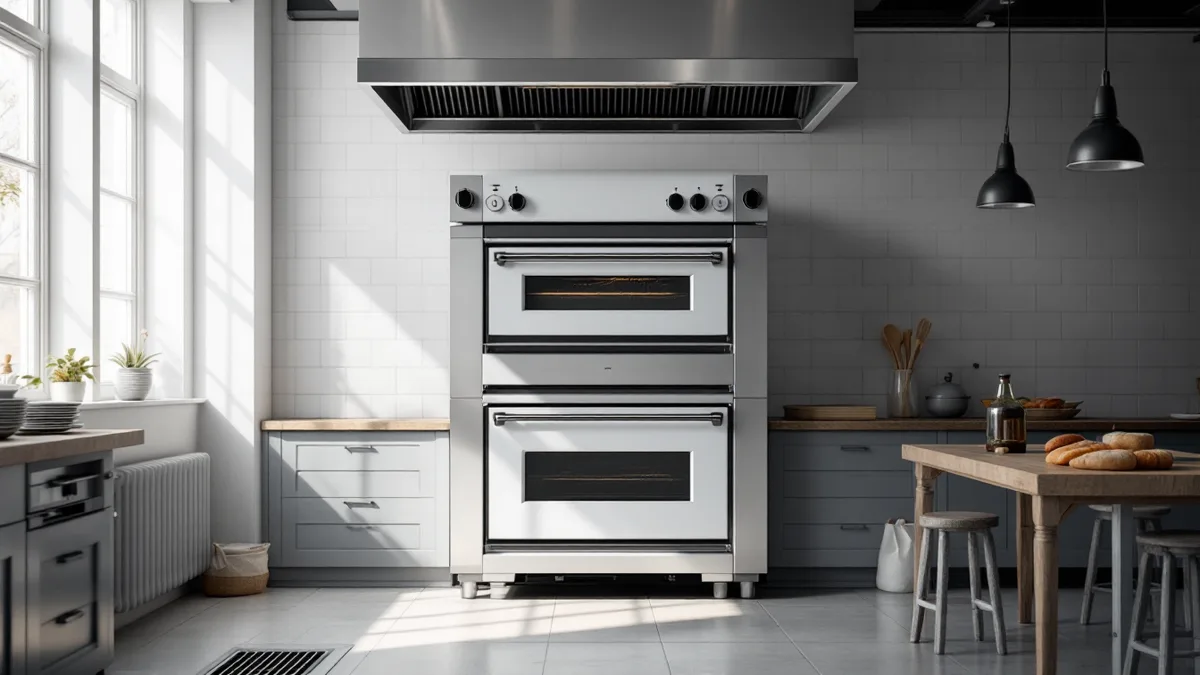
Doyon’s one-stone Artisan deck oven lists 208 volts, three phase, and Baxter’s mini rotating rack oven lists 18 kilowatts on the same supply, while a gas rack oven is another animal entirely: Doyon’s double SRO2G lists 275,000 BTU on natural gas.
Those are real listings, on WebstaurantStore’s deck oven page and its rack oven page. Small shop, same spec sheet.
The lease conversation sounds different once a spec sheet is on the table.
- Does the space have three-phase service, or only single phase?
- Is there a gas line, and is the meter sized for the oven’s BTU?
- Who pays to bring either one in?
- Is there a hood already, and what kind of oven was it built for?
- Where’s the nearest floor drain?
Then the hood. WebstaurantStore’s hood guide, last updated January 7, 2026, says a Type I hood removes heat, smoke, and airborne grease, while a Type II hood handles steam, vapor, and moisture. It adds that most commercial convection ovens are required to be under a Type I hood, with some exceptions. Most states and municipalities follow the International Mechanical Code.
Which kind your oven needs is a call for your building and fire officials, made for your exact oven and the code edition your town adopted. A dealer can’t answer it. Neither can a blog. Get it in writing before you buy.
Our rule of thumb: no lease until the gas, power, and hood questions are answered in writing for the specific model.
Health Rules and Labels for Baked Goods
A bakery with a counter is a food establishment, and the Food Code is the model that state and county rules are built from. It’s a model, not a statute. Ask which edition your county enforces, then read these sections:
- Plans and specifications go in before construction or conversion (8-201.11). They must show your intended menu, layout, finish schedules, and equipment types, manufacturers, and model numbers (8-201.12).
- A sink with at least three compartments for washing, rinsing, and sanitizing (4-301.12), a handwashing sink (5-203.11), and a service sink or curbed cleaning facility with a floor drain for mop water (5-203.13).
- The permit application at least 30 calendar days before opening (8-302.11).
Look at what the first bullet asks for. A model number. So the oven decision can’t wait for a slow month: the reviewer wants it before a wall goes up.
Fillings are where bakeries part ways with other food businesses. The Code’s definition of time/temperature control for safety food (1-201.10) covers an animal food that has been heat-treated. A custard made from milk and eggs is exactly that.
Foods inside the definition are held at 41 degrees Fahrenheit or colder, or at 135 degrees or hotter (3-501.16). A dry cookie usually falls outside it. Where your cakes and fillings land is the health department’s decision. Hand them the menu early.
Packaged goods bring labels. The FDA’s food allergy page names nine major allergens, which are milk, eggs, fish, crustacean shellfish, tree nuts, peanuts, wheat, soybeans, and sesame, and it lists bakery products among the five food types most often involved in allergen recalls. Sesame became the ninth on January 1, 2023. Label with care.
What Bakery Equipment Costs
These are listed prices, read on November 7, 2026, mostly from WebstaurantStore’s category pages for deck ovens, rack ovens, and mixers. One dealer. Treat it as a snapshot, not the market.
| Equipment | Listed price | Power or fuel |
|---|---|---|
| Deck oven, Doyon 1T1 Artisan, one stone | $15,176.15 | 208 V, three phase |
| Deck oven, Blodgett 911, compact single | $15,923.40 | Propane, 27,000 BTU |
| Rack oven, Baxter OV310E, mini | $20,710.80 | 208 V, three phase, 18 kW |
| Rack oven, Doyon SRO2G, double | $81,651.35 | Natural gas, 275,000 BTU |
| Planetary mixer, Avantco MX20H, 20 qt | $1,049.00 | 120 V |
| Spiral mixer, Estella SM60, 60 qt | $2,249.00 | 220 V |
| Planetary mixer, Vollrath 40760, 60 qt | $15,002.95 | 208 or 240 V |
Dealer to dealer, it gets interesting. That Vollrath 60-quart planetary mixer lists at $15,002.95, while a second dealer, BakeDeco, lists a new Hobart HL600, also 60 quarts, at $27,995.00. Same class. Different makers. A gap of $12,992.05.
So ask for delivery, installation, and any hood work on one quote. A price that leaves them out isn’t the price.
Mind the spiral mixer in that table, too. It’s built for dough, where a planetary mixer handles batters and creams. A menu that’s mostly cakes doesn’t need a dough mixer on day one. Menu first.
Buy the oven first. It sets the gas, the power, and the hood, and everything else on the list can bend around it. Refrigeration is next, since fillings, butter, and dough all want cold storage. Our guide to what a walk-in cooler costs covers sizes and installation.
Buying a Used Oven or Mixer
- Get a bill of sale with the serial number, whoever’s selling.
- Will a local technician service this model? Call one before you buy.
- Does the voltage or fuel match the room you planned? A gas oven and a lease with no gas line is an expensive mismatch.
- Who removes the old unit, and who reconnects the new one?
Paying for Bakery Equipment: Cash, Loan, or Lease
We finance equipment, so weigh this section with that in mind, and note that plenty of bakers shouldn’t borrow for part of this list at all, since a countertop mixer, a proofing cabinet, and hand tools are cash purchases, or they go on a credit line you already have. Cash works.
| Pay cash | Equipment loan | Equipment lease | |
|---|---|---|---|
| Who owns it during the term | You | You, with the lender’s lien on it | The lessor |
| At the end | Nothing to settle | Paid off, lien released | Return, renew, or buy |
| Read closely | The reserve left for slow months | Total cost, not the payment | The price basis of the purchase option |
A mixer you’ll outgrow isn’t an oven you’ll bake on for a decade. For the first, a fair market value lease lets you return it, renew, or buy it at what it’s worth when the term ends. For the oven, owning may sit better.
Used gear can be financed in the equipment market generally, and a used deck oven isn’t automatically harder to finance than a new one, because lenders look at the age and condition of the machine, who’s selling it, and the business behind the application, and each weighs those its own way. Ask.
Our page on used equipment financing covers how a secondhand purchase usually works. The walk-ins and ranges that share a bakery kitchen are on our restaurant equipment financing page.
First location, no sales yet? Our startup equipment financing page explains what a lender usually looks at. And on any agreement, ask one thing: does the UCC-1 filing cover the oven, or your whole business? Not the same filing.
Questions New Bakery Owners Ask
So how much money does a bakery really take to open?
$15,500 to $102,700 in ZenBusiness’s September 2026 estimates, home bakery to commercial. SBDCNet’s bakery page quotes another publisher at $700,000 for a standard shop, so no single number is safe. A contractor’s quote moves yours more than any menu choice.
Can you open a bakery out of your home kitchen?
Sometimes. Cottage food laws cover baked goods that aren’t potentially hazardous, and each state sets its own limits, like an annual sales cap: $150,000 in Texas, $30,000 in Vermont. Fillings that need refrigeration usually fall outside them. Check before you plan a menu.
Does a cream-filled pastry change the kind of permit you need?
It can. The Food Code treats a heat-treated animal food, like a milk-and-egg custard, as time/temperature control for safety food, held at 41 degrees Fahrenheit or colder. Whether that changes your permit or plan review is the health department’s call. Show them the menu early.
Realistically, what does a commercial oven set you back?
Short answer: type and size drive it. WebstaurantStore’s deck oven page, read November 7, 2026, lists a countertop single deck at $509.00 and a compact double deck at $31,401.61, and the cheapest rotating rack oven on its rack oven page is $20,710.80.
Do packaged cookies and cakes need allergen wording on the label?
A “Contains” statement, placed right after or next to the ingredient list, names each major allergen in the product: milk, eggs, fish, crustacean shellfish, tree nuts, peanuts, wheat, soybeans, and sesame. The FDA says its labeling rules extend to retail and food-service establishments that package and label what they sell. Your state may add rules of its own.
Can a used oven or a private-party mixer be financed?
Used equipment isn’t automatically harder to finance than new. Lenders look at the machine’s age and condition, who’s selling it, and the business behind the application, and each weighs them differently. Ask yours before you shop. Either way, get a bill of sale with the serial number.
Your Next Three Calls
Start with the county. Call its environmental health office. Ask for the plan review packet and which Food Code edition applies. Then call an electrician and a gas contractor, spec sheet in hand, and ask a dealer for a quote with delivery and installation on the same page. When the list is real and priced, see how bakery financing works at Paramount Financial, or start an application if you’d like us to take a look. Weighing a different food business first? We walk through how to start a restaurant and how to start a coffee shop the same way.